Tag Archives: 1950

I saw a steam train!!

No, I did not get a picture — which is why I am relying on the below photo from Wikimedia Commons.  Roaring through town yesterday morning was the vintage Norfolk & Western Class J #611, “The Spirit of Roanoke.”  You can read about it here at the Virginia Museum of Transportation.

Steam trains are pretty damn loud, as it turns out.  And those columns of steam are tremendous.

It’s really cool looking too — it has a black-and-red, 50’s-era design.  (It was built in 1950.)


In the late 1950’s the like-new J Class 4-8-4’s, owned by the Norfolk & Western, found themselves on their last duties hauling short passengers and local freights before finally being retired and eventually scrapped due to the advent and arrival of first generation diesels. Only one member of the iconic J Class avoided that fate, which is preserved and operated by the Virginia Museum of Transportation, and that’s #611. Joined by her smaller and much older counterpart at the Strasburg Railroad, M Class 4-8-0 #475 is dressed up as sister engine #382, famous in O. Winston Link’s photographs of the Abingdon Branch of the Norfolk & Western, as a part of Lerro Photography’s Photo Extravaganza weekend. Both engines are hauling consists similar to the ones the Mighty J Class and the Venerable M Class might have pulled, such as the Virginia Creeper for the 382, or perhaps a short freight out of Crewe, VA for the 611

Photo credit: Mobilus In Mobili, CC BY-SA 2.0 <https://creativecommons.org/licenses/by-sa/2.0&gt;, via Wikimedia Commons

“If the Bill of Rights were to be broken down, all groups, even the most conservative, would be in danger …”

“[T]here are some people who wish us to enact laws which would seriously damage the right of free speech and which could be used not only against subversive groups but against other groups engaged in political or other activities which were not generally popular. Such measures would not only infringe on the Bill of Rights and the basic liberties of our people; they would also undermine the very internal security they seek to protect.

Laws forbidding dissent do not prevent subversive activities; they merely drive them into more secret and more dangerous channels. Police states are not secure; their history is marked by successive purges, and growing concentration camps, as their governments strike out blindly in fear of violent revolt. Once a government is committed to the principle of silencing the voice of opposition, it has only one way to go, and that is down the path of increasingly repressive measures, until it becomes a source of terror to all its citizens and creates a country where everyone lives in fear.

We must, therefore, be on our guard against extremists who urge us to adopt police state measures. Such persons advocate breaking down the guarantees of the Bill of Rights in order to get at the communists. They forget that if the Bill of Rights were to be broken down, all groups, even the most conservative, would be in danger from the arbitrary power of government.”

— Harry S. Truman, Special Message to the Congress on the Internal Security of the United States, August 8, 1950


HarryTruman

Presidential portrait of Harry Truman, by Greta Kempton, 1945

Cover to “Authentic Police Cases” #1, Matt Baker, 1950

American News Company.

Authentic-Police-Cases-08

Cover to “Spy Hunters” #8, Ogden Whitney, 1950

American Comics Group.

2239886-spy_hunters_8

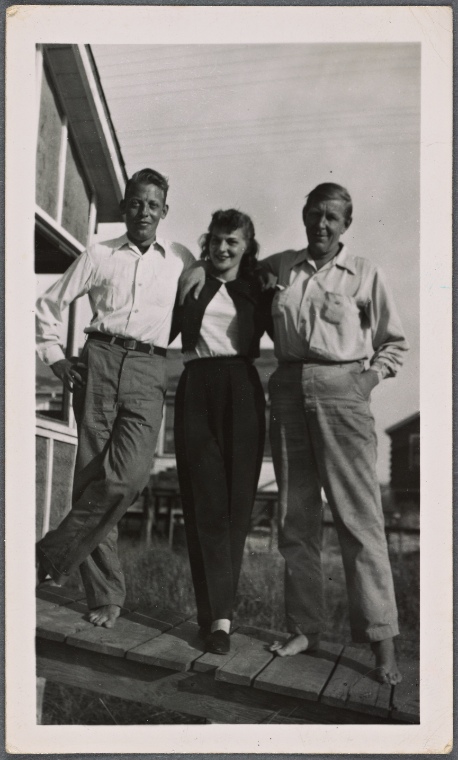
Chester Kallman, Rhoda Jaffe and W. H. Auden, Fire Island, NY, 1950

Source: New York Public Library Digital Collections.


index

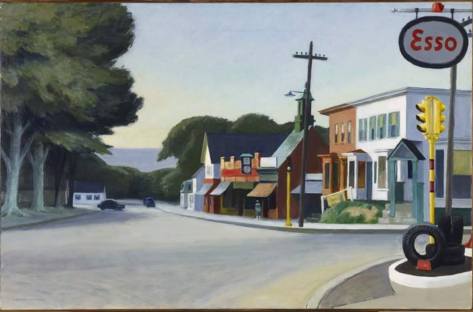
“Portrait of Orleans,” Edward Hopper, 1950

Oil on canvas.

The town depicted is Orleans, Massachusetts, but it looks a lot like Salem, Virginia.

27332724_160360267945428_519579112811010795_n