Tag Archives: Pablo Neruda

“I love you without knowing how, or when, or from where.”

“Sonnet XVII,” by Pablo Neruda

I don’t love you as if you were a rose of salt, topaz,
or arrow of carnations that propagate fire:
I love you as one loves certain obscure things,
secretly, between the shadow and the soul.

I love you as the plant that doesn’t bloom but carries
the light of those flowers, hidden, within itself,
and thanks to your love the tight aroma that arose
from the earth lives dimly in my body.

I love you without knowing how, or when, or from where,
I love you directly without problems or pride:
I love you like this because I don’t know any other way
to love,
except in this form in which I am not nor are you,
so close that your hand upon my chest is mine,
so close that your eyes close with my dreams.


“Last Flowers” by Jules Breton, 1890

“I want to do with you what spring does with the cherry trees.”

I will bring you flowers from the mountains, bluebells,
dark hazels, and rustic baskets of kisses.
I want to do with you
what spring does with the cherry trees.

from Pablo Neruda’s “Every Day You Play”


Cherry_trees_at_Kew_Gardens

Photo credit: JRennocks, CC BY 4.0 <https://creativecommons.org/licenses/by/4.0&gt;, via Wikimedia Commons

“Life is only a borrowing of bones.”

In the end, everyone is aware of this:
nobody keeps any of what he has,
and life is only a borrowing of bones.

— Pablo Neruda, “October Fullness”


a

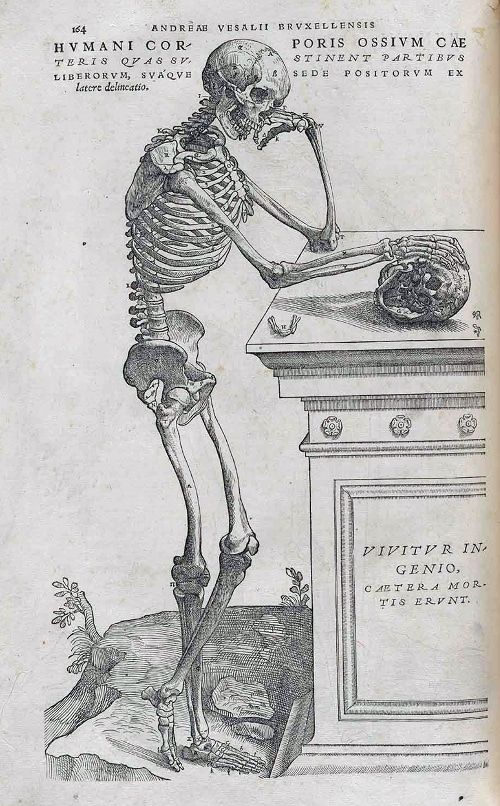
Illustration from Of the Structure of the Human Body.  Andreas Vesalius (author and illustrator).  Woodcut.

There is some confusion about the date of this illustration.  Most sources point to the book indicated above.  Two editions were published; one in 1543 and one in 1555.

“If You Forget Me,” by Pablo Neruda

I want you to know
one thing.

You know how this is:
if I look
at the crystal moon, at the red branch
of the slow autumn at my window,
if I touch
near the fire
the impalpable ash
or the wrinkled body of the log,
everything carries me to you,
as if everything that exists,
aromas, light, metals,
were little boats
that sail
toward those isles of yours that wait for me.

Well, now,
if little by little you stop loving me
I shall stop loving you little by little.

If suddenly
you forget me
do not look for me,
for I shall already have forgotten you.

If you think it long and mad,
the wind of banners
that passes through my life,
and you decide
to leave me at the shore
of the heart where I have roots,
remember
that on that day,
at that hour,
I shall lift my arms
and my roots will set off
to seek another land.

But
if each day,
each hour,
you feel that you are destined for me
with implacable sweetness,
if each day a flower
climbs up to your lips to seek me,
ah my love, ah my own,
in me all that fire is repeated,
in me nothing is extinguished or forgotten,
my love feeds on your love, beloved,
and as long as you live it will be in your arms
without leaving mine.


996622e76132ca40075af56566cb2996--pablo-neruda-cotton


“Life is only a borrowing of bones.”

“October Fullness,” by Pablo Neruda

(translated from the original Spanish)


Little by little, and also by great leaps

life happened to me, and how insignificant this business is.

These veins carried my blood, which I scarcely ever saw,

I breathed the air of so many places without keeping a sample of any.

In the end, everyone is aware of this:

nobody keeps any of what he has, and life is only a borrowing of bones.

The best thing was learning not to have too much either of sorrow or of joy,

to hope for the chance of a last drop,

to ask more from honey and twilight.


Perhaps it was my punishment, perhaps I was condemned to be happy.

Let it be known that nobody crossed my path without sharing my being.

I plunged up to the neck in adversities that were not mine, into all the sufferings of others.

It wasn’t a question of applause or profit.

Much less. It was not being able to live or breathe in this shadow, the shadow

of others like towers, like bitter trees that bury you, like cobblestones on the knees.


Our own wounds heal with weeping, our own wounds heal with singing.

But in our doorways lie bleeding widows, Indians, poor men, fishermen.

The miner’s child doesn’t know his father amidst all that suffering.


So be it, but my business was the fullness of spirit: a cry of pleasure choking you, a sigh

from an uprooted plant, the sum of all action.

It pleased me to grow with the morning, to bathe in the sun, in the great joy of sun, salt,

sea-light and waves, and in that unwinding of the foam, my heart began to move,

growing in that essential spasm, and dying away as it seeped into the sand.


pablo-neruda-photo-11

“Sonnet XVII,” by Pablo Neruda

“Sonnet XVII,” by Pablo Neruda (translated from the original Spanish)

I do not love you as if you were salt-rose, or topaz,
or the arrow of carnations the fire shoots off.
I love you as certain dark things are to be loved,
in secret, between the shadow and the soul.

I love you as the plant that never blooms
but carries in itself the light of hidden flowers;
thanks to your love a certain solid fragrance,
risen from the earth, lives darkly in my body.

I love you without knowing how, or when, or from where.
I love you straightforwardly, without complexities or pride;
so I love you because I know no other way

than this: where I does not exist, nor you,
so close that your hand on my chest is my hand,
so close that your eyes close as I fall asleep.

pablo_neruda