Tag Archives: W.H. Auden

“Lady Weeping at the Crossroads,” by W.H. Auden

Lady Weeping at the Crossroads

by W. H. Auden

Lady, weeping at the crossroads,
Would you meet your love
In the twilight with his greyhounds,
And the hawk on his glove?

Bribe the birds then on the branches,
Bribe them to be dumb,
Stare the hot sun out of heaven
That the night may come.

Starless are the nights of travel,
Bleak the winter wind;
Run with terror all before you
And regret behind.

Run until you hear the ocean’s
Everlasting cry;
Deep though it may be and bitter
You must drink it dry,

Wear out patience in the lowest
Dungeons of the sea,
Searching through the stranded shipwrecks
For the golden key,

Push on to the world’s end, pay the
Dread guard with a kiss,
Cross the rotten bridge that totters
Over the abyss.

There stands the deserted castle
Ready to explore;
Enter, climb the marble staircase,
Open the locked door.

Cross the silent ballroom,
Doubt and danger past;
Blow the cobwebs from the mirror
See yourself at last.

Put your hand behind the wainscot,
You have done your part;
Find the penknife there and plunge it
Into your false heart.


April 1940

Thanks, Poeticous.com.
 

Image

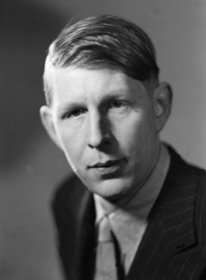
W.H. Auden on Dietrich Bonhoeffer.

Friday’s Child

(In memory of Dietrich Bonhoeffer, martyred at Flossenbürg, April 9, 1945)

He told us we were free to choose
But, children as we were, we thought—
“Paternal Love will only use
Force in the last resort

On those too bumptious to repent.”
Accustomed to religious dread,
It never crossed our minds He meant
Exactly what He said.

Perhaps He frowns, perhaps He grieves,
But it seems idle to discuss
If anger or compassion leaves
The bigger bangs to us.

What reverence is rightly paid
To a Divinity so odd
He lets the Adam whom He made
Perform the Acts of God?

It might be jolly if we felt
Awe at this Universal Man
(When kings were local, people knelt);
Some try to, but who can?

The self-observed observing Mind
We meet when we observe at all
Is not alarming or unkind
But utterly banal.

Though instruments at Its command
Make wish and counterwish come true,
It clearly cannot understand
What It can clearly do.

Since the analogies are rot
Our senses based belief upon,
We have no means of learning what
Is really going on,

And must put up with having learned
All proofs or disproofs that we tender
Of His existence are returned
Unopened to the sender.

Now, did He really break the seal
And rise again? We dare not say;
But conscious unbelievers feel
Quite sure of Judgement Day.

Meanwhile, a silence on the cross,
As dead as we shall ever be,
Speaks of some total gain or loss,
And you and I are free

To guess from the insulted face
Just what Appearances He saves
By suffering in a public place
A death reserved for slaves.

1958