William Butler Yeats’ “The Second Coming”

Happy National Poetry Month — this is the poem that I believe I liked best from among those I was taught at Longwood High School.

While everybody else loves its closing lines, my favorite line is the one about the falcon.

Eagle-eyed horror fans might also recognize this as the poem recited by the doomed general in Stephen King’s “The Stand” — both the book and television miniseries adaptation (though King has the character mispronounce the name as “YEETS”).

Thanks to Poem of the Week for the text:  http://www.potw.org/archive/potw351.html


THE SECOND COMING

    Turning and turning in the widening gyre
The falcon cannot hear the falconer;
Things fall apart; the centre cannot hold;
Mere anarchy is loosed upon the world,
The blood-dimmed tide is loosed, and everywhere
The ceremony of innocence is drowned;
The best lack all conviction, while the worst
Are full of passionate intensity.

    Surely some revelation is at hand;
Surely the Second Coming is at hand.
The Second Coming! Hardly are those words out
When a vast image out of Spiritus Mundi
Troubles my sight: a waste of desert sand;
A shape with lion body and the head of a man,
A gaze blank and pitiless as the sun,
Is moving its slow thighs, while all about it
Wind shadows of the indignant desert birds.

    The darkness drops again but now I know
That twenty centuries of stony sleep
Were vexed to nightmare by a rocking cradle,
And what rough beast, its hour come round at last,
Slouches towards Bethlehem to be born?

“As I Walked Out One Evening,” by W.H. Auden

Celebrate National Poetry Month — this is probably my second favorite poem of all time, and the very first poem I ever read by W.H. Auden.  For me, it is a thousand times darker than Edgar Allen Poe’s “The Raven.”  (“Oh stand, stand at the window, as the tears scald and start.”)

I first found this piece during my early high school years, after Whitley Strieber’s “Communion” used its “Plunge your hands in water” stanza to preface a chapter.

Thanks to the Academy of American Poets for this link:


As I Walked Out One Evening

I walked out one evening, Walking down Bristol Street, The crowds upon the pavement Were fields of harvest wheat. And down by the brimming river I heard a lover sing Under an arch of the railway: 'Love has no ending. 'I'll love you, dear, I'll love you Till China and Africa meet, And the river jumps over the mountain And the salmon sing in the street, 'I'll love you till the ocean Is folded and hung up to dry And the seven stars go squawking Like geese about the sky. 'The years shall run like rabbits, For in my arms I hold The Flower of the Ages, And the first love of the world.' But all the clocks in the city Began to whirr and chime: 'O let not Time deceive you, You cannot conquer Time. 'In the burrows of the Nightmare Where Justice naked is, Time watches from the shadow And coughs when you would kiss. 'In headaches and in worry Vaguely life leaks away, And Time will have his fancy To-morrow or to-day. 'Into many a green valley Drifts the appalling snow; Time breaks the threaded dances And the diver's brilliant bow. 'O plunge your hands in water, Plunge them in up to the wrist; Stare, stare in the basin And wonder what you've missed. 'The glacier knocks in the cupboard, The desert sighs in the bed, And the crack in the tea-cup opens A lane to the land of the dead. 'Where the beggars raffle the banknotes And the Giant is enchanting to Jack, And the Lily-white Boy is a Roarer, And Jill goes down on her back. 'O look, look in the mirror, O look in your distress: Life remains a blessing Although you cannot bless. 'O stand, stand at the window As the tears scald and start; You shall love your crooked neighbour With your crooked heart.' It was late, late in the evening, The lovers they were gone; The clocks had ceased their chiming, And the deep river ran on.

Image


“A character is never the author who created him.”

“A character is never the author who created him. It is quite likely, however, that an author may be all his characters simultaneously.”

– Albert Camus


I love this quote.  (Thanks, Dagda Publishing Facebook page!)  I need to remember this the next time someone suggests that the main character in my book is an author proxy.

Or, as my Longwood High School pal Tim Gatto so tactfully asked, “Is Rebecca just you in drag?”

I will plead the Fifth, however, on whether or not any Mary Washington College pranks involved me getting into drag.

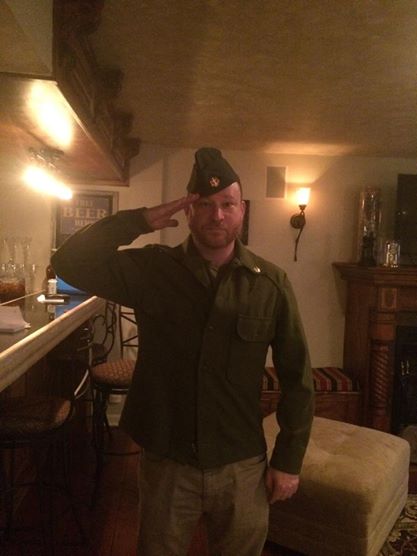
Just look at that handsome rogue …

This is the nutty friend who went to a party dressed as his favorite character from “The Dogs Don’t Bark In Brooklyn Any More.”

He’s the Army Major and cognitive ethologist at Fort Ronald Reagan who teaches wolf psychology and interrogates wolf prisoners.

And Special Animal Warfare Service Squad Captain Rebecca O’Conner discovers that there’s more to his work than she initially expects …

But that’s cool — because he’d “do anything for a fellow carrot-top.”

Image

“You’re a better man than I am, Gunga Din.”

Celebrate National Poetry Month — here is Rudyard Kipling’s “Gunga Din.”

And if your childhood was anything like mine, you have seen the 1939 film adaptation with Carey Grant more than a few times.

A fictionalized version of Kipling himself is actually a minor character in the film.

(Thanks to Bartelby.com for the text.)


Image

Gunga Din

BY RUDYARD KIPLING

You may talk o’ gin and beer   
When you’re quartered safe out ’ere,   
An’ you’re sent to penny-fights an’ Aldershot it;
But when it comes to slaughter   
You will do your work on water,
An’ you’ll lick the bloomin’ boots of ’im that’s got it.   
Now in Injia’s sunny clime,   
Where I used to spend my time   
A-servin’ of ’Er Majesty the Queen,   
Of all them blackfaced crew   
The finest man I knew
Was our regimental bhisti, Gunga Din,   
      He was ‘Din! Din! Din!
   ‘You limpin’ lump o’ brick-dust, Gunga Din!
      ‘Hi! Slippy hitherao
      ‘Water, get it! Panee lao,
   ‘You squidgy-nosed old idol, Gunga Din.’

The uniform ’e wore
Was nothin’ much before,
An’ rather less than ’arf o’ that be’ind,
For a piece o’ twisty rag   
An’ a goatskin water-bag
Was all the field-equipment ’e could find.
When the sweatin’ troop-train lay
In a sidin’ through the day,
Where the ’eat would make your bloomin’ eyebrows crawl,
We shouted ‘Harry By!’
Till our throats were bricky-dry,
Then we wopped ’im ’cause ’e couldn’t serve us all.
      It was ‘Din! Din! Din!
   ‘You ’eathen, where the mischief ’ave you been?   
      ‘You put some juldee in it
      ‘Or I’ll marrow you this minute
   ‘If you don’t fill up my helmet, Gunga Din!’

’E would dot an’ carry one
Till the longest day was done;
An’ ’e didn’t seem to know the use o’ fear.
If we charged or broke or cut,
You could bet your bloomin’ nut,
’E’d be waitin’ fifty paces right flank rear.   
With ’is mussick a on ’is back,
’E would skip with our attack,
An’ watch us till the bugles made ‘Retire,’   
An’ for all ’is dirty ’ide
’E was white, clear white, inside
When ’e went to tend the wounded under fire!   
      It was ‘Din! Din! Din!’
   With the bullets kickin’ dust-spots on the green.   
      When the cartridges ran out,
      You could hear the front-ranks shout,   
   ‘Hi! ammunition-mules an’ Gunga Din!’

I shan’t forgit the night
When I dropped be’ind the fight
With a bullet where my belt-plate should ’a’ been.   
I was chokin’ mad with thirst,
An’ the man that spied me first
Was our good old grinnin’, gruntin’ Gunga Din.   
’E lifted up my ’ead,
An’ he plugged me where I bled,
An’ ’e guv me ’arf-a-pint o’ water green.
It was crawlin’ and it stunk,
But of all the drinks I’ve drunk,
I’m gratefullest to one from Gunga Din.
      It was ‘Din! Din! Din!
   ‘’Ere’s a beggar with a bullet through ’is spleen;   
   ‘’E’s chawin’ up the ground,
      ‘An’ ’e’s kickin’ all around:
   ‘For Gawd’s sake git the water, Gunga Din!’

’E carried me away
To where a dooli lay,
An’ a bullet come an’ drilled the beggar clean.   
’E put me safe inside,
An’ just before ’e died,
‘I ’ope you liked your drink,’ sez Gunga Din.   
So I’ll meet ’im later on
At the place where ’e is gone—
Where it’s always double drill and no canteen.   
’E’ll be squattin’ on the coals
Givin’ drink to poor damned souls,
An’ I’ll get a swig in hell from Gunga Din!   
      Yes, Din! Din! Din!
   You Lazarushian-leather Gunga Din!   
   Though I’ve belted you and flayed you,   
      By the livin’ Gawd that made you,
   You’re a better man than I am, Gunga Din!


Guerilla marketing for a guerilla war?

I am laughing my @$$ off!!

A college pal and a reader of “The Dogs Don’t Bark In Brooklyn Any More” is going to a party tonight dressed as a character!!  

I know exactly what the Special Animal Warfare Service emblem “looks like,” but I have zero artistic ability, so I cannot render it.  Maybe someday when I am wealthy, I will hire graphic designer John Celio to get it down for me.

Have fun, Greg, you NUT!!!  😀


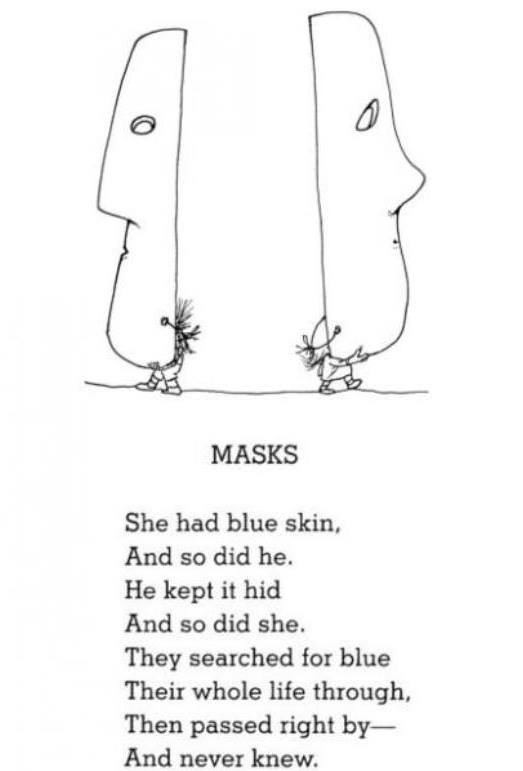
“Masks,” by Shel Silverstein

Thanks, Jessi Schweiger.

Image

“Annabel Lee,” by Edgar Allan Poe

Celebrate National Poetry Month -- here is another poem 
I remember fondly from my grade school days -- Edgar 
Allan Poe's "Annabel Lee."


Image

"Annabel Lee"
 
It was many and many a year ago,
          In a kingdom by the sea,
    That a maiden there lived whom you may know
          By the name of ANNABEL LEE;
    And this maiden she lived with no other thought
          Than to love and be loved by me.

    I was a child and she was a child,
          In this kingdom by the sea;
    But we loved with a love that was more than love-
          I and my Annabel Lee;
    With a love that the winged seraphs of heaven
          Coveted her and me.

    And this was the reason that, long ago,
          In this kingdom by the sea,
    A wind blew out of a cloud, chilling
          My beautiful Annabel Lee;
    So that her highborn kinsman came
          And bore her away from me,
    To shut her up in a sepulchre
          In this kingdom by the sea.

    The angels, not half so happy in heaven,
          Went envying her and me-
    Yes!- that was the reason (as all men know,
          In this kingdom by the sea)
    That the wind came out of the cloud by night,
          Chilling and killing my Annabel Lee.

    But our love it was stronger by far than the love
          Of those who were older than we-
          Of many far wiser than we-
    And neither the angels in heaven above,
          Nor the demons down under the sea,
    Can ever dissever my soul from the soul
          Of the beautiful Annabel Lee.

    For the moon never beams without bringing me dreams
          Of the beautiful Annabel Lee;
    And the stars never rise but I feel the bright eyes
          Of the beautiful Annabel Lee;
    And so, all the night-tide, I lie down by the side
    Of my darling- my darling- my life and my bride,
          In the sepulchre there by the sea,
          In her tomb by the sounding sea.

Thank you, Poetry Lovers’ Page.

http://www.poetryloverspage.com/poets/poe/annabel.html

Classing up the joint today …

Nicole DeCaneo is a lovely girl with a lovely talent as an artist, and she is kind enough to give a few pointers in art education to a Philistine like me. (Cuz if I want to be well rounded, I need to lern ’bout the paintin’s an’ stuff.)

This is one of her pieces.

Image

“If,” by Rudyard Kipling

Celebrate National Poetry Month -- here is another
 family favorite, Rudyard Kipling's "If."  This 
one was well loved by my parents.

"If."
If you can keep your head when all about you
Are losing theirs and blaming it on you;
If you can trust yourself when all men doubt you,
But make allowance for their doubting too;
If you can wait and not be tired by waiting,
Or being lied about, don't deal in lies,
Or being hated, don't give way to hating,
And yet don't look too good, nor talk too wise:

If you can dream -- and not make dreams your master;
If you can think -- and not make thoughts your aim;
If you can meet with Triumph and Disaster
And treat those two imposters just the same;
If you can bear to hear the truth you've spoken
Twisted by knaves to make a trap for fools,
Or watch the things you gave your life to, broken,
And stoop and build 'em up with worn-out tools;

If you can make one heap of all your winnings
And risk it on one turn of pitch-and-toss,
And lose, and start again at your beginnings
And never breathe a word about your loss;
If you can force your heart and nerve and sinew
To serve your turn long after they are gone,
And so hold on when there is nothing in you
Except the Will which says to them: "Hold on!"

If you can talk with crowds and keep your virtue,
Or walk with kings -- nor lose the common touch,
If neither foes nor loving friends can hurt you,
If all men count with you, but none too much;
If you can fill the unforgiving minute
With sixty seconds' worth of distance run --
Yours is the Earth and everything that's in it,
And -- which is more -- you'll be a Man, my son!


http://www.poetryloverspage.com/poets/kipling/if.html