All posts by Eric Robert Nolan

Eric Robert Nolan graduated from Mary Washington College in 1994 with a Bachelor of Science in Psychology. He spent several years a news reporter and editorial writer for the Culpeper Star Exponent in Culpeper, Virginia. His work has also appeared on the front pages of numerous newspapers in Virginia, including The Free Lance – Star and The Daily Progress. Eric entered the field of philanthropy in 1996, as a grant writer for nonprofit healthcare organizations. Eric’s poetry has been featured by Dead Beats Literary Blog, Dagda Publishing, The International War Veterans’ Poetry Archive, and elsewhere. His poetry will also be published by Illumen Magazine in its Spring 2014 issue.

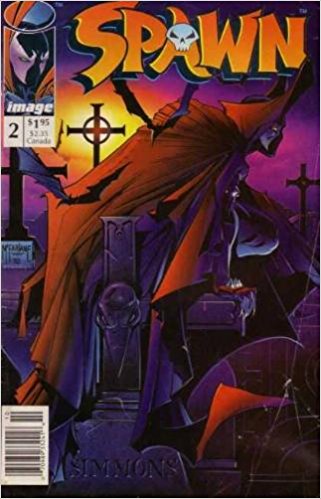
Throwback Thursday: the Debut of “Spawn” Comics (1992)

I remember greedily snapping up the first two issues of Todd McFarlane’s “Spawn” comic in the spring of 1992.  Comics fans were excited about it — it was the de facto flagship title of the newly created Image Comics, which was bringing its own ambitious interconnected comic book universe to the shelves to compete with “the Big Two,” Marvel and DC.

There already was a competitive third major comic publisher — Dark Horse Comics.  But it had no successful superhero titles or shared universe; it instead was known for science fiction and horror comics.  I also remember seeing comics back then from the short-lived Valiant here and there — or maybe it was mostly ads in the Comic Shop News.  I didn’t know a single soul who read them, though.

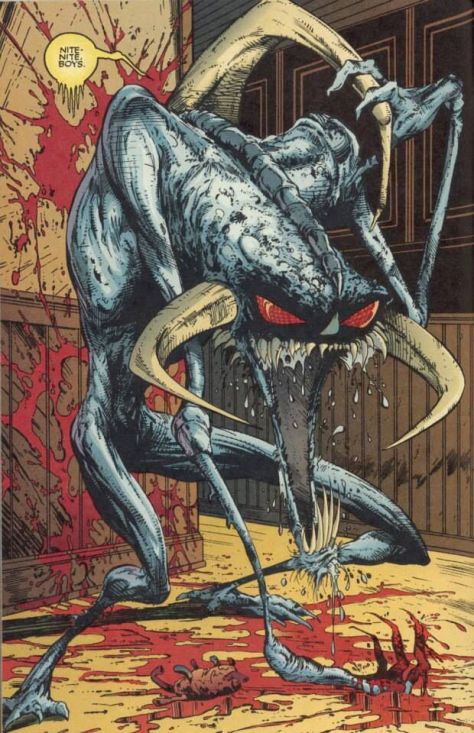
McFarlane was nothing short of famous in the comic book fan community, after his broadly popular work on “Spider-Man.”  (I still love his unique style.)  And “Spawn” had an absolutely subversive flavor to it.  Its title anti-hero was nothing less than an agent of hell, and the comic revolved around hell, sin, damnation and various demons.  There was also far more violence and gore.

“Spawn” felt subversive, too, because of the impetus behind its creation.  Image Comics was launched by a group of artists who were unhappy with Marvel’s failure to grant them creative control over their work (or, according to the artists, proper merchandising royalties).  They included McFarlane, and fan-favorite artists Rob Liefeld, Jim Lee and Marc Silvestri, among others.

I don’t pretend to know how justified their complaints were, as I was only a fan and not an industry insider.  But they sound right … I’ve always heard that major comic companies have historically screwed over their creative talent with restrictive “work-for-hire” payment arrangements.  (This is why Stan Lee, creator of so many of Marvel’s first heroes, is not absurdly wealthy.)  The start of Image seemed to fans like their favorite artists rebelling against the status quo, and that was kind of exciting.

Some of McFarlane’s acrimony with Marvel was pretty overtly expressed in the pages of “Spawn.”  There was a weird, slightly confusing plot digression early on in which McFarlane editorialized heavily about creator-owned characters … Spawn actually visited a kind of purgatory where various leading Marvel and DC heroes were imprisoned.  It seems in retrospect like a labored and self-indulgent metaphor, and it detracted from the title’s story.  But the college kids then reading “Spawn” had never seen anything like it.  It was interesting at the time.  (Bear in mind, please, that this was before the Internet.)

I started picking it up regularly.  I was going to the comic shop that was on … George Street, I think, in downtown Fredericksburg, Virginia.  There were only two comic shops in the downtown area in the early 1990’s — this one, and a seedy shop across from the Hardee’s on northern Princess Anne Street, in a tiny corner of a ramshackle, abandoned hotel.  There was a categorically unpleasant, batshit-insane woman staffing the latter – she was nasty to everyone who entered, and accused them of touching the merchandise.  (That part of Princess Anne Street has since been improved – I think the huge hotel building has since been renovated.)

As the “Spawn” title progressed, its fandom became firmly entrenched.  The art truly was fantastic, and of course it remains an incredibly successful group of comic properties today.  Over time, McFarlane’s critics also grew in number … no matter how gifted he was as an artist, fans said he wasn’t a terrific writer.  (And I do get what they’re saying.)  I will say this — the “Spawn” comics I was reading were a thousand times better than that weird movie adaptation in 1997.  I’ve only seen bits and pieces of that, but they were terrible bits and pieces.

I still think I’d have a great time perusing my back issues.


Spawn-1

41xEvucyk-L._SL500_SX319_BO1,204,203,200_

7df869d110ee2fcf1af64d8f9f1fa8a4

aad31586d7576e942f6eafba618445f4

I just watched the trailer for Stephen King’s “IT” (2017) …

… and I’l be damned if it didn’t give me the shivers.

Watch at your own risk:

20170327_081843

“As Zion’s Drawn,” by Dennis Villelmi

There is a dichotomy to Dennis Villelmi’s poetic voice.  His work is at once grotesque and baroquely alluring; his poems are beautifully crafted to describe appalling subjects.  I think that this is what makes me envy and return to his work, time and again — in addition to the facts that Dennis is a valued friend and that I enjoy dark poetry.  I think that if I had to sum up what attracts me to his poetry, it would be his apparently effortless mastery of juxtaposing elegant language with horrifying subjects.

His newly published “As Zion’s Drawn” is an excellent example.  (You can find it here over at The Bees Are Dead.)

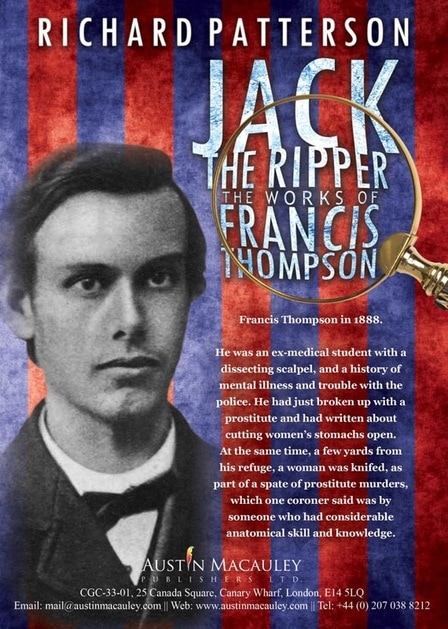
This is the second in Dennis’ series of poems inspired by the research and writing of Richard Patterson, who has traveled the world gathering historical evidence that Jack the Ripper was actually former medical student Francis J. Thompson.  (Mr. Patterson has graciously given his approval to Dennis and B.A.D. for this literary homage.)  For more information about Patterson’s startling body of work, visit his website here at http://www.francisjthompson.com/.

For the first installment in this series of poems, please see “The Hidden Player” at The Bees Are Dead.


book-poster


Grandin Village, Virginia, March 2017 (2)

Grace’s Pizzeria is damn good, and inexpensive too.  You can get a small pizza with two toppings for just under $10.  It’s occasionally extra greasy, though.  (At one point, I tilted the pie sideways and it started just sliding off.)


20170326_171547

20170326_174447

20170326_172244

20170326_174037


Herbert Cole’s illustration in “A Child’s Book of Warriors,” 1912

“A book illustration of an angel shows a model of Hagia Sofia to Justinian in a vision. The cathedral had burnt down during a riot; now Justinian would build an even more beautiful one.”  (Wikimedia Commons)


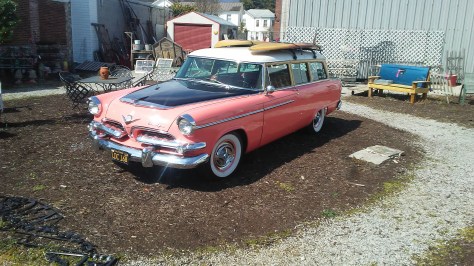
A Pretty Peach Ford (photo)

Seen at an antique shop on West Main Street in Salem, Virginia.


20170323_145221

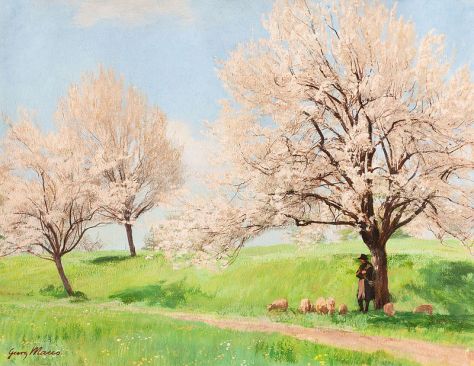
Georg Macco’s “Frühlingsmorgen” (“Spring Morning,”) early 20th Century

Georg_Macco_Frühlingsmorgen

A few quick words on “Kong: Skull Island” (2017)

“Kong: Skull Island” doesn’t have the charm and sense of fun of Peter Jackson’s version, but it’s still a first-rate monster movie that I highly recommend.  It’s got a good script, likable characters and terrific special effects.

Parts of it were actually scary.  The first action set-piece is unexpectedly brutal, and there’s a sequence with a giant spider that was a little unnerving, too.  I was surprised at how the filmmakers here so heavily emphasized the story’s action-horror elements.

I had a blast with this, and I’d give it a 9 out of 10.

I have a question — did anyone else notice a reference to “Jurassic Park” (1993)?  At one point, Samuel Jackson’s character tells his companions to “Hang on to your butts.”  Isn’t that his character’s line in “Jurassic Park” when he restores power to the facility, shortly before he gets killed?


Fugly Fortysomething Elmo.

My new haircut makes me look like a pipe cleaner.

Or an unusually tall, fugly muppet.


20170325_144350