All posts by Eric Robert Nolan

Eric Robert Nolan graduated from Mary Washington College in 1994 with a Bachelor of Science in Psychology. He spent several years a news reporter and editorial writer for the Culpeper Star Exponent in Culpeper, Virginia. His work has also appeared on the front pages of numerous newspapers in Virginia, including The Free Lance – Star and The Daily Progress. Eric entered the field of philanthropy in 1996, as a grant writer for nonprofit healthcare organizations. Eric’s poetry has been featured by Dead Beats Literary Blog, Dagda Publishing, The International War Veterans’ Poetry Archive, and elsewhere. His poetry will also be published by Illumen Magazine in its Spring 2014 issue.

“Roman Wall Blues,” by W. H. Auden

“Roman Wall Blues,” by W. H. Auden

Over the heather the wet wind blows,
I’ve lice in my tunic and a cold in my nose.

The rain comes pattering out of the sky,
I’m a Wall soldier, I don’t know why.

The mist creeps over the hard grey stone,
My girl’s in Tungria; I sleep alone.

Aulus goes hanging around her place,
I don’t like his manners, I don’t like his face.

Piso’s a Christian, he worships a fish;
There’d be no kissing if he had his wish.

She gave me a ring but I diced it away;
I want my girl and I want my pay.

When I’m a veteran with only one eye
I shall do nothing but look at the sky.


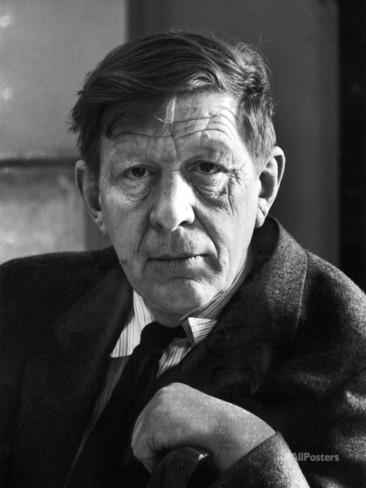
alfred-eisenstaedt-poet-author-w-h-auden

“Refugee Blues,” by W. H. Auden

“Refugee Blues,” by W. H. Auden

Say this city has ten million souls,
Some are living in mansions, some are living in holes:
Yet there’s no place for us, my dear, yet there’s no place for us.

Once we had a country and we thought it fair,
Look in the atlas and you’ll find it there:
We cannot go there now, my dear, we cannot go there now.

In the village churchyard there grows an old yew,
Every spring it blossoms anew:
Old passports can’t do that, my dear, old passports can’t do that.

The consul banged the table and said,
“If you’ve got no passport you’re officially dead”:
But we are still alive, my dear, but we are still alive.

Went to a committee; they offered me a chair;
Asked me politely to return next year:
But where shall we go to-day, my dear, but where shall we go to-day?

Came to a public meeting; the speaker got up and said;
“If we let them in, they will steal our daily bread”:
He was talking of you and me, my dear, he was talking of you and me.

Thought I heard the thunder rumbling in the sky;
It was Hitler over Europe, saying, “They must die”:
O we were in his mind, my dear, O we were in his mind.

Saw a poodle in a jacket fastened with a pin,
Saw a door opened and a cat let in:
But they weren’t German Jews, my dear, but they weren’t German Jews.

Went down the harbour and stood upon the quay,
Saw the fish swimming as if they were free:
Only ten feet away, my dear, only ten feet away.

Walked through a wood, saw the birds in the trees;
They had no politicians and sang at their ease:
They weren’t the human race, my dear, they weren’t the human race.

Dreamed I saw a building with a thousand floors,
A thousand windows and a thousand doors:
Not one of them was ours, my dear, not one of them was ours.

Stood on a great plain in the falling snow;
Ten thousand soldiers marched to and fro:
Looking for you and me, my dear, looking for you and me.
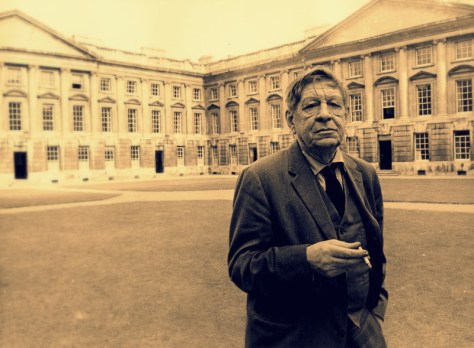

 

NPG x25900; W.H. Auden by Bill Potter


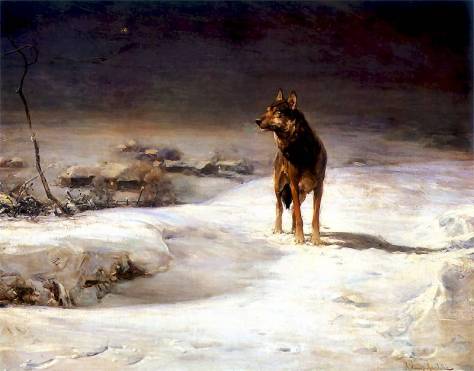
Wilhelm Amandus Beer’s “The Wolf, Captured Alive,” 1879

Oil on cardboard.

wilhelm_amandus_beer_-_der_lebendig_gefangene_wolf

Salem, Virginia, February 2017

I took these shots last night, before I joined some great friends for great conversation and a great dinner on a balmy midwinter weekend.  Every February should be as kind.


20170211_173738

20170211_174419

20170211_174935

20170211_173919

20170211_174448

20170211_173930

20170211_173940

20170211_174208


Alfred Wierusz-Kowalski’s “The Wolf,” 1895

Oil on canvas.

wilk_alfred_wierusz-kowalski

A few quick words on “What We Become” (2016)

“What We Become” (2016) is a competent, serviceable Danish horror film that nevertheless could have been better.  (The film’s original title was “Sorgenfri.”)  It’s capably written, nicely filmed, and well performed by its actors, and there is genuine suspense once its zombies are allowed to run amok.

The trouble is, that takes far too long.  Like America’s “Viral” (2016), this is a zombie movie that spends so much effort on its setup that there is little time left for enough payoff.

This is another thoughtful apocalyptic monster movie that pays a great deal of attention to the media and military response to the emerging crisis.  (And it’s creepily effective the way this is told exclusively from the point of view of a Danish suburb’s residents.)  It will hold your attention as a kind of “slow burn” horror film — it reminded me a little of the first season of AMC’s “Fear the Walking Dead.” Ultimately, however, the zombies get too little screen time.  And that’s a shame, because what we do see as a horrifying, tragic climax is actually very well executed.

Overall, I’d rate this a 7 out of 10.


large_fdm3dawxz9kkpg2gybnu0ui3gba

Check out the art of Jennifer Shepit.

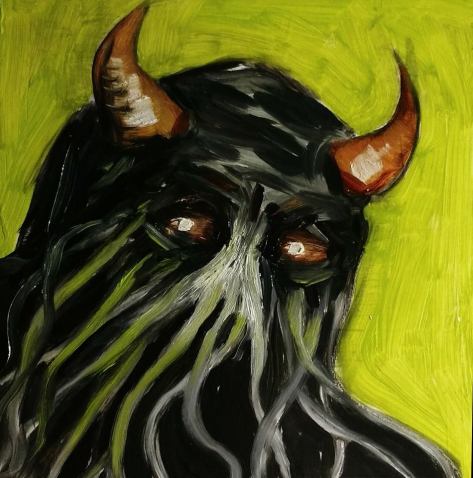
Social media is wonderful for getting acquainted with a variety of new artists to follow, but I must say that my friend Jennifer Shepit’s work has especially struck a chord with me.  Jen is a wonderfully talented (and sometimes darkly inspired) artist from British Columbia, and her work is always engaging and sometimes startling.

She has a unique muse, I think — and I think many people with a taste for horror or dark fantasy would enjoy what she creates.  I hope I get the opportunity to collaborate with her one day.

Below are several of Jen’s recent pieces that I have asked permission to share.  You can find more of her prints, oil paintings and watercolors at her Etsy shop right here:

https://www.etsy.com/ca/shop/JenniferShepit


16406777_1286663758087403_8108418981190245737_n

16423124_1283301075090338_2975103691062517022_o

16472868_1288479641239148_4418556740218413330_n

16299306_1281935558560223_7378432925340939503_n

A short review of the premiere of “24: Legacy” (2017)

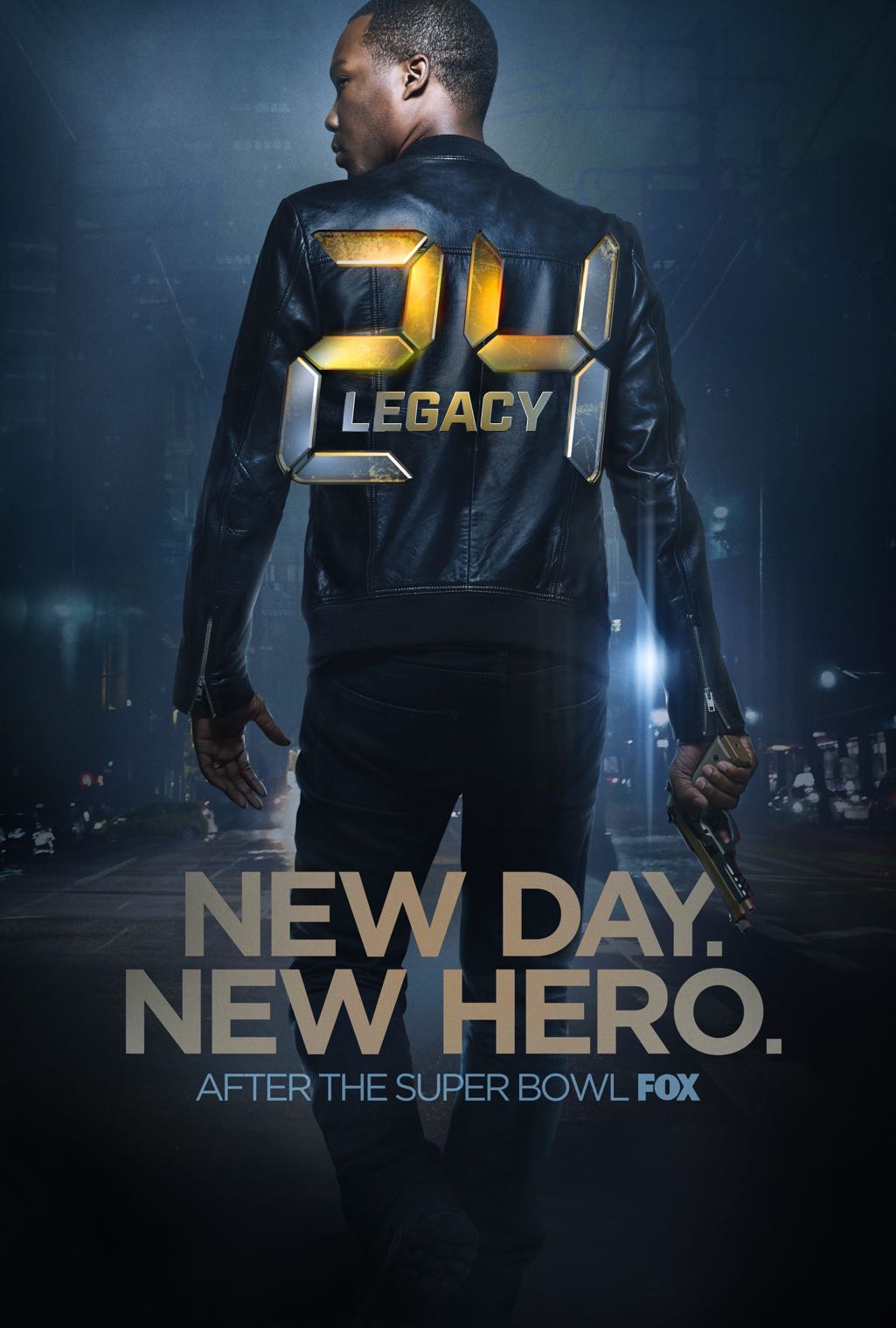
Jack may not be back, but the premiere of “24: Legacy” suggests the magic of FOX’s flagship serial thriller can survive without him.  The first one-hour episode was damn good — I’d give it a 9 out of 10.

Maybe it’s too early to gauge how well the show will follow in its predecessor’s footsteps.  It indeed feels different with its new hero (Corey Hawkins as former U.S. Army Ranger Eric Carter).  Kiefer Sutherland is a superb actor who masterfully portrayed a disturbed-yet-noble antihero, the now iconic Jack Bauer.  Hawkins doesn’t shine much in this initial outing, but there will be time for the actor to grow along with the character.  (In the long ago series premiere of “24,” Sutherland’s debut as Bauer wasn’t terribly interesting yet either.)

But the creators of “24: Legacy” have carefully assembled nearly all of the components of “24’s” greatness: the real-time urgency and the frantic pace; the surprising violence; the twists and betrayals; the cool technology; and the converging plotlines as various actors affect key outcomes in the story.  A more critical viewer might complain that that these feel like common tropes after nine years of the original show.  (And “24’s” unique mode of storytelling kind of defines it as its own sub-genre.)  But these signature elements of the show, however predictable, are exactly what will keep fans coming back.

The only thing missing is an interesting villain.  The bad guys here are suitably nasty, and drive the plot from the story’s opening minutes.  But, so far, they’re fairly generic terrorists.  Like the Hawkins’ character, it remains to be seen whether the script can develop them further.

I had a blast with this.  If you’re a fan of the original “24,” then you ought to check this out.


A very short review of “Rings” (2017)

“Rings” (2017) actually begins with great promise — it looks like the rare horror “threequel” that could live up to its two predecessors.  (And the early millennium’s “Ring” films were indeed good movies.)  It starts with a truly fascinating story device that I won’t spoil here, except to say that it’s macabre and thoughtful and involves an intrepid college professor (Johnny Galecki).

Inexplicably, the movie abandons this unsettling stroke of genius about 20 minutes in, and instead falls back on a by-the-numbers plot that too closely parallels the first films. What follows is pretty average stuff.  Instead of the lovely and talented Naomi Watts, who was the capable heroine of the first films, we get two flat, college-aged protagonists portrayed by two mostly flat young actors.  (Alex Roe is particularly bad.)  Not even the arrival of the great Vincent D’Onofrio in a supporting role can redeem “Rings” past the direct-to-video level of quality.

Oh, well.  This still wasn’t the worst horror movie I’ve ever seen, and it did have some creepy parts.  (I thought the movie’s closing moments were pretty effective.)  I’d call “Rings” an average outing and rate it a 6 out of 10.

Postscript: D’Onofrio has a damned cool voice.  I’m serious.


A review of “The Man in the High Castle” Season 2

[This review contains spoilers for Season 1 of “The Man in the High Castle.”]  Despite my love for its first season, I was surprised to find my interest waning for Season 2 of “The Man in the High Castle.”  But while the earlier episodes felt a little slow, the second season gained a lot of momentum as it progressed, and then went out with a satisfying bang.  Overall, I’d rate it an 8 out of 10.

By the time Season 2 began, some of the novelty of the show’s premise had worn off.  Its unique milieu — a post-World War II, occupied America in which Germany and Japan are triumphant — was already explored in depth.  The show also felt scattered for much of this season … we follow disparate protagonists trying to negotiate or survive the alternate-history dystopia.  Their individual stories felt like subplots, while the central plot line — the nature and purpose of the mysterious newsreels — was left in the periphery.

Compounding this problem is the fact that the characters themselves weren’t always interesting or terribly likable.  Juliana Crain is always engaging to follow, given the strength and vulnerability brought to the role by actress Alexa Davalos.  Far less so, however, was Joe Blake, a character as flat and boring as his generic name.  (And this isn’t helped by actor Luke Kleintank’s wooden performance.)

There may be a few things that I am missing, as well.  For one,  various characters view the newsreels, which depict separate events in parallel universes.  They then try to prevent those terrible futures from coming to pass in their own timeline.  But why are they so certain those events will come to pass?  They know they are viewing events in an entirely different universe, and not their own.

Also, it becomes clear that certain characters can actually travel back and forth between parallel universes, but there is virtually no exposition about this.  Why do some people have this gift, but not others?  How rare is it?  What would happen if a character met their own double in a parallel universe?  Why don’t people in power recruit these talented “travelers” themselves, instead of relying on the newsreels they bring back?  Or are they doing that already?

Despite my misgivings above, however, “The Man in the High Castle” is a terrifically smart TV thriller, full of frightening ideas and detailed world-building.  Its depiction of a mid-twentieth century America conquered by the Axis powers is unflinching.  There are some really good performances by Rufus Sewell, Brennan Brown, Cary-Hiroyuki Tagawa and the awesome, scenery-chewing Callum Keith Rennie.

The show is inspired enough to challenge the viewer with a lot of moral ambiguity, as well.  American resistance fighters act as ruthlessly as the Nazis, while the worst secret police from both the German and Japanese sides cooperate to try to prevent a nuclear war.

“The Man in the High Castle” is still pretty intricately plotted, too — the last two episodes surprisingly do reveal how some of its scattered subplots tie together in the context of the larger story.  And those final two episodes are damn dramatic and thrilling.  I’m glad I stayed with the show.


man-in-the-high-castle