Eric Robert Nolan graduated from Mary Washington College in 1994 with a Bachelor of Science in Psychology. He spent several years a news reporter and editorial writer for the Culpeper Star Exponent in Culpeper, Virginia. His work has also appeared on the front pages of numerous newspapers in Virginia, including The Free Lance – Star and The Daily Progress. Eric entered the field of philanthropy in 1996, as a grant writer for nonprofit healthcare organizations.
Eric’s poetry has been featured by Dead Beats Literary Blog, Dagda Publishing, The International War Veterans’ Poetry Archive, and elsewhere. His poetry will also be published by Illumen Magazine in its Spring 2014 issue.
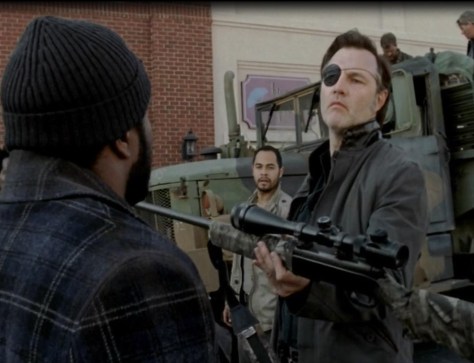
AMC’s “The Walking Dead” marathon helpfully reminds us tonight that people will be really stupid in a zombie apocalypse.
I have no military experience whatsoever, but I know that an invading force should disperse, seek cover and to try to present an opposing force with moving targets instead of stationary targets.
I also have a pretty good idea that I would not send the entirety of my forces through a single entrance and down a single corridor, and then congregate them in what looks like one enclosed space.
However, I could never make an eye-patch (or batshit crazy, for that matter) look as good as he does.
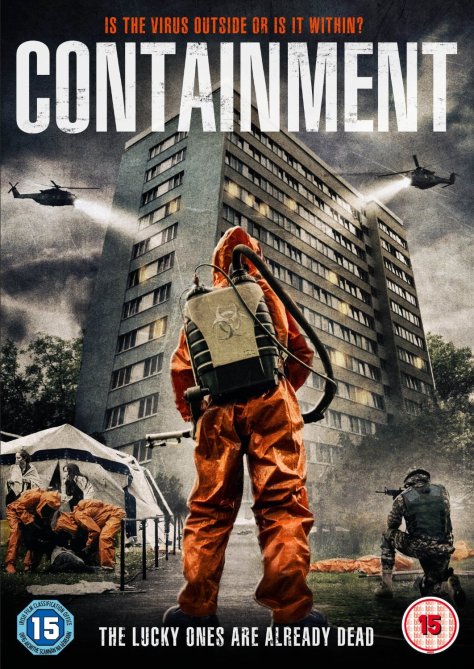
“Containment” (2015) is the film that sounds cliche but isn’t. It’s a surprisingly fresh take on an old standby — diverse people isolated by an outside threat are forced to cope and survive with each other, along with the threat. In this case, an entire apartment block in Britain is forcibly and mysteriously quarantined overnight; residents awaken to sealed doors and hazardous materials units being deployed along the grounds.
But this is a smartly written independent sci-fi thriller that avoids a lot of common tropes. Then it introduces plot developments that are unexpected, yet make perfect sense. It’s more original than you’d guess at first.
There’s a lot of nice acting, including work by Lee Ross, and by Louise Brealey of “Sherlock” (2010) fame. And all those moody establishing shots of the tomb-quiet building were creepily effective.
My only complaint was a thematically ambiguous ending that seemed lost on me. But I’d still give this an 8 out of 10.
This review of “Star Wars: The Force Awakens” will be necessarily brief, for fear of spoilers. And when I say “fear of spoilers,” I really do mean FEAR of spoilers. There are people out there who will burn your house down if you ruin this long-awaited film’s surprises.
I really liked it. I would somewhat grudgingly give it a 9 out of 10, as I can’t match the sheer ardor of its global legions of fans. (Yes, “Star Wars” was a big part of my childhood, but I have more or less gotten over it. I read last night, for example, that filmmaker Kevin Smith actually cried upon stepping aboard the Millennium Falcon when he visited the set; I am not quite as nostalgic as that.)
In short, it absolutely succeeds as a fun space fantasy, and recaptures the spirit of the original “Holy Trilogy.” It easily surpasses the much-maligned prequels on nearly every level, including screenwriting, acting and special effects. The predominance of practical effects over those that are exclusively digital make this movie’s universe feel “real” and “lived in.”
We finally have relatable characters again who sound real, and who can invite viewer sympathy. The dramatic interaction among our newer heroes and returning icons is both logical and emotionally involving. I was surprised at how well this movie handled the passing of the torch. It was a kind of skilled storytelling that was almost entirely absent from the last three films. And the special effects were top notch.
My only mild quibbles might reflect a greater degree of objectivity that you might hear from someone who is not a raging fan of the series. This film so closely parallels the original “Star Wars” (1977) that at times it started to feel like a remake. Were the similarities in structure, characters, plot points, planets and villains all an intentional homage? I suggest that our bad guys here, for example, sometimes feel interchangeable with those of past “Star Wars” films. I want to say more, but can’t, because of spoilers. Am I the only person who noticed these things?
I also submit that, like a few other “Star Wars” movies, our characters are rendered with little depth, with sparse information about their skills, motivations, backgrounds or ideosyncrasies. The dialogue is thin. Consider lines like “He’s my friend!” and “Because it’s the right thing to do.” And we are presented with no information about why the speaker here is so noble, when others are not. Even if the screenwriting here is better than the prequels, it’s still not Tennessee Williams.
It’s all very forgivable, I guess, just so long as the viewer remembers that they’re sitting down to an installment in a film franchise originally intended for young people. It’s kid stuff. It’s really, really good kid stuff, but it’s kid stuff. (Don’t burn my house down!)
And the reason I chose a 9 rating instead of an 8 was primarily the enjoyment I got from seeing familiar faces. The return of our icons was surprisingly well depicted and, if you loved “Star Wars” as a kid, then that should be enough to make this a “must-see” movie.
… since maybe two weeks preceding Christmas, like a frequent, intermittent ghost. I have no idea why.
Now it’s yours.
“Gonzalo”
— from W. H. Auden’s “The Sea and the Mirror”
Evening, grave, immense, and clear,
Overlooks our ship whose wake
Lingers undistorted on
Sea and silence; I look back
For the last time as the sun
Sets behind that island where
All our loves were altered: yes,
My prediction came to pass,
Yet I am not justified,
And I weep but not with pride.
Not in me the credit for
Words I uttered long ago
Whose glad meaning I betrayed;
Truths to-day admitted, owe
Nothing to the councilor
In whose booming eloquence
Honesty became untrue.
Am I not Gonzalo who
By his self-reflection made
Consolation an offence?
There was nothing to explain:
Had I trusted the Absurd
And straightforward note by note
Sung exactly what I heard,
Such immediate delight
Would have taken there and then
Our common welkin by surprise,
All would have begun to dance
Jigs of self-deliverance.
It was I prevented this,
Jealous of my native ear,
Mine the art which made the song
Sound ridiculous and wrong,
I whose interference broke
The gallop into jog-trot prose
And by speculation froze
Vision into an idea,
Irony into a joke,
Till I stood convicted of
Doubt and insufficient love.
Farewell, dear island of our wreck:
All have been restored to health,
All have seen the Commonwealth,
There is nothing to forgive.
Since a storm’s decision gave
His subjective passion back
To a meditative man,
Even reminiscence can
Comfort ambient troubles like
Some ruined tower by the sea
Whence boyhoods growing and afraid
Learn a formula they need
In solving their mortality,
Even rusting flesh can be
A simple locus now, a bell
The Already There can lay
Hands on if at any time
It should feel inclined to say
To the lonely – “Here I am,”
To the anxious – “All is well.”
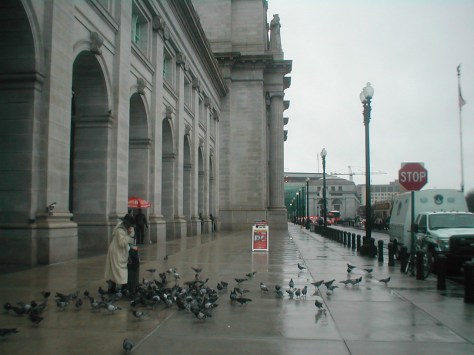
Union Station has long been synonymous in my mind with sunny days and warm nights. It was a frequent destination in my 20’s, when I visited various Mary Washington College alumni for reunions of one kind or another.
The last of those arches you see to the left of 2015’s Christmas tree was my “smoking spot” after disembarking from an Amtrak train. The spaces out front would occasionally serve as a staging area for a party weekend, as Sanjeev Malhotra would pick me up, then ready himself for several days in which he would endeavor, with varying degrees of success, to keep me out of trouble.
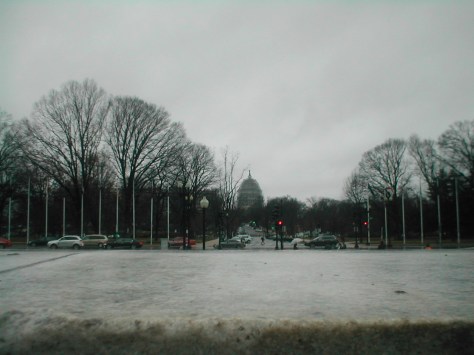
I was always used to seeing the Capitol Dome shine upon my arrival like a vast, upright egg; it was an image in a poem or two I scribbled down to commemorate my adventures.
Things were different Wednesday. 2015’s strangely mild new winter wasn’t quite cold, but it was blustery, cool, a little wet and quite gray. That is indeed the Capitol Dome that you see in the third photo, but I discovered it darkened and under renovation. And that slate sky’s color differed little from the dark monument marble you see in the foreground. I need to spend a day in DC after a kinder climate finds it, I think.
I like the shot I got of that woman feeding the pigeons.
I wanted to love “The Hallow” (2015) more than I did. It has all of the attributes of a film that I’d love. It’s a creatively conceived, independent horror film, beautifully shot on location in the forests of Ireland. It portrays a family under attack in a gorgeously scenic isolated location at night. It’s got highly original story antagonists — grotesque monsters who seem birthed from Irish folklore and science fiction both. They’re rendered quite nicely with some great special visual and sound effects, and are truly frightening.
Yet, at times, my attention wandered. I’m not sure why. Maybe it was because the pacing was way off, maybe it was the story’s bland parent-protagonists. Maybe it was because the modus operandi for the monsters was confusing at first. I get the sense that “The Hallow” might have been more enjoyable had it been just slightly shorter.
It was still good, though. I’d give it a 7 out of 10.
If you do watch it, then continue to watch through the credits. There’s a really neat coda that adds a new and interesting level to the story.
My take tonight on “The Man in the High Castle” (2015) is again cheerfully redundant; I concur with all of its glowing reviews. I’d give “Season 1” a 10 out of 10, even if I hesitated over a couple of small criticisms. I was leaning toward a 9 over my quibbles, but I can’t get this hooked on a show and look forward to it so much without giving it a perfect rating.
First, it was a terrific television drama in all of the ways I was expecting — it’s an intelligently written and competently directed adaptation of what seems like a truly great science fiction classic. (No, I haven’t read Philip K. Dick’s award-winning 1962 book.) The drama is actually better than I expected.
Second, it also surprised me by being good in some unexpected ways. It’s nifty genre-buster, for one. I recommended it last night to a friend because it has some military-sci-fi elements. But it’s far more of an espionage thriller. It’s a dystopian sci-fi story, but not a futurist one; our negative utopia here exists in an alternate-history 1962. It’s a mystery, as our central plot thread involves mysterious newsreels being transported by the American resistance and sought after by the Axis counterintelligence agencies. And I suggest that the episodes taking place in “the Neutral Zone” (a kind of “no man’s land” between the eastern Nazi territory and the Japanese-annexed East Coast) work just fine as a horror-thriller. The psychotic “bounty hunter’s” pursuit of his various quarry is easily more frightening than many psycho-killer horror films that I’ve seen via Netflix.
The “world building” here has depth. It’s easy for a dystopian-fictional work to just portray New York with Nazi symbols, statues and flags, or California streets with Japanese-language signs. But this show goes to great lengths to (quite successfully) show a range of people and how their personalities are shaped by this alternate universe.
We see heroic resistance fighters and callow American collaborators; frightening Nazis and those with regret; terrifying Imperial Japanese secret-policemen and officials trying to preserve the peace. Conflicts exist among factions and personalities everywhere — divisions and power struggles within the Nazi ranks, threats between the Imperial kempeitai and mobster yakuza, and a brewing possible war between the Axis victors of World War II.
All of this is tightly plotted, with various characters’ actions affecting the missions and safety of others — it really reminded me of Tom Clancy’s novels that way. It’s all kind of brilliant.
The acting is top-notch. Alexa Davalos (Juliana Crane) isn’t just a pretty face, she’s an extremely talented performer. So, too, are Rufus Sewell (Oppergruppenfuhrer John Smith) and Cary-Hiroyuki Tagawa (Nobusuke Tagomi). All three give great performances.
Honestly, there are too many terrific things about this program to name. It’s just a damn good show.
My only complaints were forgivable. When characters drop personal mementos and those serve as clues to their identity, it’s an eye-rolling deus ex machina. This happens not once, but twice. We also learn far too little about the nature of the mysterious (and plot-driving) newsreels. The entirety of this ten-episode “Season 1” is so lacking in closure that this feels like an incomplete story arc. To make matters worse, there seems to be little information about if or when Amazon will produce another season.
Anyway … I think I spotted an Easter egg. Alexa Davalos is a dead ringer for the equally beautiful Sherilyn Fenn, who played the enigmatic Audrey Horne on “Twin Peaks” 25 years ago. When interrogated by the Kempeitai, she reports that she was looking for her sister in “her favorite places,” which include “Twin Peaks.” That … can’t be a coincidence, can it?






 Eric Robert Nolan, Author