Tag Archives: 1917

“He travels the fastest who travels alone.”

If you are wondering what poem is referenced at the beginning of the incredible two-take war film, “1917” (2019), it is none other than Rudyard Kipling’s “The Winners.”  Lieutenant Leslie (Andrew Scott) quotes its refrain in explaining why only two men will be sent to deliver urgent news to the British 1st Battalion Devonshire Regiment.

Incidentally, the poem that Scofield (George MacKay) recites to the French baby in the film’s second half is Edward Lear’s “The Jumblies.”

Kipling’s piece is presented below.


“The Winners”

What is the moral? Who rides may read.
When the night is thick and the tracks are blind,
A friend at a pinch is a friend indeed;
But a fool to wait for the laggard behind
Down to Gehenna, or up to the Throne,
He travels the fastest who travels alone.

White hands cling to the tightened rein,
Slipping the spur from the booted heel,
Tenderest voices cry, “Turn again,”
Red lips tarnish the scabbarded steel,
High hopes faint on a warm hearth-stone–
He travels the fastest who travels alone.

One may fall, but he falls by himself–
Falls by himself, with himself to blame;
One may attain, and to him is the pelf–
Loot of the city in Gold or Fame
Plunder of earth shall be all his own
Who travels the fastest, and travels alone.

Wherefore the more ye be holpen and stayed,
Stayed by a friend in the hour of toil,
Sing the heretical song I have made–
His be the labour, and yours be the spoil. 
Win by his aid, and the aid disown–
He travels the fastest who travels alone.


“You appeared, and there was a burst of life in my soul; All my inner flowers opened and sang the bird of festive days.”

“You appeared, Anuari, when I, with my blind eyes and tended hands, sought you out.

“You appeared, and there was a burst of life in my soul; All my inner flowers opened and sang the bird of festive days.

“Now you are mío, like the water that darkens between your fingers, like the shadows that loom large with the day; You are not worried that I will always lose you.

“I love your eyes that give me your plants with the languidness of the sunset. I love them because they shine through my pupils, like the light of crystals, and they recreate contemplating my soul.

“I see in them the key of my secret longing, the source of my spiritual delirium.

“Anuarí, the embers of your gaze have consecrated me as a woman.

“In the stillness of the night, and with our hands together, I give you my soul.”

— from Teresa Wilms Montt’s, “Inquietudes Sentimentales”, 1917

Source: Sociedad Literaria Nº 13 & Underground


398969199_320226327419681_3644471550515876307_n

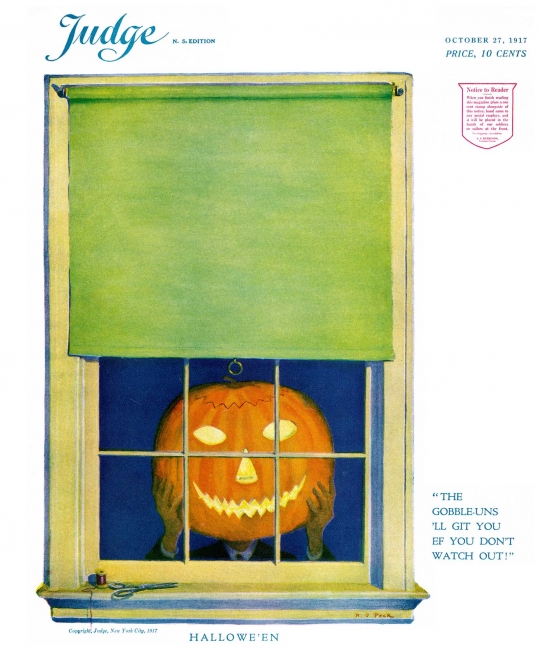
Cover to “Judge,” October 27, 1917

JudgeMagazine27Oct1917

Illustration by Franklin Booth for Harry Van Dyke’s “The Proud Lady,” 1917

Harper’s Magazine.

proud - Copy

“Cynthia,” William Strang, 1917

William_Strang_portrait_Cynthia_1917

Painting of a British Sopwith Camel attacking a German Taube, Christopher R. W. Nevinson, 1917

From Wikimedia Commons: The painting is mentioned in correspondence in September 1917 as being re-worked prior to its presentation to the Imperial War Museum: it may possibly have been the painting ‘Taube Pursued by Commander Samson’ shown in March 1915.

800px-C.R.W._Nevinson_-_Swooping_Down_on_a_Hostile_Plane,_1917_-_Art.IWMART517

Poster for “Topiel” (1917)

“Abyss.”  Polonia Moskwa.  Poland.

ZdMggAN

“Liebesfruehling,” Franz von Stuck, 1917

Liebesfruehling_stuck-1917

Photo of “Cookery 51-52” class, Mary Washington College, 1917

“Serving breakfasts, luncheons and dinners, with practice in different styles of table service; soups, entrees, sauces, salads and desserts, with various methods of preparation and garnishings. An opportunity for review of principles learned in Cookery 51-52 is given. One single and one double period per week for the session for non-teaching Seniors.”

— from the Bulletin of the State Normal School, Fredericksburg, Virginia, June, 1917


Bulletin_of_the_State_Normal_School,_Fredericksburg,_Virginia,_June,_1917_(1917)_(14781550294)

By University of Mary Washington [No restrictions], via Wikimedia Commons

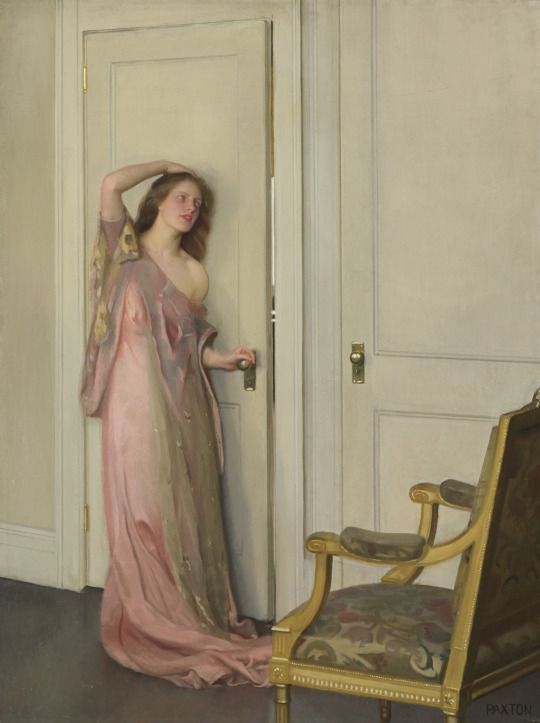
“The Other Door,” William McGregor Paxton, 1917

Oil on canvas.

f1242c840d5f4dae5044cb50afecf00c