Colors by “Grendel” creator, writer and artist Matt Wagner. This was the original artwork for the “Devil’s Legacy” storyline first published by Comico; Wagner completed the cover art for Dark Horse Comics’s reprints in 2000.

Colors by “Grendel” creator, writer and artist Matt Wagner. This was the original artwork for the “Devil’s Legacy” storyline first published by Comico; Wagner completed the cover art for Dark Horse Comics’s reprints in 2000.


2000.

This is the cover for Dark Horse Comics’ millennial reprint, and not Comico’s original release of the series in the late 1980’s.

This is Matt Wagner’s cover for the Dark Horse Comics re-release of the series in 2001 — not its first publication by Comico in 1987.
I know this is a silly observation (and almost certainly unintended by Wagner), but this absolutely reminds me of the Green Lantern Corps comics. (Consider the color scheme combined with the placement of the circles, and even Christine Spar’s pose.)

This cover would be a reprint for an issue from the original series in the late 1980’s.

Cover by “Grendel” creator Matt Wagner.

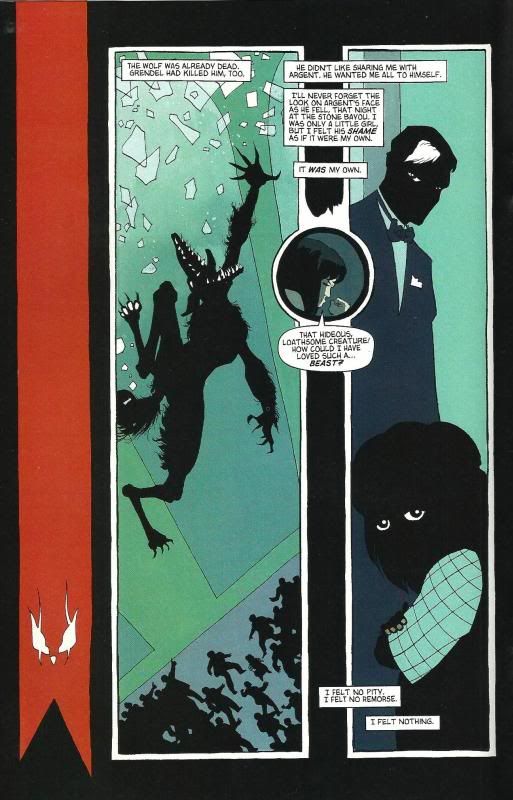
Interior art by Tim Sale, with colors by Teddy Kristiansen. The story was written by Diana Schutz.


I am now the proud owner of … a goodly portion of all the “Grendel” comics Matt Wagner ever wrote. What you see in the top row are “Grendel Omnibus” Volumes 1, 2 and 3. (I believe I actually shared my review of Volume 1 on this site a while ago.) These would comprise a nearly inclusive history of Hunter Rose, Christine Spar, Brian Li Sung, Orion Assante and Eppy Thatcher. All that remains for me to collect is the fourth Omnibus trade-paperback, chronicling the possibly immortal Grendel Prime and his imperiled charge, Jupiter Assante.
The Omnibus editions do not include crossovers with heroes such as Batman and The Shadow, as those characters are obviously owned by other companies. Nor do they include the diverse dystopian future tales depicted by various artists in the 1990’s “Grendel Tales.” But I am in heaven with what you see below — or maybe hell, considering these books’ central motif.
To top it all off, that hefty tome beneath the comics is W. H. Auden’s “Collected Poems,” edited by Edward Mendelson, with the poet’s work between 1927 and his death in 1973. It’s 927 pages. It weighs 30 pounds, probably. And it is indexed by both the poem’s titles and their first lines. That is what you call a lifetime investment.
The comics will be excellent summer reading; as will Auden. But I’ll focus more on the Briton when fall arrives. Like his countryman, Doyle, he might be best enjoyed outdoors on a gray and increasingly brisk Autumn day.
I need to buy books more often.

Today is the Ides of March.
I suppose that Marc Antony’s speech from “Julius Caesar,” below, is the Western World’s definitive treatise on sarcasm?
I haven’t read it in its entirety since 10th grade English at Longwood High School. In doing so now, I’m surprised at how many pop cultural references to it spring to mind: