Tag Archives: W.H. Auden

That wicked cool moment when “The Gunslinger” reminds you of W. H. Auden.

The following is from Auden’s “The Third Temptation,” part of “The Quest.”

He watched with all his organs of concern
How princes walk, what wives and children say,
Re-opened old graves in his heart to learn
What laws the dead had died to disobey,

And came reluctantly to his conclusion:
“All the arm-chair philosophies are false;
To love another adds to the confusion;
The song of mercy is the Devil’s Waltz.”

And the quote below is from Stephen King’s “The Gunslinger.”

12003155_10203925409334735_8322614684030940377_n

“The Quest” actually contains a bunch of key images reminiscent of King’s series.  We can easily conclude that these are coincidental, as they serve different thematic purposes.  But it’s still fun to spot the common images.

You can find the entirety of “The Quest” right here:

http://www.poemhunter.com/best-poems/wh-auden/the-quest-5/

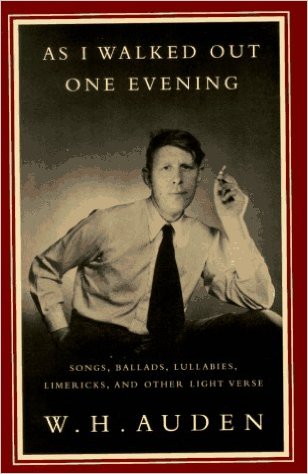
“As I Walked Out One Evening,” by W. H. Auden

I posted a new poem of mine a little while ago; this is the poem that it makes reference to — W. H. Auden’s “As I Walked Out One Evening.”

This was the first of Auden’s poems that I’d ever read, maybe 25 years ago.  I believe it is his most popular.

“As I Walked Out One Evening,” by W. H. Auden

As I walked out one evening,
Walking down Bristol Street,
The crowds upon the pavement
Were fields of harvest wheat.

And down by the brimming river
I heard a lover sing
Under an arch of the railway:
“Love has no ending.

“I’ll love you, dear, I’ll love you
Till China and Africa meet
And the river jumps over the mountain
And the salmon sing in the street.

“I’ll love you till the ocean
Is folded and hung up to dry
And the seven stars go squawking
Like geese about the sky.

“The years shall run like rabbits
For in my arms I hold
The Flower of the Ages
And the first love of the world.”

But all the clocks in the city
Began to whirr and chime:
“O let not Time deceive you,
You cannot conquer Time.

“In the burrows of the Nightmare
Where Justice naked is,
Time watches from the shadow
And coughs when you would kiss.

“In headaches and in worry
Vaguely life leaks away,
And Time will have his fancy
To-morrow or to-day.

“Into many a green valley
Drifts the appalling snow;
Time breaks the threaded dances
And the diver’s brilliant bow.

“O plunge your hands in water,
Plunge them in up to the wrist;
Stare, stare in the basin
And wonder what you’ve missed.

“The glacier knocks in the cupboard,
The desert sighs in the bed,
And the crack in the tea-cup opens
A lane to the land of the dead.

“Where the beggars raffle the banknotes
And the Giant is enchanting to Jack,
And the Lily-white Boy is a Roarer
And Jill goes down on her back.

“O look, look in the mirror,
O look in your distress;
Life remains a blessing
Although you cannot bless.

“O stand, stand at the window
As the tears scald and start;
You shall love your crooked neighbour
With your crooked heart.”

It was late, late in the evening,
The lovers they were gone;
The clocks had ceased their chiming
And the deep river ran on.
51ZZNADNKKL._SX306_BO1,204,203,200_

“But should you fail to keep your kingdom …”

But should you fail to keep your kingdom
And, like your father before you, come
Where thought accuses and feeling mocks,
Believe your pain; praise the scorching rocks
For their desiccation of your lust,
Thank the bitter treatment of the tide
For its dissolution of your pride,
That the whirlwind may arrange your will
And the deluge release it to find
The spring in the desert, the fruitful
Island in the sea, where flesh and mind
Are delivered from mistrust.

—  from “Alonso to Ferdinand,” in W. H. Auden’s “The Sea and the Mirror”

W.H.AUDEN

“The song of mercy is the Devil’s Waltz.”

“The Third Temptation” (Part VIII of “The Quest”), by W.H. Auden

He watched with all his organs of concern
How princes walk, what wives and children say,
Re-opened old graves in his heart to learn
What laws the dead had died to disobey,

And came reluctantly to his conclusion:
“All the arm-chair philosophies are false;
To love another adds to the confusion;
The song of mercy is the Devil’s Waltz.”

All that he put his hand to prospered so
That soon he was the very King of creatures,
Yet, in an autumn nightmare trembled, for,

Approaching down a ruined corridor,
Strode someone with his own distorted features
Who wept, and grew enormous, and cried Woe.

W.-H.-Auden-001

“Your need to love shall never know Me …”

“Your all is partial, Prospero.

          “My will is all my own.

“Your need to love shall never know

“Me: I am I, Antonio

          “By choice myself alone.”

—  Antonio, refrain from W. H. Auden’s “The Sea and the Mirror”

Azerbajiani_landscape_-_Another_version

Photo credit:  “Azerbajiani landscape – Another version” by Original: Matthew Hadley (nickname diff_sky)derivative work: Ximonic (talk), Simo Räsänen – Azerbajiani_landscape.jpg. Licensed under CC BY 1.0 via Wikimedia Commons.

“A terror shakes my tree, A flock of words fly out …”

A terror shakes my tree,
A flock of words fly out,
Whereat a laughter shakes
The busy and devout.

Wild images, come down
Out of your freezing sky,
That I, like shorter men,
May get my joke and die.

— Selection from “Trinculo,” from W. H. Auden’s “The Sea and the Mirror”

800px-Winter_Sky_New_Jersey

Photo credit: By Tomwsulcer (Own work) [Public domain], via Wikimedia Commons.

O, but what worm of guilt or what malignant doubt am I the victim of?

“Dear, though the night is gone,” by W.H. Auden

Dear, though the night is gone,
Its dream still haunts today,
That brought us to a room
Cavernous, lofty as
A railway terminus,
And crowded in that gloom
Were beds, and we in one
In a far corner lay.

Our whisper woke no clocks,
We kissed and I was glad
At everything you did,
Indifferent to those
Who sat with hostile eyes
In pairs on every bed,
Arms round each other’s neck,
Inert and vaguely sad.

O but what worm of guilt
Or what malignant doubt
Am I the victim of,
That you then, unabashed,
Did what I never wished,
Confessed another love;
And I, submissive, felt
Unwanted and went out?

W.H. Auden

W.-H.-Auden-001

“Are You There?” by W. H. Auden

Are You There?

Each lover has some theory of his own
About the difference between the ache
Of being with his love, and being alone:Why what, when dreaming, is dear flesh and bone
That really stirs the senses, when awake,
Appears a simulacrum of his own.

Narcissus disbelieves in the unknown;
He cannot join his image in the lake
So long as he assumes he is alone.

The child, the waterfall, the fire, the stone,
Are always up to mischief, though, and take
The universe for granted as their own.

The elderly, like Proust, are always prone
To think of love as a subjective fake;
The more they love, the more they feel alone.

Whatever view we hold, it must be shown
Why every lover has a wish to make
Some kind of otherness his own:
Perhaps, in fact, we never are alone.

**********
— Thanks to blogger Ashok Karra for sharing this poem on his own blog.  Read his analysis here:
Auden29

“Song of the Master and Boatswain,” by W. H. Auden

“Song of the Master and Boatswain,” by W. H. Auden

(a selection from “The Sea and the Mirror”)

At Dirty Dick’s and Sloppy Joe’s
We drank our liquor straight,
Some went upstairs with Margery,
And some, alas, with Kate;
And two by two like cat and mouse
The homeless played at keeping house.

There Wealthy Meg, the Sailor’s Friend,
And Marion, cow-eyed,
Opened their arms to me but I
Refused to step inside;
I was not looking for a cage
In which to mope my old age.

The nightingales are sobbing in
The orchards of our mothers,
And hearts that we broke long ago
Have long been breaking others;
Tears are round, the sea is deep:
Roll them overboard and sleep.

“Vocation,” by W. H. Auden

Part XII of “The Quest”

Vocation

Incredulous, he stared at the amused
Official writing down his name among
Those whose request to suffer was refused.

The pen ceased scratching: though he came too late
To join the martyrs, there was still a place
Among the tempters for a caustic tongue

To test the resolution of the young
With tales of the small failings of the great,
And shame the eager with ironic praise.

Though mirrors might be hateful for a while,
Women and books would teach his middle age
The fencing wit of an informal style,
To keep the silences at bay and cage
His pacing manias in a worldly smile.