“You know there are no secrets in America. It’s quite different in England, where people think of a secret as a shared relation between two people.”
— W. H. Auden


“You know there are no secrets in America. It’s quite different in England, where people think of a secret as a shared relation between two people.”
— W. H. Auden
Oil on canvas.

Suppose that we are wise enough to learn and know—and yet not wise enough to control our learning and knowledge, so that we use it to destroy ourselves? Even if that is so, knowledge remains better than ignorance.
It is better to know—even if the knowledge endures only for the moment that comes before destruction—than to gain eternal life at the price of a dull and swinish lack of comprehension of a universe that swirls unseen before us in all its wonder. That was the choice of Achilles, and it is mine, too.
— Isaac Asimov

Variant (Arya).

One face cries nothing, Prospero,
My conscience is my own;
Pallid Sebastian does not know
The dream in which Antonio
Fights the white bull alone.
— excerpt from W.H. Auden’s The Sea and the Mirror

By Adam Marian Pete – Adam Marian Pete, CC BY-SA 4.0, https://commons.wikimedia.org/w/index.php?curid=38121754
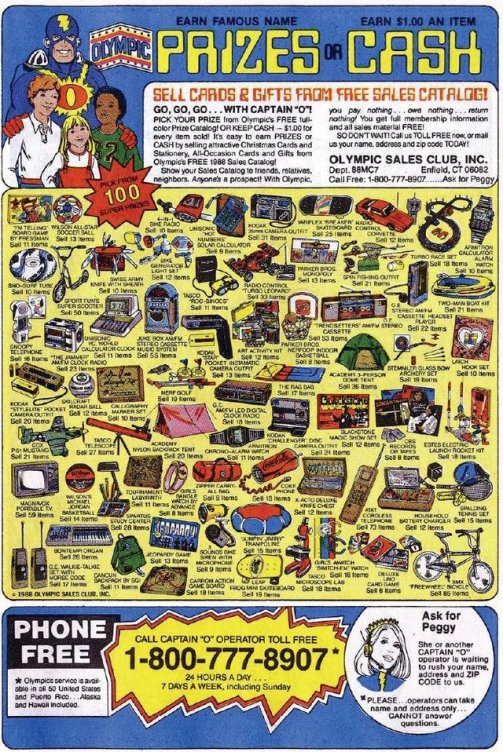
Here’s another ad that was a permanent fixture of comic books in the 1980’s. I myself was never interested in joining the advertised “Olympic Sales Club;” nor did I want to “GO, GO, GO WITH CAPTAIN “O”!” [sic].
I found this ad pretty patronizing, with its generic champion hugging his demographically diverse charges in the upper left-hand corner. What kind of superhero was “Captain O” supposed to be, anyway? Was he the protector of the company? The guardian of the kids who went door to door selling its wares? The hero of … salespeople generally? To me, this was really just an example of adults pandering to kids as though they were idiots.
But ads like this fueled a lot of conversation among grade-school boys. It really made it seem like you could earn some cool prizes for selling only a moderate amount of greeting cards or stationary. (The radio-controlled cars and planes were what all the boys eyed most eagerly.)
And 80’s kids often prided ourselves on our sales skills. Most of us had sold things door-to-door for school-related fundraisers — it was just a very common practice at the time, even if it seems needlessly dangerous to me as an adult. When I was in second and third grade at Catholic school, we annually sold candy bars door-to-door. If memory serves, we weren’t even required to do that for any particular fundraising purpose, like a school trip or a sports team. I think it we were just turning a profit for the school, in addition to what our parents were paying them in tuition.
I also remember seeing ads in my older comics that recruited kids to sell “Grit,” which was some sort of periodical that was oddly billed as a “family newspaper.” But I think that was primarily a 1970’s thing, and was just before my time.
Three Dimension Pictures.

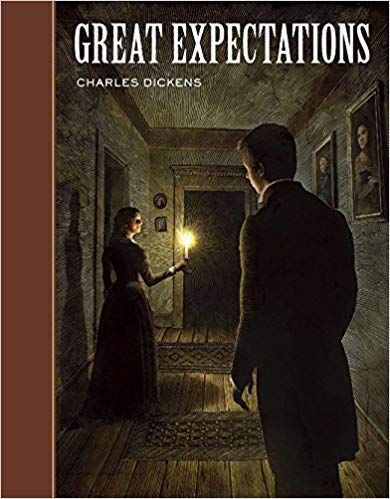
Out of my thoughts! You are part of my existence, part of myself. You have been in every line I have ever read, since I first came here, the rough common boy whose poor heart you wounded even then.
You have been in every prospect I have ever seen since – on the river, on the sails of the ships, on the marshes, in the clouds, in the light, in the darkness, in the wind, in the woods, in the sea, in the streets.
You have been the embodiment of every graceful fancy that my mind has ever become acquainted with. The stones of which the strongest London buildings are made, are not more real, or more impossible to displace with your hands, than your presence and influence have been to me, there and everywhere, and will be.
Estella, to the last hour of my life, you cannot choose but remain part of my character, part of the little good in me, part of the evil. But, in this separation I associate you only with the good, and I will faithfully hold you to that always, for you must have done me far more good than harm, let me feel now what sharp distress I may. O God bless you, God forgive you!
― Charles Dickens, Great Expectations
Oil on canvas.

“Well, Doctor, what have we got—a Republic or a Monarchy?”
“A Republic, if you can keep it.” — Benjamin Franklin, at the close of the Constitutional Convention of 1787, when asked as he left Independence Hall

First Lady and Son. Mrs. Kennedy, John F. Kennedy, Jr. White House, South Portico Entrance, 1962.

