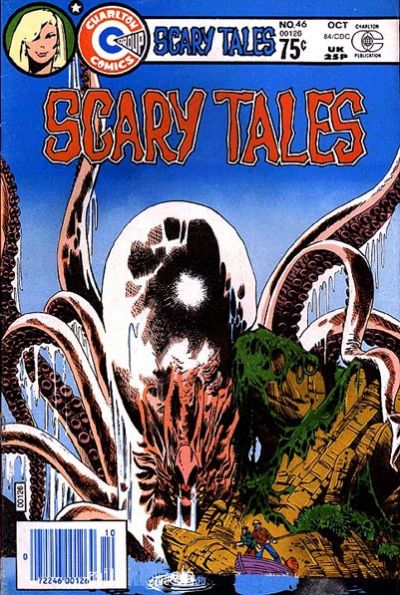
Cover to “Fantastic Four 2099” #2, Rick Leonardi and Al Williamson, 1996

Marvel Comics.

235933-18413-118100-1-fantastic-four-2099

Alpha on “The Walking Dead” was Agatha in “Minority Report” (2002).

Didn’t see that one coming.  (Waitaminute. Why are actors “on” shows, but “in” movies?)  The name of the actress is Samantha Morton.

She’s bald in both roles, and both roles depict her in dystopias.

And her characters are repeatedly referred to by others as “the strongest” member of their group.

AND both the show and the film place her in a key plot arc in which girls are taken from their mothers.  Damn.


agatha-john.0


Illustration of “Bara Ode Kryka,” Pehr Arvid Säve, 1858

Lithograph.  From Säve’s and Carl Johan Bergman’s book, “Gotland Och Wisby I Taflor.”

The picture that appears here just doesn’t do this gorgeous depiction justice.  By all means, click here for the larger version over at Wikimedia Commons.

800px-Bara_öde_kyrka_–_P_A_Säve_1858


A short pan of “Velvet Buzzsaw” (2019)

Sorry, but for me “Velvet Buzzsaw” (2019) was a bust.  I’d rate it a 3 out of 10 for being an interesting and ambitious Netflix horror film that nevertheless failed to hold my interest.

My interest was piqued along with everyone else when I first saw the trailer for this earlier this year.  It looked amazing.  It was a high-concept supernatural horror film with great visual effects and a cast that included Jake Gyllenhaal, Rene Russo and John Malkovich.  (The cast also includes Toni Collette, who I’ve recently come to understand is a damned good actress.)  It looked funny too.

But “Velvet Buzzaw” fatally suffers from the characters that it depicts.  All of the above actors portray profoundly irritating characters, and not even their formidable talents make these characters any fun to watch.  The movie takes place in the Miami Beach art world, and the major characters are artists, critics, or gallery owners and employees.  (The plot device here is a collection of haunted paintings that kill their owners.)  With the exception of Malkovich’s artist (“Piers”), these characters are so cloying, trite and pretentious that seeing them on screen is nearly nerve rattling.  You don’t care much that they’re imperiled.  You just want to see them die, so that the movie will be over.

This would have been a far better movie if screenwriter Dan Gilroy chose to depict its events mostly from Piers’ point of view.  I suppose that would have been difficult; he isn’t central to the plot.  But it would have been worth it.

There are some things to like.  Malkovich and Russo re always fun to watch, a lot of the special effects are quite good, and the final demise in the film is actually very well rendered.  (Given the mediocrity of the movie as a whole, I was surprised at how clever and unsettling this was.)  A college buddy of mine with excellent taste in horror actually liked “Velvet Buzzsaw” quite a bit.  So maybe this is just a matter of taste.

I can’t recommend this, though.


velvet_buzzsaw-829687870-large

“La Charmeuse de Serpents,” Paul Désiré Trouillebert

“The Snake Charmer.” Oil on canvas.  Circa 1880?

Paul_Désiré_Trouillebert,_The_Nude_Snake_Charmer

“Hereditary” (2018) is an expert horror film that I’m not sure you should see.

“Hereditary” (2018) is a difficult movie to review.  It’s an exceptionally well made horror film, enough for me to rate it at least a 9 out of 10.  But its content is so disturbing that I’m not sure that I can actually recommend it to others.

From a technical standpoint, the movie is almost perfect.  It’s an astonishingly good first feature film for writer-director Ari Aster, it’s gorgeously shot in the hills and deserts of Utah, and it’s masterfully directed.  The performances are uniformly perfect.  If I were to name each actor who hands in a fantastic performance, I’d simply be reading its cast list.  I can’t remember the last time I watched a feature film in which every single major performance was exemplary.  And “Hereditary” gets damned scary in its third act.   (Seriously, give it time.)

The only flaws that I can think of are extremely minor.  The pacing isn’t perfect.  (The story occasionally seems to slow when events should be accelerating.)  I had problems with the way that one key character was portrayed, and there was one plot point that gave me trouble.  (I can’t say more for fear of spoilers.)  But these things are so forgivable that they hardly merit a mention here.  You simply can’t argue that this movie was expertly assembled.

Yet I didn’t always enjoy “Hereditary.”  I’d be lying by omission if I didn’t state that.  I shut it off more than once, and then came back to it when I felt more able to stomach the brutal events it depicted.

“Hereditary” is more than a “dark” movie; it’s gut wrenching.  Even if you have read its reviews and you’ve seen the movie’s marketing, then you still aren’t anticipating what will transpire on screen.  (I’d even go so far as to say that the film’s marketing was misleading, but I can’t specify why here.)  Yes, there’s a obvious “Rosemary’s Baby” (1968) vibe, and it’s sometimes reminiscent of “The Exorcist” (1973), but the movie pushes well past the boundaries of those films, and it does so fairly early on.  If I, a lifelong horror fan, was turned off by this, then I’m willing to bet that it would also be too much for a lot of casual film goers.  (And indeed, while critics loved this film, audiences last year generally hated it.)

I’m closing with a little bit of trivia.  Toni Collette gives a tour-de-force performance here as the troubled mother.  If she looks familiar to you, that might be because she’s also the mom in another well known supernatural horror film — M. Night Shyamalan’s “The Sixth Sense” (1999).


p9fmuz2Oj3HtEJEqbIwkFGUhVXD-0

“The Difficult Lesson,” William-Adolphe Bouguereau, 1884

Oil on canvas.

William-Adolphe_Bouguereau_(1825-1905)_-_The_Difficult_Lesson_(1884)

20190321_140820b

“Vecchio con Clessidra,”Antonio Zifrondi, circa 1717

Oil.

2017-03_Brescia_Mattes_Pana_(144)

Throwback Thursday: “The Tripods” comic strip in “Boys’ Life” magazine!

I had a subscription to Boys’ Life magazine for a couple of years when I was a Cub Scout in the early 1980’s.  My parents canceled it after a year or two, and I can’t blame them — I just wasn’t reading it.  Boys’ Life was the official magazine of the Boy Scouts of America, and it was pretty wholesome stuff … it just didn’t offer the excitement of my comic books or the occasional copy of Fangoria that I manged to get my hands on.

But there was one feature of Boys’ Life that I followed religiously — the serialized comic strip adaptation of John Christopher’s The Tripods book trilogy.  (Christopher published the first three of his books in the late 1960’s; he added a prequel novel in 1988, but that was long after the Boy Scouts and Boys’ Life was behind me.)

The Tripods was cool, dark dystopian stuff.  The story opened with the first book, The White Mountains, to find humanity settled into an agrarian, pre-industrial age in which their overlords were the titular “tripods” — massive three-legged vehicles piloted by unknown beings.  Humans were ritualistically “capped” with a brain-altering device when they reached age 14 — thereafter becoming docile and conformist and easier for the mysterious machines to subjugate.

The White Mountains followed a trio of 13-year-old boys who escaped the “capping” to seek out a human resistance movement; the second book, The City of Gold and Lead, shows two of these protagonists infiltrate the city of the tripods’ operators.  (Spoiler — they’re grotesque aliens.)  The third book, The Pool of Fire, presumably picks up from there, but my Boys’ Life subscription ran out before the magazine got to that.

I recently, however, used this Interwebs thingamajig to discover what looks like a real gem of a find — a 1984 BBC mini-series adaptation of the books.  I started the first episode and it looks quite good.  If I get around to watching the whole thing, I’ll review it here.


40da7d9da25e489860f6e1bc7bccf65a7112394a

3

4

5

2

Nurse Your Favorite Heresies in Whispers