Tag Archives: 1976

Throwback Thursday: “Donny & Marie” (1976-1979)!

You think that 80’s kids are old?  Well, I also have memories of the 1970’s; after all, they fully occupied the first seven years of my life.

And I remember “Donny and Marie” (1976-1979), which ran on ABC.  It was a sanity-challenging, Kafkaesque combination of disco, country music, family entertainment, themed-comedy skits, sequined outfits and … ice-skating.  Which made it either the height of 70’s cheese or the very nadir of Western civilization — you decide.

I’m embarrassed to admit here that I loved it, even if I was a tot at the time.  (Hey, if you’re five or six years old, then the sight of Donny being a non-threatening goofball on stage was the very height of hilarity.)  You can see what I mean in the second clip below, if you can stomach all four minutes of it.

What’s interesting about this show is that it was kind of a dinosaur in its time … variety shows had been on the decline for a while in the late 1970’s, and were already being supplanted by the situation comedies that would become the trademark of the 1980’s.  Bizarrely, NBC tried to launch Marie in her own solo variety show during the 1980-81 television season, but it just didn’t catch on.  It was cancelled after seven episodes.

What’s truly crazy is that Donny and Marie are still performing in Las Vegas.  I kid you not.  Google it.  You can even see them tonight at The Flamingo.  There’s at least a chance that they’re immortal vampires.

Postscript: I at first typed “Donny and Maurie” in that blog post headline, and I feel certain there’s a terrible joke hiding there somewhere about Donny hearing the results of paternity test on “Maury Povich.”  That would make a great “Saturday Night Live” sketch.


https://www.youtube.com/watch?v=FJA3qWQpd1g

Throwback Thursday: “Laverne and Shirley” (1976-1983)

Rest in Peace, Penny Marshall.

This is one of only a handful of TV shows that I can remember watching as a tot in the late 1970’s.  “Laverne and Shirley” (1976-1983) was the kind of of thing I’d see in my older sisters’ room.  My Dad and older brother watched war movies, westerns and monster movies, but my two sisters preferred considerably lighter fare.  Two that they watched a lot at the time, if I recall, were this show and “Donnie & Marie” (1976-1979) — about the scariest thing you could find playing on their black-and-white TV was “The Hardy Boys/Nancy Drew Mysteries” (1977-1979). (One of my sisters had a crush on actor Shaun Cassidy; I think there was a poster of him in their room.)

I loved “Laverne and Shirley” when I was that young.  Lenny and Squiggy were my favorite highlight of any episode, even if I was sometimes confused about whether they were meant to be “good guys” or “bad guys.”  I was in kindergarten, and not altogether bright, and I thought that men who wore black leather jackets (Fonzie notwithstanding) were usually “bad guys.”  I also remember thinking that hippies and motorcyclists were the same group of “bad guys” because they disobeyed God or something … my confusion at the time resulted from some vaguely moraled born-again Christian comic books I’d happened across somewhere.

I also remember recognizing “Laverne and Shirley” as being related to another show that a lot of kids back then loved — “Happy Days” (1974-1984), of which it was a spin-off.  This might have been the first time in my life that I was aware of two live-action television properties occupying the same fictional universe; I’d already seen it happen in the movies with the various incarnations of “King Kong” and “Godzilla.”

Here’s what makes me feel old — for both “Laverne and Shirley” and “Happy Days,” I probably watched a lot of the episodes when they were first broadcast, and not just in re-runs (although “Happy Days” was also played in syndication endlessly throughout the 1980’s — it remained a fixture of daytime television).

And I only just realized writing this that Lenny was played by the priceless Michael McKean.  As an adult, I know him primarily from his brilliant turns in “This Is Spinal Tap” (1984) and “The X-Files” (1998-2018).  He’s 71 now.  Wow.


Cover to “Creepy” #81, Ken Kelly, 1976

Warren Publishing.

CreepyMagazine 081-00

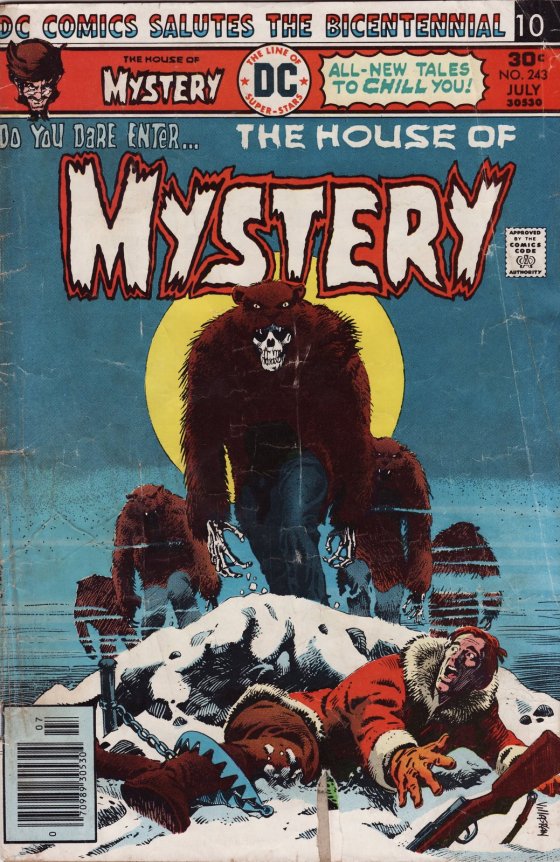
Cover to “House of Mystery” #246, Ricardo Villagran, 1976

DC Comics.

houseofmystery_0003


Amateur footage of New York City, 1976

I’m linking here to the stuart bailey media Youtube channel — this is footage of Manhattan over 40 years ago, shot by some unknown tourist with a Super 8 camera.  Most of the buildings look the same.  The clothes, haircuts and cars look very, very different.

Check out the frame you can see below.  That is indeed the original “Rocky” playing at a Loews Theater — alongside the year’s truly awful “King Kong” remake that I’ve mentioned previously here at the blog.


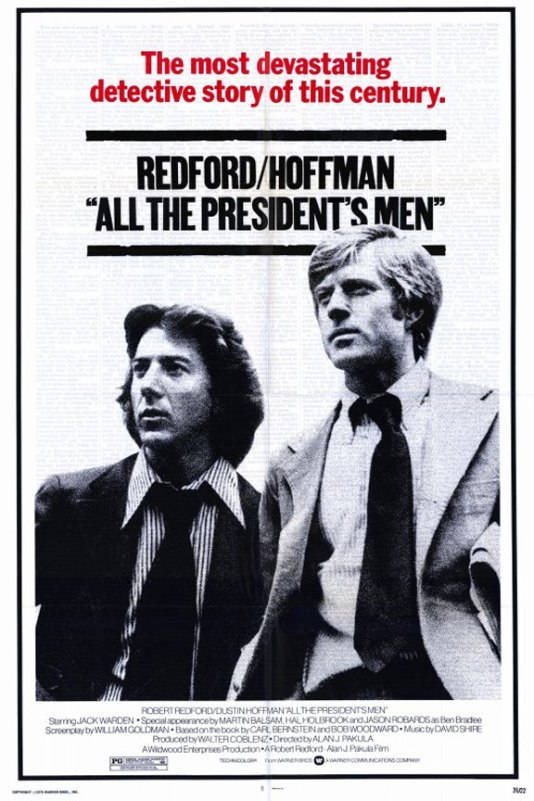
Poster for “All the President’s Men,” 1976

Warner Bros.

AE_allthepresidentsmen_CourtesyofWarnerBros

Throwback Thursday: “Rudolph’s Shiny New Year” (1976)

This was one of the really weird holiday specials that Rankin/Bass Productions made after their success with 1964’s “Rudolph the Red-Nosed Reindeer.”  Yes, this is the one with dinosaurs.

And, whaddya know?  Frank Gorshin (The Riddler from the 1960’s “Batman”) was in this.


http://www.dailymotion.com/video/x3gszzz

Throwback Thursday: More of the WOR-9 Thanksgiving Monster Movie Marathon!!!

As I explained last year, monster movies were simply a part of Thanksgiving if you lived in the Tri-State region around New York City between 1976 and 1985.  This was due to WOR-9’s “Holiday Film Festival” broadcast, which actually also extended to the day following the holiday after the lineup’s first year.  (People just called it the “Monster Movie Marathon.”)

As a kid, I was a hell of a lot more thrilled with the monster movies than anything being served for dinner.  (Remember, video stores only began arriving the early 1980’s.  Before that, you usually had to catch a movie on television if you wanted to see it at all.  It’s why every house had a “TV Guide.”)

“King Kong vs. Godzilla” (1962) was one gem in the marathon.  (Or, at least, it seemed like an amazing film to a gradeschool boy.)  I was raised with the enduring myth that this Japanese film had two endings — an American version where King Kong prevailed, and a Japanese version where its native Godzilla was the victor.)  My Dad told me that, and I remember being fascinated that a movie could have two different endings.  I actually only learned just now, writing this blog entry, that it was a particularly widespread urban legend — stemming from an erroneous report in “Spacemen” magazine.  The American version of the film had tons of alterations, but the outcome was essentially the same — King Kong won.

There were always a few more Godzilla movies on the day after Thanksgiving, too.  “Son of Godzilla” (1967) was one of them; that was always hit with the kids.  (I could swear at some point there was a cartoon adaptation in the early 80’s.)  It was weird how 80’s kids apparently loved that ostensibly “cute” character; the adult in me today swears that “Son of Godzilla” looks like an upright, reptile-shaped poop.  (Seriously, check out the second clip below.)

“Godzilla vs. Megalon” (1973) was another one I seem to remember being pretty thrilled with.  I was even occasionally scared of the giant monsters in flicks like these.  (Hey, I was a little kid.)  Even as a first- or second-grader, though, I was smart enough to question why these movies were weirdly inconsistent.  (Why was Godzilla a bad guy who destroyed Tokyo in one movie, but the “good monster” that the Japanese rooted for in another?)

I’m learning now that “Godzilla vs. Megalon” was the target of a Mystery Science Theater 3000 episode.  I’m going to have to hunt that one down.


A spoiler-free review of “Sherlock” Season 4

I actually can understand why some “Sherlock” fans were less than thrilled with its fourth (and apparently last?) season.  (I’ve read that the final episode received the lowest ratings in the show’s history.)  Even if Season 4 wasn’t quite as strong as past seasons, however, I’d still give it a 9 out f 10.

The narrative style and the content of this three-episode arc changed drastically.  The detail and methodical pace of past seasons gave way to a faster, looser narrative that made the show feel more … mainstream, in a way.  These episodes felt more like the standard adventure tales that you’d expect from any television thriller, and far less a genuine homage to the literary source material.  At times it was a little sloppy, with bombs, disguises, false memories and other over-the-top plot devices that were sometimes pretty implausible.  The final episode even seemed directly inspired by a series of horror films not known for being critically acclaimed.

The writing and directing wasn’t as clean, either.  This was easily the most surreal of the show’s four seasons — especially if you count the standalone “special,” “The Abominable Bride,” which preceded the official initial episode.  There were some overly stylized flashbacks, spliced scenes, and other departures from a linear narrative.  (I can’t be more specific without spoilers.)

The tone of the humor changed, too.  Some of the droll, dialogue-driven British humor was replaced by the zanier, crowd-pleasing stuff that you would expect from a more mainstream television comedy.  (One lamentable scene involving the outcome of a car chase, for example, was entirely too silly.)

At the same time, this was the darkest season yet.  The goofier humor was juxtaposed with story elements that were hard-hitting, sad and occasionally frightening.  When one character delivers the line, “Maintain eye-contact,” it was chilling enough to stay with me hours after the show aired.  There was some scary stuff this season, on a couple of different levels — the second episode, in particular, superbly delivers creeping psychological horror, then tops if off with a chilling story resolution.

And here is where Season 4 shined.  At one point, I asked myself, “When did ‘Sherlock’ become a horror show?”  But it was shortly thereafter that I realized that I absolutely didn’t mind.

The season’s success boils down to three things.  The first is the darker story content, which I thought was a bold and surprising choice for what is probably the show’s last season.

The second is the quality of the writing.  I realize that sounds strange, given my above criticisms above, but it is still a superbly scripted show.

And, third, the performances from its principal actors were still uniformly excellent.  (And when they combine via some great dialogue, “Sherlock” still hits it out of the park.)  Martin Freeman, Benedict Cumberbatch, and Amanda Abbington were all at their peak — particularly since their characters have evolved now to what is probably their culmination.  This last  season was easily the most personal and character-focused, and sees these protagonists finally complete their individual arcs.  Sherlock is finally sufficiently humanized, Mary’s development finally reaches full fruition, and Watson has finally grown into his own man.  If I had quibbles about Holmes and Watson’s portrayals in past seasons, it was that Holmes was too much of a jerk , while Watson was merely a weak, even neutered foil for him.  Holmes was never such a heel in the stories I loved a boy — neither was he in the film adaptations.  And I found the far stronger Watson in “The Abominable Bride” to be truer to the stories as well — not to mention reminiscent of my favorite Holmes films, like 1976’s “The Seven Percent Solution” or 1979’s “Murder By Decree.”

The villains were damn good too.  “Sherlock” has always excelled at bringing believable, well scripted and creatively conceived bad guys, and this season was no exception.

All in all, this was still terrific television, despite its relative flaws.  I heartily recommend it to Holmes fans.


sherlock-did-you-miss-me

Nolanferatu’s tip for a trippy vintage horror double feature!

Well there’s one thing I can cross off my bucket list.  (There’s a lot on there, and some of it’s weird.)  I finally saw F.W. Murnau’s “Nosferatu: ein Symphonie des Grauens” (1922).

And am I damn glad I did!  I actually enjoyed it more than I thought I would.  I love plenty of classic movies; “The 39 Steps” (1939) and “To Have and Have Not” (1944) are among my all-time favorites.  But I’m accustomed to modern horror — my tastes generally extend only as far back as “The Birds” (1963) and “Night of the Living Dead” (1968).

I waited until I was in just the right mood.  (This is the first silent film I’ve ever seen from start to finish — the only exception being Mel Brooks’ 1976 parody, “Silent Movie.”)  Then I began it shortly before midnight.

The movie just worked for me. It was sublimely creepy.

I think it helped that the grainy, flickering, black-and-white period footage made this expressionist movie utterly atmospheric for a modern viewer.  These, combined with the shots of Max Schreck superbly made up as “Count Orlok,” were damned unsettling.  Schreck also appeared to be a great physical actor, with his gaunt stance and stilted, inhuman movements.  (Was he unusually tall too?)

The vintage footage also enhanced my enjoyment of the movie in a way that Murnau probably couldn’t have expected.  I know this is strange, but … nearly a century later, the thought that occurred to me several times during this movie was this: “Everyone involved in this production is long dead by now.”  Yes, I know that is a morbid thought — I’ve never done that before!  I think it was just the film itself that did that to me — it’s about undeath and immortality, after all.

It also helped that I’d read Bram Stoker’s “Dracula” (1897), of which this film is an unauthorized adaptation.  The resulting lawsuit by Stoker’s estate is interesting reading: supposedly all copies of the movie were ordered by the courts to be destroyed, bankrupting Prana, the production company.  But a permanent cult following developed for the few surviving prints.

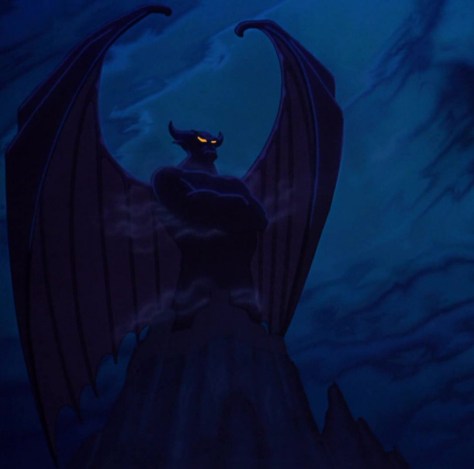
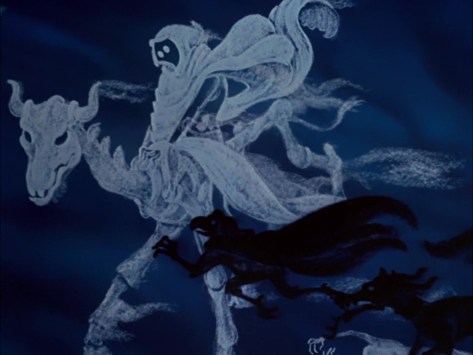
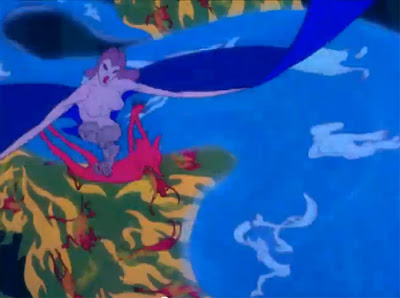
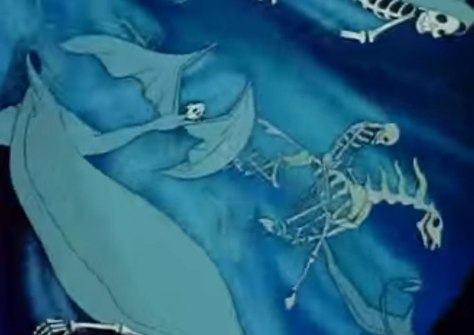
Anyway, I followed this up with the palate-cleansing “Night on Bald Mountain,” the final segment of Disney’s “Fantasia” (1944).  That combination, too, totally worked for me — I followed up the black-and-white nightmare-fuel of the seminal vampire film with some vivid, incongruously hellish Disney nightmare-fuel.

“Nosferatu” is in the public domain.  You can view the entire film on Youtube at the link below.


nosferatu

c1402340b6a518f114e12da99fefa1e8

download

nosferatu10

nosferatu-1922

Fantasia-Night-on-Bald-Mountain-864x855

night-on-bald-mountain-ave-maria-078

bald-mountain_harpy2

night-on-bald-mountain


https://www.youtube.com/watch?v=rcyzubFvBsA