Tag Archives: 2019

A review of “The Dead Don’t Die” (2019)

“The Dead Don’t Die” indeed has the greatest zombie cast ever assembled.  Seriously, just look at that poster below.  Unfortunately, it doesn’t have the best zombie screenplay ever written, or the best direction ever seen in a zombie film.  This would-be classic was a surprisingly average viewing experience; I’d rate it a 6 out of 10.

I almost feel guilty for feeling so unenthusiastic, because I like so many of these actors so much.  Bill Murray and Adam Driver actually are quite funny as the movie’s two torpid police officers; Chloe Sevigny makes them even funnier as their panicked straight man.  And the addition of Tilda Swinton’s zany Scottish samurai undertaker makes them the perfect comedic quartet.  (I think this is the first time I’ve seen Sevigny in a movie, as she mostly does arthouse films — including 2003’s ignominiously reviled “The Brown Bunny.”  And I had no idea that Driver was this talented, given his milquetoast turn as a villain in the most recent spate of “Star Wars” films.)  I honestly would love to see the four of these characters battle apocalyptic threats in a series of comedies — aliens, vampires, killer robots from the future … whatever.

Other big names shine here as well.  Tom Waits and Caleb Landry Jones are both surprisingly funny, delivering little bouts of quirky, laconic, character-driven dialogue in a film that seems intended as mashup between “Cannery Row” (1982) and the first two “Return of the Living Dead” films (1985, 1988).  (I first saw Jones as the creepy kid in 2010’s “The Last Exorcism;” I suspect that more of my friends will recognize him as Banshee from 2011’s “X-Men: First Class.”)

The problem is this — although many of the characters are engaging, they populate a subdued, disconnected movie that is frequently quite slow.  Writer-director Jim Jarmusch’s heart is in the right place — assembling this oddball ensemble cast for the mashup I mentioned above is actually a terrific idea.  But “The Dead Don’t Die” ultimately lacks punch, and even a tongue-in-cheek horror-comedy needs a minimum of tension.  The movie is a bit too lethargic to become the truly great film that the trailer led us to hope for.

Complicating matters is the fact that that several groups of characters follow story arcs that go nowhere — sometimes literally.  (Where did the kids from the juvenile detention center run off to?  Why were they included at all?  Not much happens to them and they have nothing to do with the rest of the movie.)  This movie often felt like a number of comedy skits stitched together — some were admittedly quite funny, but they didn’t add up to a cohesive story.

Oh, well.  It’s possible that you will like “The Dead Don’t Die” much more than I did.  I might be the wrong audience for this, as I’ve never cared much for horror-comedies.  (The aforementioned “Return of the Living Dead” films are on the short list of those that I like.)  Your mileage may vary.


deaddont775

A review of HBO’s “Chernobyl” (2019)

HBO’s “Chernobyl” (2019) is … flawless, as far as I can tell.  I can’t name a single criticism I have of its writing, directing or performances.  It is among the best miniseries I’ve ever seen, and I don’t hesitate to rate it a 10 out of 10.

I can’t comment with any credibility about its historical accuracy, of course.  I know that the character of Ulana Khomyuk (wonderfully played by Emily Watson) was a composite meant to represent a number of scientists responding to the world-changing 1986 nuclear disaster; HBO notes this in its closing notes of the last episode.  But, to an average viewer like myself, the show certainly felt accurate — not once did I pause to remember that I was watching a TV show, and not getting a real-life glimpse into the closing days of the Soviet Union.  There is an immersive authenticity to “Chernobyl” that underscores every second of the horrors it depicts.

The entire five-episode program is an exercise in balance.  Screenwriter Craig Mazin deftly portrays terrifying events (including the effects of radiation exposure on average people nearby) without sensationalizing them.

The show does a masterful job of explaining the necessary technical information without overwhelming the viewer.  I typically have some trouble following material like this, and I understood most of it.  (The relationship between Jared Harris’ character and Stellan Skarsgard’s character helps quite a bit.  The former is a leading nuclear scientist who explains things in layman’s terms for the latter, who is a high-ranking Soviet official supervising the disaster response.)

And the script is ultimately quite moving, without once approaching the threshold of melodrama.  The character interaction and dialogue is a lot more restrained than you might expect for this subject matter.  But I was surprised at the sense of sympathy for the Russian people that this engendered for me, and at the dismay I felt for the visceral  technological horrors they faced.  (The show admirably highlights how average Russians were very much like Americans in 1986, albeit under an oppressive government.  It was ironic how some characters ominously referred to “The West,” with the same apprehension as people here in the 1980’s referred to “the Russians.”)

It’s a nuanced script too.  By the times the miniseries concludes, the viewer comes to understand that the putative “bad guys” are scapegoats who are not fully and solely responsible for the disaster.  (And the character arc for Skarsgard’s bureaucrat is a compelling redemption.)  More troubling, though, is that some of the “good guys” we are rooting for are also not completely inculpable.

For me, though, Chernobyl succeeded mostly because of Harris and Skarsgard.  They were both phenomenally good — perfect, in fact.  They are accomplished actors who have the subtlety and restraint to play men from a stoical culture who must nonetheless have human reactions to tragedy.

I obviously recommend this.


chernobyl-hbo-miniseries-review-960x475

“Jerry started to shell the beach at about 9 AM.  Suddenly, all hell let loose.”

Jerry started to shell the beach at about 9 AM.  Suddenly, all hell let loose.

The beach was under fire from shells, mortars and machine guns, we dived for cover. The sea was covered in blood and vomit and flies began to arrive by the thousands, which created another nightmare…

We continued all night and the following day without a break. Slowly, slowly we overcame all the nightmares …

There was no lack of humor.  A soldier coming ashore asked, “Is this a private beach? I was promised a private beach.   If not I am not staying.”

And we heard, “My mother told me not to travel by air, she thought it was much safer by sea.”

An army officer came ashore and instead of getting his men off the beach quickly, he stopped to consult his map. I approached him, “Sir, off this beach, now!” ‘

“And who are you?” he asked.  “Sorry, no time for introductions.”

— David Teacher, No. 71 Royal Air Force Beach Unit, No. 2 RAF Beach Squadron and No. 2742 Squadron, RAF Regiment.

Today is the 75th Anniversary of the Normandy Invasion.


06a6bbbe-4c3f-4da3-be57-1f65135dd85c-cindc5bk-5i9duqhdtzc16n2fcovn_original

Today is Memorial Day.

“Damn the wars but bless the soldier.” — T. L. Moffitt


Flags-In_at_Arlington_National_Cemetery_(27175593882).jpg

A short review of “Brightburn” (2019)

For all of its promise, “Brightburn” (2019) is the kind of movie that you can wait to rent from Redbox, rather than paying for a theater ticket.  It isn’t a bad movie, exactly — I’d rate it a 7 out of 10, due to its admittedly great premise and some nice visuals.  But you can wait for the DVD for two reasons:

  1.  The film does little with its wicked-cool premise (what if a super-powered child like Clark Kent became a homicidal bad guy?).  After walking the viewer through a horror-movie version of Superman’s origin story, the movie does almost nothing to expand on the idea.
  2. If you’ve already seen the trailer for “Brightburn,” then you’ve already seen most of the important parts.  Seriously — this is another instance where a movie’s trailer reveals too much, and shows you virtually the entire story.  I can’t see spending the ticket price to see what you might feel is mostly filler.

One of the more interesting things about “Brightburn” is its story concept, which is borrowed wholesale, of course, from DC Comics — apparently without any agreement with the company.  I’m no expert on intellectual property rights, but … isn’t that kind of a big deal?  Why is nobody commenting about it?  This is essentially an unauthorized “Elseworlds” tale.  (For those who don’t read comics, “Elseworlds” was an official DC imprint series where its characters were re-imagined in “what-if” scenarios, unconnected with the “real” DC universe’s continuity.  What if Superman landed in the jungle as a baby and was raised by animals?  What if he landed in Soviet Russia?  What if he were found by Thomas and Martha Wayne, whose subsequent murder motivated his emergence as Batman?)  

To make matters even more interesting, I’m willing to bet that some people will like “Brightburn” better than a few of the official Superman movies, especially 2016’s head-scratching “Superman vs. Batman: Dawn of Justice.”

The filmmakers appear to making no effort to lampshade the intentional similarities, even in the movie’s marketing.  (Even the boy villain’s “logo” in the story is like a twisted cubist remix of Superman’s logo.)  I suppose if they claimed that “Brightburn” was a deliberate parody of the Superman mythos (and you could kinda view it that way), then it seems acceptable as satire.


brightburn-movie-l9-1280x2120

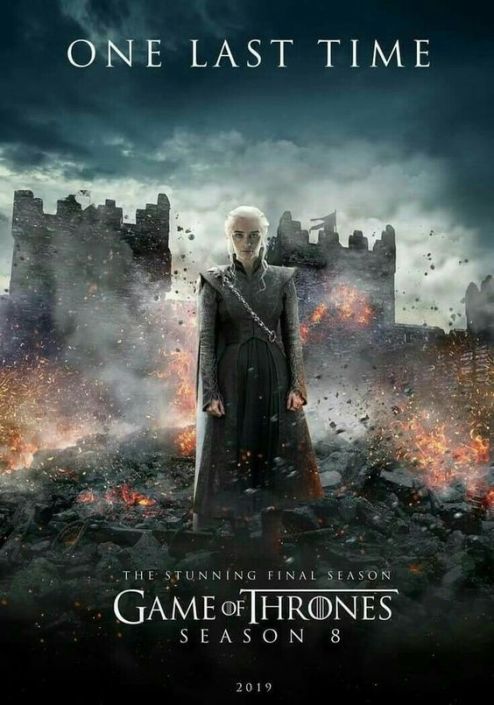
“Game of Thrones” Season 8 (2019) was a Greek tragedy. And I’m fine with that.

I’ve read and heard so many of the popular complaints about Season 8 of “Game of Thrones.”  Most of them are understandable.  A couple I agree with.  But I’m not on board with panning this six-episode final season.  Even with my own reservations about it, I still loved enough to rate it a 10 out of 10.

By far and away, of course, the part of Season 8 that has people up in arms is a major story development in its final two episodes.  (You almost certainly know what it is; because fans are complaining about it everywhere.  I’m not sure why I am trying so hard to keep this review spoiler-free.)  It was a bombshell, and it was damned saddening, and even I’ll admit that it affected my enjoyment of everything that transpired until the credits rolled for the last time.

But I made peace with it quickly.  (Granted, the character who figured the most prominently here was not my favorite, so it was a little easier for me to do so.)

I think it boils down to a matter of taste — specifically what you wanted out of “Game of Thrones.”  I like tragedies.  I love pathos in stories, whether they’re books, movies or television shows.  Stories that end badly aren’t bad stories.  One of the things that excited me about “Game of Thrones” since its second season was how it so often took the traditional elements of fantasy and fairy tales and turned them on their head with a brutal, unexpected (yet reasonable) conclusion to a story arc.  (I wasn’t fanatical about the show during Season 1, which overwhelmed me with exposition and plotting.)

The show has always tried to give us stories that were complex or ambiguous in terms of character, theme, setting and resolution.  One of the things that I tell people who have never watched the show is this — it is almost never as simple as “the good guys vs. the bad guys.”  Instead, it parallels human interaction in the real world — there are disparate groups and individuals fighting and aiding one another out of self-interest or philosophy.  The character turns and story turns that we saw in the last two episodes … somewhat parallel what we’ve seen in and heard on this show before.  As Ramsay Bolton said back in Season 3, “If you think this has a happy ending, you haven’t been paying attention.”

“Game of Thrones” was a Greek tragedy.  This last season’s classical plot resolution was arguably perfect for the show’s sweeping fantasy epic masterpiece.  The ending didn’t make me happy.  But it impressed me and affected me and made me think.  This was a fantasy show for adults.  It was an edgier, less predictable, more provocative alternative to “The Lord of the Rings” in all of that epic’s incarnations.  I far prefer the ending I saw to a pandering, cookie-cutter “happily ever after.”

And the show has indeed hinted at the outcomes we see in the final two episodes.  It’s been doing so for years, not just with major events but also with obvious dialogue.  I kept asking one other fan in particular, “Are you seeing what I’m seeing?”  But he didn’t.  Maybe a lot of fans didn’t.

If you tell me that a certain character decision was made too abruptly, with insufficient buildup, I hear you.  But, in the real world, I’m inclined to think that the internal processes we witness in the penultimate episode are often completely invisible.

If I had any complaints about Season 8, they lay elsewhere.  I simply cannot understand why this was six episodes instead of 10.  The two major battles we see each occupy one episode.  Why?  Even with a longer running time for each episode, this season felt rushed and truncated.  It still bothers me, even as I write this.

I had the same quibble as everyone else about the Battle of Winterfell being difficult to follow, but I’m willing to accept that this was a deliberate stylistic choice.  (And although I loved both major battles this season, I think the show’s three prior major land engagements were superior.  The Massacre at Hardhome, the Battle of the Bastards and the Attack on the Rose Road were all so well choreographed and scored that they were just too difficult to surpass.)  I even had my own disappointments for the outcomes we see for various characters.

I consequently almost rated the eighth season a 9 out of 10, instead of a perfect 10.  But I couldn’t.  I loved Season 8 too much.  It wasn’t perfect, but it was … still so damned riveting and enjoyable.  It was still “Game of Thrones,” with all of the attention to story and detail and performances that I’d come to love.  It was still the best thing on television.
 

7266820ea23a32cfa984e7be5e1450f0

A very short review of the premiere of HBO’s “Chernobyl” (2019)

I’m arriving at the opinion that Jared Harris is one of the finest actors working today.  His performance in last year’s “The Terror” was nothing short of beautiful.  So I tuned in the other night to the first episode of HBO’s “Chernobyl” miniseries, in which he is the protagonist.

I wasn’t disappointed.  “Chernobyl” is gripping.  I’m no expert about the 1986 nuclear disaster in the Soviet Union, but this certainly comes across like a meticulous historical adaptation.  But what’s surprising is how its smart, relatively spare script moves so quickly and so adeptly incorporates the human horror of the event.  (After a brief prologue with Harris’ voiceover, the story begins almost immediately with the accident occurring.)  The plot points that follow are by necessity mostly technical.  But the pitch-perfect writing here makes the story quite easy to follow.

It’s gut-wrenching stuff — made even more frightening by the Soviet administrators who cared little about whether the power plant’s workers died an agonizing death.  It’s the kind of story that would be frightening even if it were pure fiction.  But the program’s authenticity and attention to detail are constantly present to remind you that it is not.

There’s some impressive camera work, too — especially the final shot, which will feel like a punch in the stomach.

I’d rate this a 9 out of 10, and I highly recommend it.


chernobylposter

Cover to “Entertainment Weekly,” March 15, 2019

Variant (Arya).

031519.COVER.GOT.LO.indd

Cover to “Entertainment Weekly,” March 15, 2019

Variant (Cersei).

031519.COVER.GOT.LO.indd

Rest easy, Peter Mayhew.

1944 – 2019.

[Update: I didn’t create this meme, and I don’t know its author; I shared it from Facebook.]

58586736_10155791526500388_405678013502455808_n