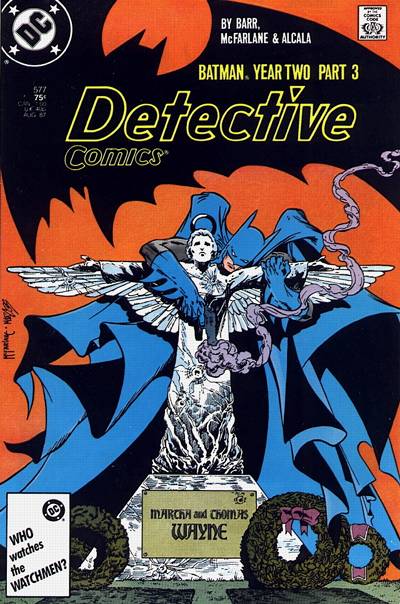
DC Comics. Part of the “Batman: Year Two” storyline.
I keep thinking of Todd McFarlane as a 90’s phenomenon, because that was when I started reading comics. It’s weird seeing a cover by him that was published when I was in high school.
The weed of crime bears bitter fruit. Crime does not pay.
Dabbling in old time radio inevitably brought me to “The Shadow” — a character I’d heard about periodically when I was growing up. My Dad had been a fan of the radio program and film serials when he was a kid, and he was fond of rattling off that tagline you see in this blog post’s headline. (The radio shows were broadcast in to the mid-1950’s, long after they started in 1937.) I also remember the character from the truly unfortunate 1994 feature film with Alec Baldwin, which I actually saw in the theater with my college girlfriend. (The less said, the better. About the movie, I mean.) The Shadow is also cited periodically as an influence in the creation of my own favorite iconic dark detective, Batman.
The Shadow has a loooooooong, varied and occasionally confusing history – spanning radio, pulp magazines, comic books, television and film. He’s still being portrayed in comics. DC Comics released a crossover with Batman last year that looks interesting, and the incomparable Matt Wagner produced a couple of books in 2015 and 2016 that I’d love to get my hands on. (He fights Grendel!!!)
The radio shows are a lot if fun, just like the antique horror and mystery programs that I’ve linked to here at the blog. And, just like those, they’re easily found on Internet. (How my Dad might have marveled at that!) They’re definitely more campy. And I suppose that makes sense, as they seem aimed at children, whereas the horror shows seem intended for general audiences or just adults. The period commercials for Blue Coal are a weird glimpse into the past, too. If I had to name one thing that I found annoying about all of the old time radio shows I’ve found, it’s the omnipresence of that damned organ music. (Was it just a cultural staple of the time?)
If “The Shadow’s” stories are a bit hokey, the show’s voice acting and production are just terrific. I particularly like the actor performing The Shadow for the episode in the first link below — “Death is a Colored Dream” (1948). I believe it is Bret Morrison. (And I was surprised to learn that the famous Orson Welles only voiced the character for a year or so a decade earlier.)
But what’s most interesting is the character’s inception. He didn’t start out as a character in a story at all … “The Shadow” was simply the name of the generic host for a series of unrelated mystery stories comprising “The Detective Story Hour” in 1930. After a surprising fanbase developed around the creepy-sounding host (voiced at the time by Frank Readick, Jr.), people started asking for stories featuring “The Shadow” at the news stand. Street & Smith commissioned writer Walter B. Gibson to write up some tales featuring a supernatural detective; the first came out in 1931. The iconic character was just sort of made-to-order for confused customers who might have thought he already existed. That “Shadow” later arrived at the airwaves in 1937, with Welles voicing him.
Seriously, though, I totally need to get my hands on “Grendel vs. The Shadow.”
My buddies and I have “Avengers” fever. We can barely wait to see “Avengers: Infinity War,” which opens tonight, and answer some burning questions. I myself want to know how the relatively humble Captain America can deflect a blow from Thanos’ omnipotence-granting Infinity Gauntlet (as depicted in the trailer). Meanwhile, a pal of mine insists it’s possible that some iteration of the Venom alien symbiote will make an appearance — even though that character is owned separately by Sony Pictures. (I’m inclined to think that this is wishful thinking.)
I was actually around for the 1991 debut of “The Infinity Gauntlet” — the six-issue 1991 crossover series upon which this movie is based. (“The Infinity War” was actually a sequel comic crossover that Marvel released a year later.) An upperclassman upstairs in my sophomore dorm lent it to me, and it pretty much blew my mind. I had only recently discovered that the characters owned by the “big two” comic book companies inhabited shared universes. (DC Comics has released its own universe-wide crossover series at about the same time — “Armageddon 2001,” a series I still love, despite other fans’ contempt for it.) I had read a lot of comic books growing up, but they were usually war comics or horror comics; superheroes had always seemed lame to me when I was a kid.
“The Infinity Gauntlet” was thick stuff, as comics went. The sheer number of characters involved (and an abundance of cosmic characters) made it a little hard to follow for a reader new to Marvel. (DC’s major characters were fewer, more familiar and easier to understand.)
But it was still a load of fun. I still think it’s messed up what Thanos did to poor goddam Wolverine, who’d skillfully gotten the drop on him at first.