Tag Archives: Eric Robert Nolan

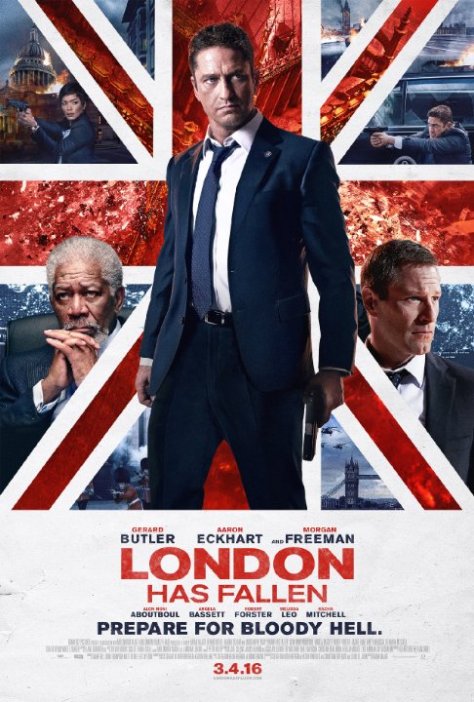
A quick review of “London Has Fallen” (2016)

“London Has Fallen” (2016) includes two very good action sequences.  The first is an establishing major action set piece in which a state funeral in London is the occasion of a major terror attack.  (SPOILER!)  The second is a finale that should really please action fans — it’s fun and exciting to watch; the first-person-shooter style of it actually works, rather than coming across as cheesy.

That’s probably about all the positive things I could say about it … as others warned me, it was a pretty brainless movie.  It’s a thin, poorly scripted story that isn’t nearly in the same league as 2013’s outstanding “Olympus Has Fallen.”  The dialogue is painful to hear.  And that’s especially sad considering that the film’s two fine lead actors (Gerard Butler and Aaron Eckhart) have terrific chemistry with each other.

The terrorists pull off an operation that is logistically incredible in this movie.  No exposition is given about how the @#%$ they accomplished what they did, and in so little time.  (Two years to put those assets in place?)

How does the entire population of London become invisible within minutes — even if they were told to stay indoors?  Why did this movie suddenly turn into “The Quiet Earth” (1985)?

Am I mistaken, or did a Butler’s Secret Service Agent actually tell the terrorists exactly where he and the president were, as part of a macho personal challenge?

And if Butler and Eckhart are alone and on the run on the streets of London, doesn’t it make sense to seek refuge in a random home or apartment?  The odds are astronomical that they person from whom they’d seek quarter would be in league with the bad guys.

I’d rate this movie a 6 out of 10.  Honestly?  I’d really recommend you wait until it comes out on DVD.  Then watch only the opening and closing set pieces, and imagine your own coherent story and engaging dialogue in between.  You’ll enjoy it more.


MV5BMTY1ODY2MTgwM15BMl5BanBnXkFtZTgwOTY3Nzc3NzE@._V1_SX640_SY720_

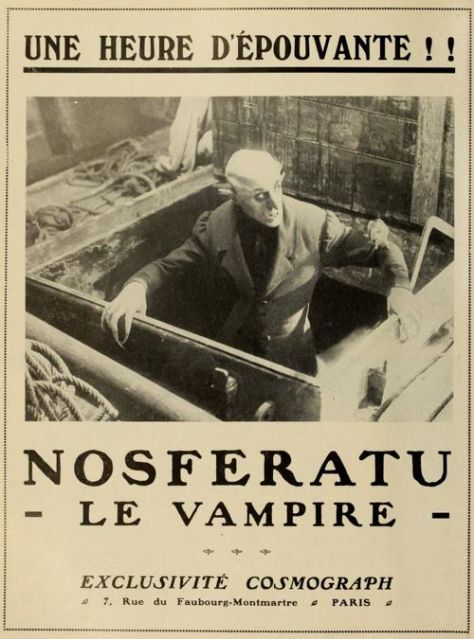
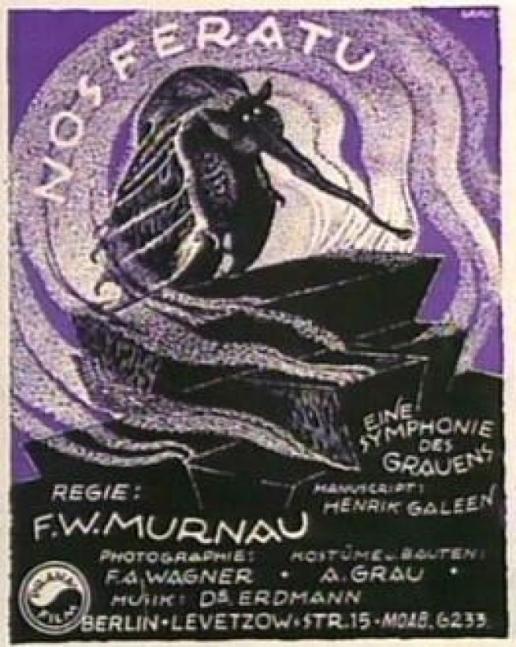
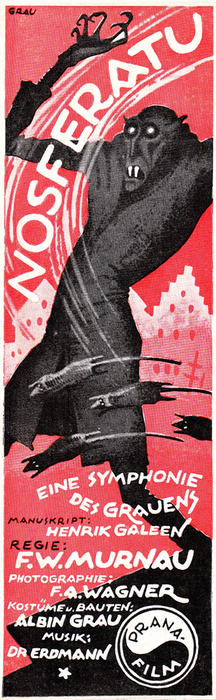
Vintage “Nosferatu” posters.

Just for fun, here are a few images of period-era posters for F. W. Murnau’s “Nosferatu: eine Symphonie des Grauens” (1922).

I’d love to have one (or more!) of these professionally framed.  Anyone aspiring to be my wealthy patron, get right on that.


c58bbb332f1aad79f96a96b66b1e37d0

3085359_640px

d42c384a26b54d84366a92ffda007484

nosfera1

nosferatu_1922_tall_poster1


“Blue Wolves Move In An Indigo Wood,” by Eric Robert Nolan

Blue Wolves Move In An Indigo Wood

               “Show me a sane man and I will cure him for you.”
                    — Carl Gustav Jung

All the colors are off —
Blue wolves move in an indigo wood
Their cobalt backs arrive, arising
Like coarse dorsal fins over
low-lying orange flora,
their beryl heads hung low — every
aquiline cerulean nose is angled down —
tracing the escape of a flaming hare —
their racing red rabbit has evaded them again.

Dreams leave all our long nights’ inner canvases
in singular tints and incongruous
strange iridescence.
Reason, here, is pariah.
Senses are its surrogates.
Vision its impostor
in the illogic’s ether:

Slow stars arc in scarlet.
Racing sable comets
make black wakes against
blinding white night.
A full moon rises in violet —
the fat and full and low-lying fruit of a
dark and overripe plum.

Yellow bucks bounce
high and away in the wolves’ wake —
sun-colored stags beat bright retreat
a running herd of burning gold —
all sunlit sinewed limbs and flashing hooves.

Flurries of green quail flutter,
flushed from fushia grasses —
alate bladed emeralds, blazing away.
The verdant birds burnish silhouettes —
angles on lunar lavender.

But ever all the blue wolves ignore the moon.
Each arrows forth in formation
ardently advancing —
oblivious to bucks and disregarding birds.
It’s the hare that they’re after —
its crimson prints
lure azure noses
and bait the ordered forward pace
of the great broad and blue padded paws.

In a surprising eloquence,
one predator’s head
rises and sonorously
sounds its disinterest.

“See, then, dreamer, see,
“what evades the lucid wit at dawn.
“The obvious moon is the obvious girl;
“your love is a glaring suggestion —
“as bare-faced and as common
“as a hundred thousand loves that came before — her face
“turning and facing away is as plain
“as a routine moonrise, but we,
“we are the Jungian Shadow.
“And our red hare is your red hare
“And hare for one and all.”

The predator’s head is an arrow —
its broad blue ears angle back
as its blue nose rises and scents.
And its voice is song.

“See then, dreamer, see
“what confounds the heart at noon.
“The stags to which we’re indifferent
“Are the heroes of your childhood.
“The flight of every bird is your every
“moment of loss, but we,
“we are the Jungian Shadow.
“And our red hare is your red hare
“and hare for one and all.”

Then the blue nose dips
to sniff the ground again
in the predator’s diligence. If
this wolf’s tones were physical,
they would be blue tears.

“See then, dreamer, see
“what escapes the brain at day, see,
“Arriving at your reservoir,
“that its pedestrian waters
“though shallow, still may drown
“in existential death, so rather
“hunt at its circumference
“the red of a Collective hope.
“We are the Jungian Shadow.
“And our red hare is your red hare
“and hare for one and all.”

Finally its eyes soften,
running from burning blue cobalt
to the warm sky-blue of hopeful new boyhood summers, and yet,
its sad irises reflect
a distant dancing red:
a spinning flame –a prancing hare.

“See, then, dreamer, see
“what renders your pain as prosaic —
“the racing red flame of the hare.
“It might have tempted Ovid once
“or pained the painters of caves,
“baiting them as their discovered fire
“first turned stone to a nocturnal
“canvas — the clay
“reddened their hands but they
“could only glimpse an inner quarry,
“as you glimpse it, now,
“turning away
“from your minutiae.”

“See, then, dreamer, see.
“See a universal grief
“and a shared catharsis
“rendered in red in your sleep:
“blood red, the color of prey,
“sunset red at end of day,
“flame, the color of pain
“and, yet, created light.

“See, then, dreamer, see.
“Hunt with us and hear our call.
“Our red hare is your red hare
“and hare for one and all.”

— (c) Eric Robert Nolan 2016


WOLF_TRACKS_ALONG_THE_SHORE_OF_A_LAKE_NEAR_MILE_141._PUMP_STATION_14_WILL_BE_BUILT_ATOP_THE_HILL_OVERLOOKING_THIS..._-_NARA_-_550492

Photo credit: By Dennis Cowals, 1945-, Photographer (NARA record: 2196327) (U.S. National Archives and Records Administration) [Public domain], via Wikimedia Commons.
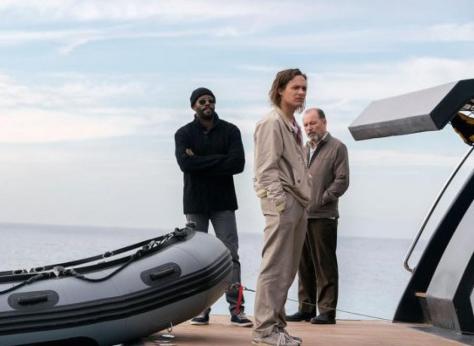
A review of the Season 2 premiere of “Fear the Walking Dead.”

[THIS REVIEW CONTAINS SPOILERS FOR SEASON 1 OF “FEAR THE WALKING DEAD.”]  “Fear the Walking Dead” has done something interesting.  It’s taken two truly reprehensible characters, and made them the most attractive among an ensemble of protagonists in a survival-horror story.

I’m talking about Victor Strand and the young, troubled, drug-addicted Nick, who I’ve been reluctantly but undeniably rooting for since the closing episodes of last season.  They’re both expertly played, by Colman Domingo and Frank Dillane, respectively.  Colman is actually amazing: his deep voice and perfect line delivery should make him a leading man here or elsewhere, either as a hero or a villain.  In just a couple of episodes, he’s easily become one of the best things about the show.

But these aren’t “good guys.”  Or, at least I don’t think they are.  Are they?  Strand is openly a sociopath, and doesn’t even bother to hide it.  He appears to act nobly in rescuing the group.  But as Ruben Blades’ character, Salazar, shrewdly observes, he is almost certainly acting somehow according to his own self-interests.  (And Salazar has been right about these kinds of things so far.)

As for Nick?  No, I am definitely not judging the character about his addiction to illegal drugs.  That would make him a flawed protagonist, not a bad guy.  I’m talking about his demonstrated willingness in Season 1 to victimize the helpless in order to feed that addiction — he does nothing less than kill a sick, elderly man in order to get his “fix.”  (I did understand that scene, didn’t I?)

And what about Salazar himself?  He is easily the third most interesting character to me, and he’s perfectly portrayed by Blades.  I want him to survive this show’s zombie apocalypse, simply because I enjoy watching him so much.  He’s a former torturer for the El Salvadoran junta.  That’s … that’s pretty much as bad as you can get, isn’t it?  And this isn’t a character aspect that the viewer can easily put aside, as audiences did with the character of Sayid on “Lost.”  (He was a past torturer with Saddam Hussein’s Republican Guard.)  Salazar’s deplorable skills are front and center at the end of the show’s first season, driving the plot.)

There’s nothing pathological about my attraction to these characters.  (And I’m sure it’s shared by other viewers.)  It’s just that these are creatively conceived characters on a show that seems to bungle its efforts to create anything resembling or interesting likable good guys.  The remaining protagonists of “Fear the Walking Dead” are written to be utterly bland, even when they are very well portrayed by their actors.  Travis (Cliff Curtis) is a one-note altruist.  Madison (Kim Dickens) shows promise, but isn’t yet that interesting to watch.  Alycia (Alycia Debnam-Carey) is a boring nice-girl.  Ofelia (Mercedes Mason) is so forgettable that I can’t really remember how to describe her as I write this.

The worst offender, by far, though, is the character of Chris.  I can’t imagine how dreadful a job it must be for actor Lorenzo James Henrie to play him.  He’s an utterly punchable brat — an entitled, immature, self-absorbed teenager that makes you root for any zombies that pursuing him.  I can’t imagine the show’s writers created him to be sympathetic … surely they must be setting him up as zombie fodder.

All told, though, the Season 2 opener last Sunday was good stuff.  I’d rate it an 8 out of 10.  Fans who were frustrated with Season 1’s slow pace (I wasn’t) will be pleased to discover that the show opens with an action sequence and a pretty skilled depiction of the destruction of Los Angeles.  No, the show doesn’t have the same special effects budget as a major feature film.  But this was still impressive — we get to see some of the destruction and mayhem that’s only been alluded to or briefly, limitedly portrayed via flashback throughout six years of “The Walking Dead.”  (Remember the faraway shots of the bombing of Atlanta?)

The suspense is also quite good.  I can’t really say much more for fear of spoilers.  But I thought it was well written and intelligent, and I think it will please even seasoned fans of the zombie horror sub-genre.

This was pretty decent stuff.  I think Season 2 should be a fun ride.


fear-the-walking-dead-season-2-key-art-logo-400x600


victor-nick-and-daniel-prepare-for-the-journey

Nolanferatu’s tip for a trippy vintage horror double feature!

Well there’s one thing I can cross off my bucket list.  (There’s a lot on there, and some of it’s weird.)  I finally saw F.W. Murnau’s “Nosferatu: ein Symphonie des Grauens” (1922).

And am I damn glad I did!  I actually enjoyed it more than I thought I would.  I love plenty of classic movies; “The 39 Steps” (1939) and “To Have and Have Not” (1944) are among my all-time favorites.  But I’m accustomed to modern horror — my tastes generally extend only as far back as “The Birds” (1963) and “Night of the Living Dead” (1968).

I waited until I was in just the right mood.  (This is the first silent film I’ve ever seen from start to finish — the only exception being Mel Brooks’ 1976 parody, “Silent Movie.”)  Then I began it shortly before midnight.

The movie just worked for me. It was sublimely creepy.

I think it helped that the grainy, flickering, black-and-white period footage made this expressionist movie utterly atmospheric for a modern viewer.  These, combined with the shots of Max Schreck superbly made up as “Count Orlok,” were damned unsettling.  Schreck also appeared to be a great physical actor, with his gaunt stance and stilted, inhuman movements.  (Was he unusually tall too?)

The vintage footage also enhanced my enjoyment of the movie in a way that Murnau probably couldn’t have expected.  I know this is strange, but … nearly a century later, the thought that occurred to me several times during this movie was this: “Everyone involved in this production is long dead by now.”  Yes, I know that is a morbid thought — I’ve never done that before!  I think it was just the film itself that did that to me — it’s about undeath and immortality, after all.

It also helped that I’d read Bram Stoker’s “Dracula” (1897), of which this film is an unauthorized adaptation.  The resulting lawsuit by Stoker’s estate is interesting reading: supposedly all copies of the movie were ordered by the courts to be destroyed, bankrupting Prana, the production company.  But a permanent cult following developed for the few surviving prints.

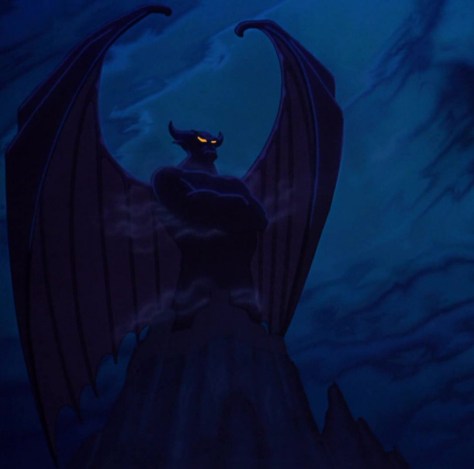
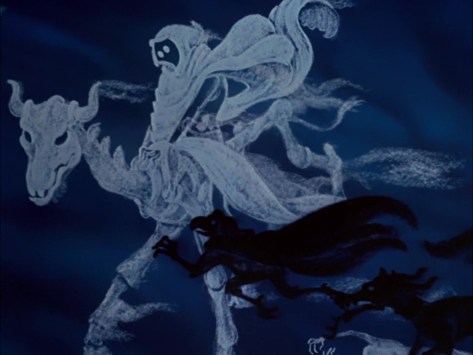
Anyway, I followed this up with the palate-cleansing “Night on Bald Mountain,” the final segment of Disney’s “Fantasia” (1944).  That combination, too, totally worked for me — I followed up the black-and-white nightmare-fuel of the seminal vampire film with some vivid, incongruously hellish Disney nightmare-fuel.

“Nosferatu” is in the public domain.  You can view the entire film on Youtube at the link below.


nosferatu

c1402340b6a518f114e12da99fefa1e8

download

nosferatu10

nosferatu-1922

Fantasia-Night-on-Bald-Mountain-864x855

night-on-bald-mountain-ave-maria-078

bald-mountain_harpy2

night-on-bald-mountain


Throwback Thursday: Balsa Wood Gliders

This meme says the “THE 70’S,” but I encountered a little boy playing with something kind of like a balsa wood glider yesterday!  I told him how much I loved these when I was his age.

His was a bit fancier — it might have been made of thin plastic.  The gliders that I received from visiting aunts and grandparents were like the mostly unadorned balsa wood jobby that you see below.  It came in a long plastic sleeve like the one pictured, and you had to assemble it yourself.  (It wasn’t quite as high tech as the X-Box.)

Loop-de-loops were damn fun.  It was slightly less fun seeing it snap off a wing or fin after a nosedive.  Note to any well meaning aunts or uncles who might spy a balsa wood glider, if they’re still around:  buy a couple of them for that kid in your life — these things break easily.


12342655_1031432936917687_2523498639771454225_n

Stay current with Nolan’s newest nerd verses (2016).

2016 has been good to me so far; I’ve been lucky to have a few pieces published since the start of the year.  If you like my poetry and care to peruse my publications since January 1st, then just click the link below:

My poetry, from 2016

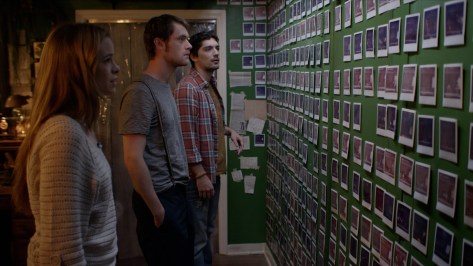
A very quick review of “Time Lapse” (2014)

Despite it being highly recommended, I almost stopped watching “Time Lapse” (2014) after a few minutes.  But I’m glad I stayed with it — it’s a smart, damn fun and unexpectedly dark time-machine tale that transcends its microbudget to become edgy and entertaining.  I’d give it an 8 out of 10.

It begins weakly.  A few strictly average actors perform what seems like a weak script right out of a sitcom doomed to cancellation.  Its premise seems cheesy — three friends discover a mysterious camera that can take pictures of its subject as it will be 24 hours into the future.  Its plot sounds trite and unwieldy.  (They send themselves photographed notes containing advice from their future selves.)  Even the film’s minimalist set (the movie appears to have only two of them) seems to betray the threadbare budget of an earnest-but-average film school project.

But, damn, was I pleasantly proven wrong.  The script turns out to be quite strong, inviting the viewer down a progressively frightening and maddening rabbit hole alongside its characters.  The acting improves, as George Finn settles into his role as the greedy, impulsive and least stable of the trio.  (Trust me, this isn’t just a cliche sci-fi morality tale about greed; the movie has far more to offer than that.)  Then Jason Spisak arrives and masterfully almost steals the entire movie, chewing the scenery as a fabulously frightening bad guy.

The last shot of this movie is absolutely killer.

Seriously, check this film out.  It deserves its positive press, and I guarantee it’ll at least surprise you with how good it becomes.


Time-Lapse-Still

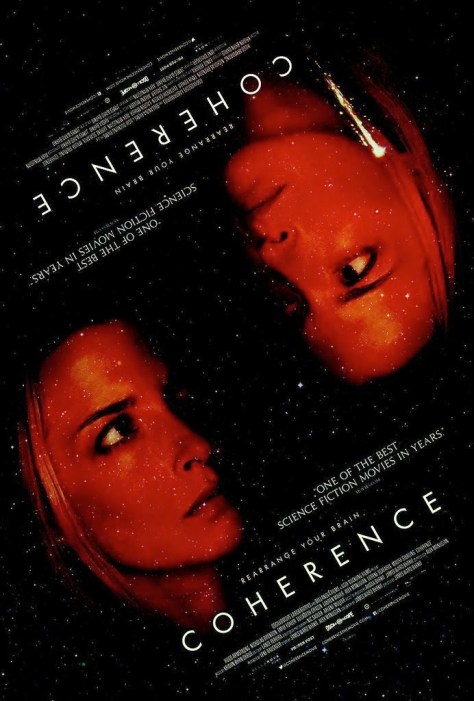
A very short review of “Coherence” (2013)

James Ward Byrkit wrote the screenplay for “Coherence” (2013), then filmed and directed it on a shoestring budget in his living room.  And the result is pretty impressive — this a trippy, unusual, and unusually cerebral science fiction thriller.  I’d rate it an 8 out of 10.

The movie portrays eight friends at a dinner party who find their sense of reality frighteningly altered after a comet flies overhead.  I really can’t write much more than that without spoilers — even this movie’s central story device is best arrived at as a surprise for the viewer.    I don’t even want to name which “science” serves as the basis for the “science fiction” here, as that would be a big hint as to what transpires.

It’s pretty good.  The thriller elements here are creepy.  And it’s a wonderfully intelligent “what-if?” story that other reviewers have compared to “The Twilight Zone” episodes.  (I myself … mostly kept up with it — I was sometimes a little murky about the strategies adopted by the group to address their predicament.)

The closing minutes are damned good.

I’d recommend this to sci-fi fans looking for a unique, dialogue-driven brain-buster.

Hey, just for fun, consider this — the refreshingly intelligent “Coherence” employs the exact same MacGuffin as one of the stupidest, overrated cult “classics” of all time — 1984’s “Night of the Comet.”


coherence-poster

“The Revenant” (2015) was astonishingly good.

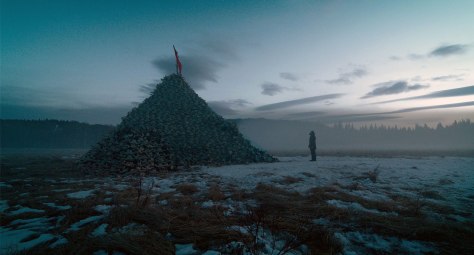
“The Revenant” (2015) changed the way that I see movies.  This utterly immersive, jaw-droppingly gorgeous period thriller is easily one of the best films I’ve ever seen, and I plan to see it again, soon.  I’d rate it a perfect 10.

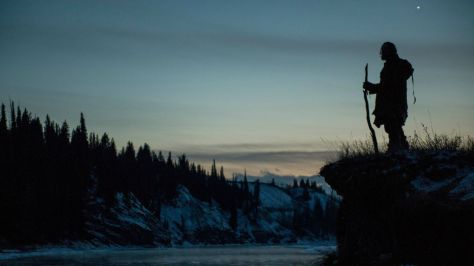
It’s a visual masterpiece.  Its cinematography renders its mountains, valleys and plains both dreamlike and lucid, and its action is unflinchingly visceral.  Shot mostly in Alberta, Canada (standing in for 1823 Montana and South Dakota), the film’s visuals are more stunning than anything I’ve ever seen.  You truly do feel that “you are there.”  But “there” is an absolutely brutal 19th century middle American winter wilderness.  It’s fatally dangerous, both with its unforgiving elements and with the human violence that seems to erupt casually and constantly over its land and resources — not to mention bloody retribution among groups and individuals.  This isn’t a movie for the faint of heart.  I won’t spoil the subject of its gut-wrenching action sequences for fear of spoilers — most of these sequences arrive as frightening surprises, thanks to Alejandro G. Inarritu’s expert direction.  It is this juxtaposition of beauty and brutality that define the movie.

Leonardo DiCaprio plays Hugh Glass, an American trapper who begins as one of the seemingly few characters that do not quickly resort to unnecessary violence, prejudice or revenge.  He later does seek vengeance for his son’s death against fellow trapper John Fitzgerald, played by Tom Hardy.  (Glass was a real frontiersman who was the subject of Michael Punke’s 2002 biography, “The Revenant.”  But a cursory Google search suggests to me that this is not actually “a true story;” I think of it as loosely based historical fiction.)  Like DiCaprio and Hardy, Domhnall Gleeson and Will Poulter also excel in their supporting roles.  (Gleeson seems to specialize in playing reluctant innocents; I remember him from his skilled performance as the gentle young computer genius in last year’s outstanding science fiction thriller, “Ex Machina.”)

But the main star of “The Revenant” is the setting itself, beautifully shot by Emmanuel Lebezki and masterfully employed by Inarritu as a kind of character unto itself in the story.  It’s lovely.  I’ve never seen a movie like this.  And while I’m no film connoisseur, or even a genuine critic, I’ve seen a lot of good ones.

The direction most reminds me of Francis Ford Coppola’s work in 1979’s “Apocalypse Now.”  I was also reminded of Stanley Kubrick’s “The Shining” (1980) — that was a film that also depicted threatening snowscapes as dreamlike and eerily beautiful.  There was one shot near the end, following DiCaprio’s vengeful hero on his path through immense firs on either side — it reminded me a lot of Jack Nicholson’s murderous Jack Torrance on his path through the hellish hedge labyrinth.

There is also a central action set piece involving an attack on one group of characters on another — it actually reminded me of Oliver Stone’s work in “Platoon” (1986).  Like Stone’s finale, the battle is staged so that the viewers have no sense of which direction the attack is coming from, paralleling the experience of the confused defenders.  There are countless long tracking shots throughout this film, with fewer cuts — and amazing circular surrounding shots of the action.  I’ve read that Inarritu actually had to transport cranes to his mountaintop shooting locations in order to execute those.

If you had to find a flaw with “The Revenant,” I suppose you could complain that its story and characters are thin.  We know little more about DiCaprio’s Glass beyond that he is competent, patient and slow to fight — then merciless and unrelenting in seeking justice.  Poulter’s Jim Bridger  is loyal, but not as strong as the hero.  Hardy’s Fitzgerald is a greedy, opportunistic bully whose murder of an innocent drives the plot.  That’s … little more than the plot and characters of a lot of throwaway westerns, isn’t it?  (I’ve indeed seen this movie categorized as a western in reviews.  That’s technically correct, I guess, but it feels too unique to pigeonhole that way.)

You could easily read the movie for moral ambiguity.  There are the obvious issues connected with revenge, of course, underscored by a final shot in which one character appears to break the fourth wall.  I found myself wondering about Glass’ compatriots.  Yes, it is Fitzgerald who acts villainously, but all of Glass’ fellow trappers also consign him to death by abandoning him after his injuries.  I do understand that they feel they can’t survive themselves if they try to carry him back to their staging area at Fort Kiowa.  But … is what they do “right?”  What would you or I do?

I think I am coming too close here to revealing too much about the film.  The best way to experience “The Revenant” is to walk into it knowing little about it.  I strongly recommend you do so.


revenant-poster

The-Revenant-03

the-revenant-trailer-screencaps-dicaprio-hardy6

revenant-horse-xlarge

revenant

24115986425_3e247de327_b