Tag Archives: review

A very short review of the pilot for “The Man in the High Castle” (2015)

My reaction to the pilot episode of “The Man in the High Castle” (2015) here will be brief.  I am inclined only to praise it, and that would just be redundant with the accolades already heaped upon it by better reviewers than me.  (Yes, I still have only seen the first ep.)

It’s wonderfully well written, directed and performed, with some layered world-building and unexpectedly interesting character interaction (particularly among the bad guys).  I’d give it a 9 out of 10.

I might not be quite as confident as other viewers, however, that this show can continue to sustain my interest at this level.  The espionage subplots are well executed, but seem by the numbers.  The world has seen a hell of a lot of spy fiction and cinema since Philip K. Dick wrote this source material in 1962.  It might be tough to keep those elements fresh.  And this might be an even greater challenge for a story somewhat constricted by 1960’s-era technology, as opposed to a modern technothriller.


hqdefault

A quick review of “Re-Kill” (2015)

I want to give “Re-Kill” (2015) more than a 5 out of 10 rating.  I do.  It’s an ambitious post-apocalyptic independent zombie film that earnestly and unpretentiously tries to give fans of the subgenre everything they’re asking for: great action, decent makeup effects, gore, good scares and lots of creative world-building, all culminating in a nifty little sci-fi subplot that isn’t stupid and isn’t too forced.

There’s a wealth of fun ideas here — the original story was obviously developed by people with a love for zombie tales.  We follow a “COPS”-style reality-TV program documenting a”Re-Kill” unit, a squad of specially trained commandos who repel brushfire outbreaks during a global, stalemated war between the living and the dead.  They “rekill” the “re-ans,” this universe’s slang for re-animated dead.

We see the entire program, complete with commercials from this fictional world: PSA’s to encourage people to have sex (in order to repopulate the world), and drug companies opportunistically pushing drugs for PTSD and depression.  My favorite was an ad for a Desert Eagle sidearm marketed to protective mothers, “for the children.”  We get wicked-cool peeks into a fairly detailed fictional world, including the activities of the police, the military, the media and civilians.

This would have made a fine book series, in the manner of Max Brooks’ “World War Z.”  Or it would make a terrific TV series … like a far faster paced and more expansive equivalent of “The Walking Dead.”

Tragically, though, this movie’s execution is too often lacking.  The acting is sometimes poor (but not from the always awesome Roger Cross, who you and I know as Curtis Manning from “24.”)  The script has problems.  And worst of all is the absolutely unnecessary shaky-cam directing.  This movie could have been a fantastic action-horror flick … if only we were able to see the action a little better.  The style of shooting here was a disastrous creative decision.

Oh, well.  It’s still a fun watch for hardcore zombie fans.


ReKill_poster


A quick review of “The Godsend” (1980)

A picnicking English family encounters a mysterious, pregnant young woman in a meadow.  Her behavior is strange, and the little she says is puzzling.  They take her home, and are then surprised when she suddenly gives birth to an infant girl there.  Then she inexplicably vanishes.

The couple, who already have five children, adopt the baby as their sixth.  But their unusually large family begins to be depleted, after their biological children die, one by one, under mysterious circumstances.

That’s the premise of “The Godsend” (1980).  You’ve got to admit, that is chilling, and it held my attention throughout the length of this passably entertaining movie.  It has an interesting story setup, and there is at least one truly frightening sequence at the story’s end.  In addition, the spooky young mother is effectively played, however briefly, by Angela Pleasence, daughter of Donald Pleasence.

But I doubt this will wind up on many top ten lists.  It’s thinly scripted, slowly paced, and features two parents who seem minimally affected by the deaths of their children.  It’s also too derivative of its obvious inspiration, “The Omen” (1976).

I’d give it a 6 out of 10.


MV5BNTI2MDMyNzI5MF5BMl5BanBnXkFtZTcwNTE3ODA0MQ@@._V1_SY317_CR13,0,214,317_AL_


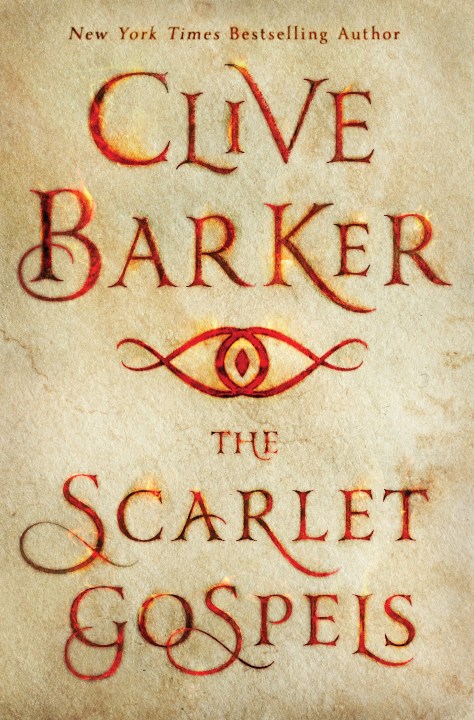
Check out a terrific review of Clive Barker’s “The Scarlet Gospels.”

Dennis Villelmi has published a great review of “The Scarlet Gospels,” by Clive Barker.

Trust me – I’ve known Dennis for a while, and he’s an expert on Clive Barker.

Click the link to see the review over at Gruemonkey.com:

THE GOSPEL ACCORDING TO CLIVE


9781250055804_FC-4

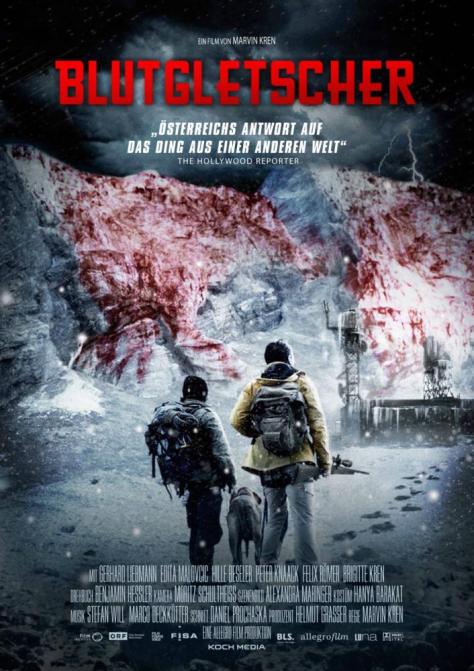
My review of “Blood Glacier” (2013), with general spoilers

[The following review contains general spoilers.]

I want to love “Blutgletscher” (“Blood Glacier”), an earnestly made independent German science fiction-horror film from 2013.  I just can’t ignore its flaws, however, and I’ve got to settle on a giving it a 6 out of 10.

It has so much going for it.  There’s a freezing, arctic-like location.  (This time out, we’re in the mountains of Austria.)  There’s a nifty, nasty sci-fi plot device.  There’s a variety of gooey monsters.  It’s creepy and atmospheric — a group of protagonists huddle in an isolated location while the wind howls outside on a cold night.  There’s a cunning everyman antihero.  All of these are rendered by a reasonably intelligent script that lets “Blood Glacier” rise above the level of a horror-comedy.

But its flaws make me hesitate to recommend it.  It’s poorly paced, for example, and it’s sometimes confusingly plotted.  One person assailed by the creepy-crawlies emerges as kind of villain, but the character’s motivations are never clear.  Also, why is another character consistently a idiot?  Is he just a really dumb scientist?  And the ending shows otherwise intelligent people doing something incredibly ill advised.

And I was puzzled by the special effects.  At times, they were actually damn good!  But at many points in the movie (as so many other reviews will point out) they were downright poor.  I kept thinking that they looked like papier mache props in a high school play.

Additionally, (and this can’t be the fault of the filmmakers) the version of “Blood Glacier” that I watched had incredibly poor English-language dubbing.  The actors on screen (especially Gerhard Liebmann and Briggite Kren) did a fine job, but their corresponding voice actors had … no talent or enthusiasm at all.

Look, I don’t think it’s much of a spoiler if I tell you that this movie strongly parallels John Carpenter’s “The Thing” (1982).  Any horror fan worth his or her salt should suspect as much if they read the preceding paragraphs.  Our MacReady-like antihero drinks heavily and … he even looks like MacReady!  And a dog and a helicopter are actually minor plot devices.

But I liked this movie’s thoughtful story device too much to call this film “a rip-off;” I rather think of it as a fairly skilled homage.

Honestly?  If you’re fan of “The Thing,” you might enjoy this as an interesting companion film.  As another online reviewer bluntly forgave it, “It isn’t TOTAL crap.”

If you hunt it down, its alternate title is “The Station.”

MCDBLGL EC003

A very quick review of “Circle” (2015)

“Circle” (2015) is a particularly dark sci-fi thriller that manages to be pretty good despite its obviously low budget.  I’d give it a 7 out of 10.

Fifty strangers awaken in mysterious high-tech room in which they’re forced to vote on who among them will next die, until only one survivor remains.  (It’s a setup reminiscent of the “Survivor” reality tv series.  Good Lord, has that show really been on for 15 years?!)  Other amatuer reviewers have called this a “study in human nature;” I think maybe that’s a bit generous.  We see a few obvious stereotypes and some pretty thin characters (even if a couple of unexpected flourishes were very well played).  I also think that the vast majority of people who would find themselves in this story’s setting would lack the composure we see from virtually every character on screen.

Still, this movie was different and creative.  It kept me in suspense at times, and held my attention.  And early on, the talk about awakening “in a red room” appears to be a pretty cool nod to what seems like this movie’s direct inspiration — 1997’s classic “Cube.”

I really disliked the ending, but an explanation about why would be a tremendous spoiler.


MV5BMjQwNjM3NTM4N15BMl5BanBnXkFtZTgwNDU4NDE3NDE@._V1_SX214_AL_

“Bone Tomahawk” (2015) was superb. “Wyatt Earp” meets “Cannibal “Holocaust!”

Let’s get something out of the way first — “Bone Tomahawk” (2015) isn’t only a western.  It’s a genre-busting … “horror-western,” as other review sites have called it.  It pits four protagonists against a tribe of monstrous “cave dwellers” who have kidnapped two people from their tiny frontier town of “Bright Hope.”  And the results at the movie’s end are pretty damned horrifying.

This was superb — I’d give it a 9 out of 10.  “Bone Tomahawk” succeeds in being scary and enjoyable simply because it’s a quality film.  The script is outstanding, with nuanced, occasionally funny, and ultimately quite likable characters.  The four leads — Kurt Russell, Patrick Wilson, Matthew Fox and Richard Jenkins — play the diverse quartet perfectly.  I could honestly watch another one or two movies about these guys, even without the horror-movie plot device that this flick employs — and that is coming from a guy that doesn’t like westerns.

The directing and cinematography are perfect.  And the end of the movie is nerve-shattering, smartly written and satisfying.  (Although there is one violent sequence that might make your heart stop.  Good lord.)

My only criticisms are very subjective.  For one, this movie sometimes felt slow.  The exciting horror-movie element that drives the plot is introduced early, but briefly.  It is then more than an hour before we arrive at it again, as we follow the four protagonists traveling to an uncharted valley just to reach the bad guys’ lair.

For another … this movie got just a little too dour during its lengthy second act (the trek to the valley where the climax takes place).  We see a few sad things, including the fates of innocent people and animals.  These punctuate what is literally a painful journey for one of our heroes waging a doomed battle against a horribly wounded leg.  Throughout its middle,  “Bone Tomahawk” isn’t so much of a “scary movie” as it is a slightly depressing movie.

Still, this was fantastic.  And if you see it and you really like it, as I did, then spread the word.  This flick hasn’t gotten the press it deserves.

Quick postscript: watch for David Arquette and none other than Sid Haig in surprise supporting roles!  And … supposedly Sean Young was in this movie, but I’ll be damned if I could spot her.

bone_tomahawk_poster

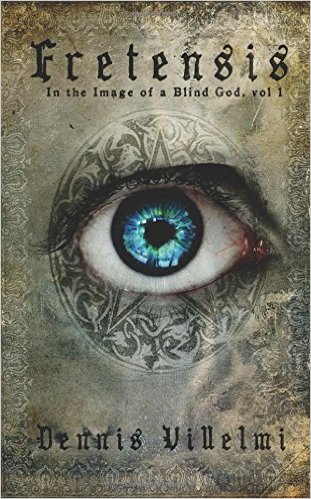
A review of “Fretensis: In the Image of a Blind God, volume 1,” by Dennis Villelmi

With “Fretensis: In the Image of a Blind God, volume 1” Dennis Villelmi expertly enmeshes the reader in a twisting, troubling narrative that is both mythic and tragically personal for the poem’s speaker. It’s a unique work, employing both arcane myth and personal impressions in equal measure. And it’s a hell of a ride.

“Fretensis” is a 56-page book of dark, modernist poetry divided into three parts and baroquely illustrated with medieval woodcuts and other images of the monstrous and the grotesque. The narrative it presents is like nothing else I’ve discovered reading poetry. Its protagonist is a rich intellect and a troubled soul. The mood of “Fretensis” throughout is striking; the overall work expertly conveys sadness, desperation and an enervating sense of struggle. (In the interest of full disclosure here, Villelmi is a valued friend and a poet whose work I have long admired.)

“Fretensis” might be challenging for the average reader. It might take a seasoned academic to understand all of its references and allusions while also understanding their significance within the poem. Villelmi draws on what appears to be an encyclopedic knowledge of ancient history, myth and religion. (He studied philosophy at Old Dominion University, but his expertise is visibly far more expansive in all of his work.) The title of this story, “Fretensis,” is the name of the Tenth Roman Legion, employed at the start of the Fall of the Roman Empire. As with Villelmi’s other published poetry, this debut book is linked intricately to those myths and symbols from which he draws inspiration.

But this is a good thing. Villelmi’s dark and antiquated iconography makes his work unique and unusually rich. This is a poem that begs for rereading and further scrutiny. I myself gleaned so much more from my second reading.

If I could name one thing about Villelmi’s style that makes his work distinctive to me, it would be how he meaningfully interweaves his esoteric symbols and references with the narrator’s personal experience. That duplexity characterizes the entire book, and it makes “Fretensis” remind me of a personal favorite, W.H. Auden’s “September 1, 1939.” That famous poem and its “accurate scholarship” also uses classical references to frame the narrator’s personal experience in context. (In Auden’s case, he called upon Thucydides, Luther and others to frame his own reaction to the 1939 German invasion of Poland.)

Villelmi’s resulting juxtaposition, which is consistent throughout the book, makes for an excellent poetic device. Memphis, Egypt, is made interchangeable with Memphis, Tennessee. References to Jeudayn are used to provide context for the death of a prostitute. A small boy plays “Deity” in “a grey dirt patch behind [a] garage.”

Consider the context that he employs to describe ravens feeding upon a dog’s carcass:

“Driving, I find it ironic, even inappropriate, that as the roadside augur is a dog on which the forest ravens have come to feast on the meat pulled out from under the fur, courtesy of other scavengers, the convent isn’t named after St. Paul. Paul and ravens both know how to seize an opportunity. Rather, it’s named for Fiacre, an old Irish woman-hater of the woods. I once read there were other Fiacres predating Christ’s arrival on Irish soil; they were warlords, predators by serendipity, much like those ravens chowing down on the mutt.”

And Villelmi’s mastery of the language is truly enviable. I found myself most immersed in “Fretensis’” prose-poetry sections. I’m not sure why, but here is where I best felt that I could identify with the narrator. These seemed the most personal to me. They’re so beautifully illustrated by the narrator’s sad, resigned voice that they have the feel of a genuine vignette spoken by a real person.

Consider the opening of “Part II: The Whore’s Afternoon.”

“On my ongoing canvas, there’s only been caricatures and carcasses, with a highway torture dividing the two. Somewhere, I took a detour of forgeries and virgins, and lost the rest of the America I was meant to see …

“Every time I try to measure the time I get a case of dry mouth. That’s how I met Ettey, Ettey Roth. She, too, had a memoir, not unlike mine, and it was over slugs in Seire’s Tavern time and again that we found the mutual souring of our lives to have been rooted in the hems of our birthplaces.”

All in all, “Fretensis” depicts a universe that is both twisting and twisted – a byzantine existence where an eloquent narrator’s darkness is informed by far greater forces that are divine, demonic or both. It’s an accomplished book of poetry that deserves not only to be read, but reread and reconsidered … assuming that you are willing to take that winding, redoubtable journey more than once.

Bravo.
51HuLmHrseL._SX309_BO1,204,203,200_

Will Reichard favorably reviews “The Man in the High Castle” television adaptation.

Author Will Reichard gives us a nice rundown today of the small-screen adaptation of “The Man in the High Castle” (2015).  Check it out over at his blog, right here:

http://plaeroma.com/2015/10/go-watch-the-man-in-the-high-castle/

I’ve been dying to get to this alternate-history dystopia — it looks so much more ambitious and thoughtful than the usual fare, and it depicts a Nazi occupation of the United States!  I’ll review it when I get to it.  Right now, I’m finding myself tempted by the “Limitless” television adaptation and that new “Tales of Halloween” anthology horror flick.

There is actually a really basic question I’d love to ask about the plot of “The Man in the High Castle,” but I’m afraid an answer would be too spoilerish.  (It concerns the films that various characters watch within this show.)

A quick review of “Howl” (2015).

You can’t call “Howl” (2015) a great movie — not all of its acting, screenwriting and directing supports that statement.  But this indie British horror flick’s better qualities make it a pretty good one — enough to warrant an 8 out of 10.

There were three things about this film that made me like it.

  1.  It’s a straightforward werewolf tale.  Monsters attack average commuters on a red-eye train after it breaks down under a full moon in an English forest.  There is no Byzantine backstory, no sexing it up and no humanizing of the werewolves.  (They’re gross.)  I found that refreshing in an age of franchises like “Underworld” and “Twilight.”
  2. Our protagonists are average people who are relatable.  Who among us hasn’t been stuck on a stalled train at least once, even briefly?  These unarmed, everyday commuters would probably be easy prey for a human predator, not to mention a super-strong supernatural threat.  That made it scary.
  3. I thought that the special effects (a mixture of practical effects and CGI) were actually quite good.  I was pleasantly surprised when this low-budget, direct-to-video film bared its fangs as a decent creature feature.

And did anyone else recognize the train conductor?  That’s none other than Sean Pertwee, who starred in the werewolf classic, “Dog Soldiers” (2002).  It’s fun imagining “Howl” as a companion film.

Howl-2015-Teaser-Poster