Tag Archives: Stephen King

That wicked cool moment when “The Gunslinger” reminds you of W. H. Auden.

The following is from Auden’s “The Third Temptation,” part of “The Quest.”

He watched with all his organs of concern
How princes walk, what wives and children say,
Re-opened old graves in his heart to learn
What laws the dead had died to disobey,

And came reluctantly to his conclusion:
“All the arm-chair philosophies are false;
To love another adds to the confusion;
The song of mercy is the Devil’s Waltz.”

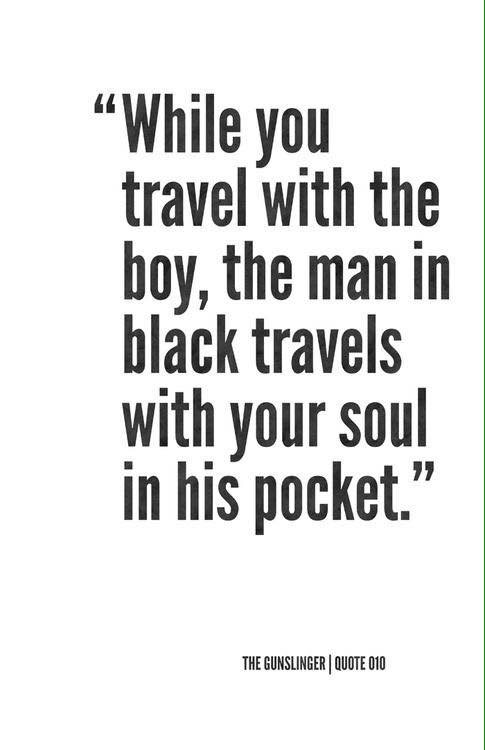
And the quote below is from Stephen King’s “The Gunslinger.”

12003155_10203925409334735_8322614684030940377_n

“The Quest” actually contains a bunch of key images reminiscent of King’s series.  We can easily conclude that these are coincidental, as they serve different thematic purposes.  But it’s still fun to spot the common images.

You can find the entirety of “The Quest” right here:

http://www.poemhunter.com/best-poems/wh-auden/the-quest-5/

The Dude would not abide …

So an old college pal wrote to me the other day to ask for advice on which recent Stephen King novel he might check out.  He told me that he was interested in something more mainstream horror.  He said he enjoyed King more before the author “got into all the dark tower stuff and a wondering dude.”  I steered my friend away from “Joyland” and toward “Mr. Mercedes.”

But I love that typo.  A “wondering dude” immediately makes me think “The Dude” from “The Big Lebowski” wandering around Mid-world, befuddled, after accidentally stepping through an inter-dimensional door.  He’d have a “beverage” in one hand and a WTF expression on his face.

darktowerlongroad  Waste_Monsters_2

film-the_big_lebowski-1998-the_dude-jeff_bridges-tops-pendleton_shawl_cardigan

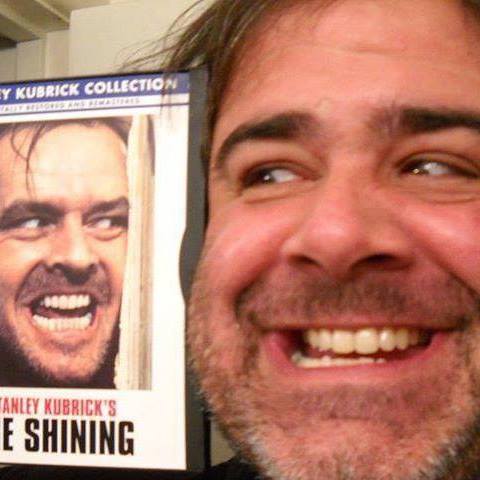
Separated at birth?

One of these men is Jack Nicholson in his iconic performance in Stanley Kubrick’s classic 1980 film adaptation of Stephen King’s “The Shining.”

The other is my friend and fellow horror movie fan, Pete Harrison.

You can’t tell which is which, can you?

11215150_10152864711720388_3241429421233289877_n

“We ourselves may be accidentally ‘haunting’ others …”

“Ghosts may not be a spiritual manifestation of ectoplasmic material, the psychic remains of a deceased human being.

“They may in fact be visual traces of beings from an alternate plane of existence from our current location in space-time, or visual traces of beings from some past or future date in the reality that we are consciously aware of, bleeding through into OUR here and now.

“Temporal slippage of a sort, kind of a leak through, totally random and accidental, and not in any way, shape or form malign or predestined.

“Accepting THIS as fact, we ourselves may be accidentally “haunting” others right at this very moment.”

—  Pete Harrison

My buddy above just came up with this.  I think it’s goddam impressive for 2:45 a.m.!  It reminds me of the “Walk-Ins” described by Stephen King in “Bag of Bones.”

(Pete’s t-shirt denotes his status as a fellow horror movie, magazine, and comic fan.)

11745853_10152885290765388_8012902720658506198_n

“My first thought was, he lied in every word …”

“My first thought was, he lied in every word,
“That hoary cripple, with malicious eye
“Askance to watch the workings of his lie
“On mine, and mouth scarce able to afford
“Suppression of the glee, that pursed and scored
“Its edge, at one more victim gained thereby.”

—  From Robert Browning’s “Childe Roland to the Dark Tower Came”

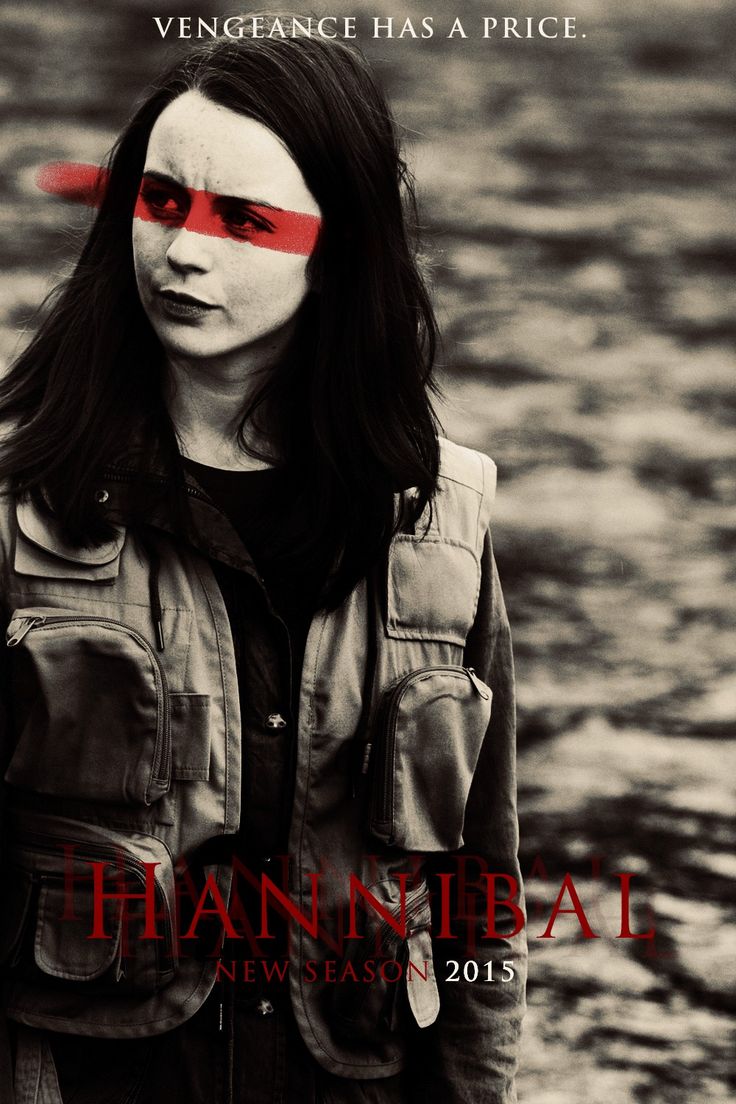
490ae931f71cee515b37bc102e33dd76

Did NBC’s “Hannibal” reference Stephen King’s “The Dark Tower” series?!

[WARNING — THIS POST CONTAINS MAJOR SPOILERS FOR SEASONS 2 AND 3 OF “HANNIBAL,” AS WELL AS STEPHEN KING’S “THE DARK TOWER” SERIES.  READ AT YOUR OWN RISK.]

*

*

*

*

*

*

*

This could be overeager nerd eisigesis, but something jumped out at me immediately in the second episode of this summer’s “Hannibal.”

When Will Graham greets Abigail Hobbes at the beginning, he wonders about “some other world.”

The doomed young Abigail responds:  “I’m having a hard enough time dealing with this world.  I hope some of the other worlds are easier.”

That’s “worlds,” plural — not “another world” or “the next world.”  It sounds a hell of a lot like the doomed Jake Chambers’ famous line towards the end of “The Gunslinger,” before he falls to his fate:  “Go then.  There are other worlds than these.”

Graham goes on the discuss string theory: “Everything that can happen, happens.”  This dovetails perfectly with the idea of the nearly infinite parallel universes that comprise different levels of “The Tower.”

Then other story parallels occurred to me:

1)  Both Abigail and Jake are children of surrogate fathers who are on a crusade (Graham’s pursuit of Hannibal Lecter, the Gunslinger’s quest for The Tower).

2)  Both are specialized, cold-blooded killers by training (Abigail’s bizarre tutelage by her serial killer biological father, Jake’s training by the Gunslinger).

3)  Both are willingly sacrificed by their surrogate fathers.  (NBC’s show makes it clear that Hannibal is also a father figure to Abigail.)

4)  Both characters were sacrificed by the show’s/book’s title character.

5)  The memories of both haunt the stories’ protagonists as a recurring motif.  Both appear to drive the heroes insane.

6)  Both characters are ostensibly dead at some point, and then are quasi-resurrected by a surprise plot device.  (Abigail has been secreted away by Hannibal; Jake is returned from a parallel universe to which he was consigned.)

7)  The loss of both characters are tied to themes of forgiveness.  (Jake forgives the Gunslinger for letting him fall; Graham explicitly forgives Hannibal for Abigail’s loss as part of the show’s overarching theme.)

It would be fun and perfectly viable to imagine that the show’s events transpire on a “level” of The Tower.  The differing continuities of the original books and feature films could even comprise other levels.  King makes it clear that “twinners” are character analogs living in different universes.

But I am probably just imagining things.  I also thought that Hannibal’s reference to his “person suit” in this season’s first episode was a reference to “Donnie Darko” (2001): “Why do you wear that silly man suit?”  And, in retrospect, that seems like a coincidence.

a80a802b2baea0ead4b2b8ce1e020d82          The_Gunslinger

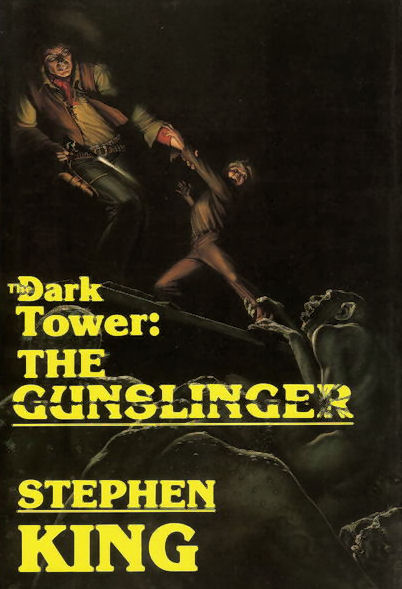
I want this framed.

I am not so intense a fan that I need to pursue the first editions, but I would eventually love to have certain artwork in my home.

“The desert was the apotheosis of all deserts, huge, standing to the sky for what looked like eternity in all directions. It was white and blinding and waterless and without feature save for the faint, cloudy haze of the mountains which sketched themselves on the horizon and the devil-grass which brought sweet dreams, nightmares, death. An occasional tombstone sign pointed the way, for once the drifted track that cut its way through the thick crust of alkali had been a highway. Coaches and buckas had followed it. The world had moved on since then. The world had emptied.”

11140003_1580200968921924_1079606276969932639_n (1)

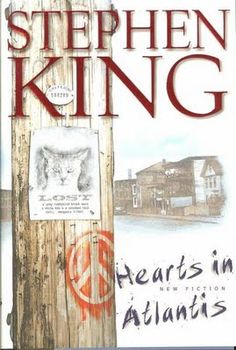
A recommendation: Stephen King’s “Hearts In Atlantis.”

This book is, in a word, beautiful.

I still remember receiving my hardback copy one Christmas.  After tearing off the wrapping paper, I was nonplussed with its cover.  Peace signs and missing-cat posters?  This didn’t look like “Night Shift” or “The Tommyknockers.” The back cover’s synopsis did little to reassure me that I would like it.  It was some kind of “coming-of-age” drama, and promised nothing of the monsters and mayhem that I’d always loved in Stephen King’s work.  I got the sense that this was a gift book that I would read out of politeness.  If memory serves, I indeed only sat down with it years later.

I just recommended it to a college friend this weekend.  (And now I am tempted to go grab it again, even though I have been itching for so very long to revisit that quick, short little tale entitled “IT.”)  I tried to explain to my alum that “Hearts In Atlantis” was a “more mainstream” King novel that could be enjoyed by anyone.  She asked if there were “monsters,” and I told her, “Well, yeah, but they’re almost always mostly off-screen.”  (I have a habit of describing books as though they are movies.)

And I do think that’s a good way to describe it.  This is a great introduction to King for a mainstream reader.  The horror elements are minimal.  The fantasy elements are used as a plot device, but quite sparingly.  Yes, the “Low Men” from whom one character hides are fantasy characters from Stephen King’s sprawling and expansive “Dark Tower” multiverse.  But, since they are portrayed so mysteriously, they can be just as easily read as sinister government agents — and this would fit right in with the 1960’s paranoia that this period novel often establishes as part of its setting.

If you do happen to love “The Dark Tower,” however, the characters of Ted Brautigan and Bobby Garfield will be familiar to you.  And there is even a single, fleeting reference to a certain frightening provocateur for the violence and dissent in 1960’s America.  We only hear him spoken of once.  His initials are “R.F.,” although he is known to employ pseudonyms.  The reference to him makes perfect sense in the context of the story, and spells great sadness for another character we’ve come to like.

But, again — this is definitely a more mainstream novel, maybe more in the spirit of a dark drama like “Dolores Claiborne” (which I have not read).  Psychic powers and shadowy pursuers take a backseat to stories about people.  There isn’t just one “coming-of-age story.”  There are many, as we see key characters faced with trials and crossroads at different points during their often tragic lives, preceding, during and following a difficult and confusing time in American history.  (I keep calling it a “novel,” even though it’s actually several novellas and three long stories.)  Since it’s the same characters in the same universe, I like to think of it as a single overall novel.  The quite-good film adaptation in 2001, starring Anthony Hopkins, actually covers only one novella within the book, “Low Men In Yellow Coats.”  The eponymous “Hearts in Atlantis” novella is actually a separate tale — one that I enjoyed even more.  This book is a tour de force in showing the points of view for multiple characters.

I was going to state that this is the most moving King tale I’ve ever read.  I hesitate now … I know that a lot of fans point to “The Stand” for such a distinction.  (I personally don’t agree, even though that book is my favorite of all time.)  And certain entries in “The Dark Tower” series are very moving too.  We’ve got Jake’s introduction and fate in “The Gunslinger:”

He is too young to have learned to hate himself yet, but that seed is already there; given time, it will grow, and bear bitter fruit.”

“Go then.  There are other worlds than these.”

We also have Roland of Gilead’s tearful embrace with his father in “Wizard and Glass,” and Steven Deschain’s reveal:  “I have known for five years.”

Still, “Hearts In Atlantis” is a contender.  Parts of it are heartwarming; parts are unflinchingly sad.  It is alternately heartrending and sweet.  I think that this is Stephen King’s most intimate treatment of his characters, with the possible exception of “The Body” (which film fans know as “Stand By Me”).  (And bear in mind, we’re talking about a master of characterization and point-of-view.)  I read “The Body” (part of the collection, “Different Seasons”) when I was a young teen, and that’s so long ago that I cannot adequately compare them.  At any rate, we are a long, long way from straight genre-stuff like “The Boogeyman” and “The Raft.”

I found “Hearts In Atlantis” moving, to say the least.  I hate to invoke the somewhat tired and trite-sounding standby, “I felt as though this book was written especially for me.”  But I do feel that way, and I am not just thinking of one character or one part.  I identified closely with the stages of life and the crises depicted for several characters.  And I can’t even elaborate on why, because such information would be too personal for a public forum.  (Okay, here’s one exception — if anyone reading this lived in Mary Washington College’s Bushnell Hall in 1990 and 1991, there indeed were a slew of guys who played “Hearts” incessantly!!)  This book, which I read in my late 20’s, actually changed the way I looked at … hell, BOOKS.

I’m sorry to gush like a fanboy here yet again … I promise to return to form tomorrow by panning low-budget horror movies.  In the meantime, goodnight, friends.  And do stay ahead of the Low Men.

b1066b5a93bc14a51ce2cf3f3055dc12

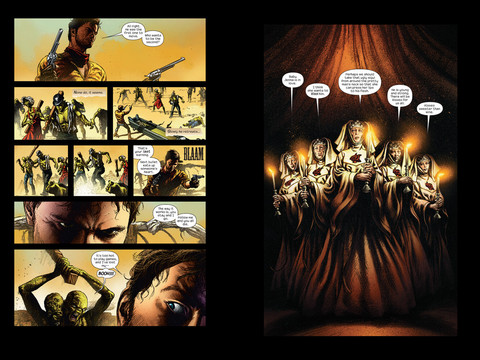
A few quick words on Marvel Comics’ adaptation of “The Little Sisters of Eluria.”

Prose works are usually difficult to translate to comics. (Anyone old enough to remember “Classic Comics?”) “The Little Sisters of Eluria,” Stephen King’s long story adjunct to his “Dark Tower” series, is an example of this. The story’s hero spends most of the story incapacitated in a hospital bed, which presents problems for a visual medium.

Still, the creative team at Marvel Comics does a good job, as they’ve done with every King adaptation I’ve seen them handle. It’s a good, creepy story that captures King’s voice, and it’s a fun late-night read. I’d give it an 8 out of 10.

Dark_Tower_The_Gunslinger_-_The_Little_Sisters_of_Eluria_Vol_1_2

little-sisters

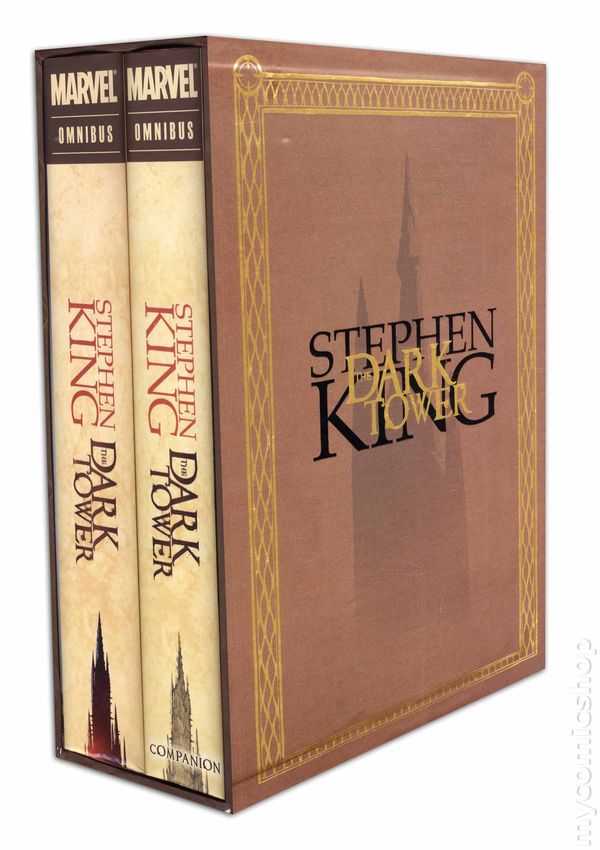
A Review of Stephen King and Marvel Comics’ “The Dark Tower Omnibus.”

Marvel Comics’ “The Dark Tower Omnibus” is a fantastic two-tome deluxe set that offers an unprecedented and truly inclusive look at Mid-World and its place in Stephen King’s multiverse. It’s an almost perfect collector’s item, deserving a 9 out of 10, with new (and usually quite beautiful) looks at the people, places, monsters and magic that surround Roland of Gilead, the single-minded anti –hero first introduced to readers as “The Gunslinger” in 1982.

I was very happily surprised at what I found. This isn’t merely a comic book adaptation of “The Dark Tower” series of books. Although portions of it recount events seen in flashback in “The Gunslinger” and “Wizard and Glass,” most of it is new material. And it’s exactly what a hell of a lot of fans would want – chronicling Roland’s younger years, in which he and his closest friends train as Gunslingers, carry out their first quest, try in vain to prevent the fall of their kingdom and then meet their final fates at Jericho Hill. Also covered in great detail is the role of The Man in Black (known elsewhere as Randall Flagg, among other aliases) in the Fall of Gilead, as well as the destruction of Roland’s family and friends.

It’s a great book. I’d honestly recommend it to fans who have completed the series of prose novels, because much of the fun of those is the gradual exposition of Roland’s brutal childhood and the inception of his inter-dimensional quest. Much of that is rendered in detail here, which could ruin the narrative power of his tales and flashbacks throughout the books.

There are all sorts of treasures for people who fell in love with Mid-World, as I did in the early 1980’s. We see Steven Deschain and his contemporaries in action for the first time, in adventures that seem penned by King himself. (King was Executive Director of the project, while the story was adapted by Robin Furth and scripted by Peter David.) We see Flagg, known here as Marten Broadcloak, betray Roland’s father by seducing his mother, and the even greater tragedy that results. We see the Fall of Gilead and the Battle of Jericho Hill (even if they’re a little mishandled here). And, maybe best of all, we get to better know fellow young Gunslingers Cuthbert Allgood and Alain Johns as they fight alongside Roland – something only covered before in one book, “Wizard and Glass.”

The biggest surprise, however, is a DETAILED ORIGIN STORY FOR RANDALL FLAGG. Any King fan knows that Flagg’s nature and origin have been a mystery for decades – in all the various Stephen King novels in which he’s appeared. Here, we literally meet his parents and see him born, and are shown in greater detail his role in The Crimson King’s planned destruction of the infinite multiverse.

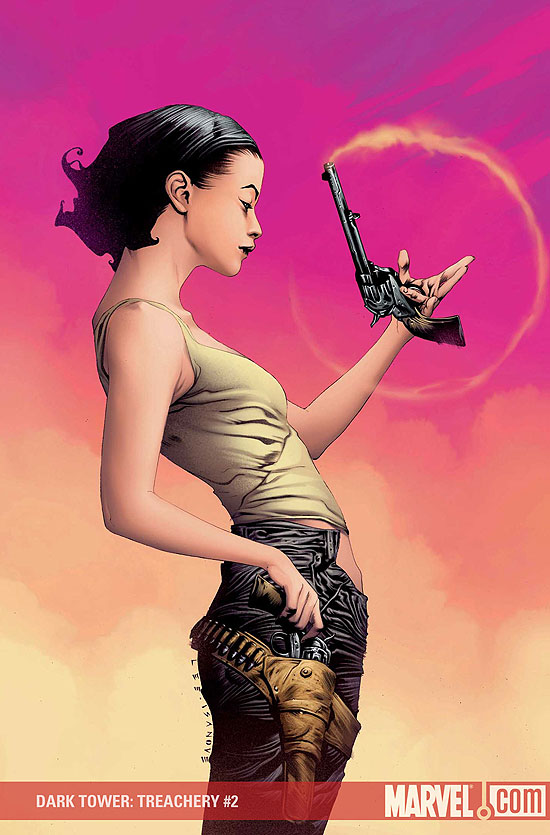
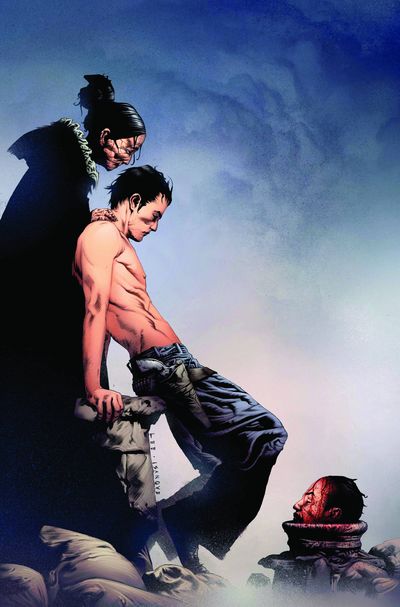
The art by Jae Lee is simply amazing – it’s some of the best I’ve ever seen in comics. All of the characters – except Flagg, regrettably – are portrayed how a reader might have easily envisioned them. Roland has a great look, and the characters of Susan and Aileen are beautiful. Lee makes great use of color, large panels and sweeping vistas that bring Mid-World to eerie, dreamlike life. Lee’s most fearsome portrayal is John Farson, aka The Good Man, shown here battling the forces of light in black armor and blood-red mask, astride a giant black steed. The art was just perfect.

The stories are generally good. The horror elements we’d hope for are all there, and there are countless moments that enrich the pre-existing books for us – often courtesy of Lee’s amazing talent.

Roland is mostly consistent with the character we love; Cuthbert and Alain are pitch-perfect and incredibly likable. This book was enhanced in many, many ways by featuring characters that were spot on and mostly what we would expect. Peter David is well known as a humorous comic book writer (he could have been a disastrous choice for this material), but he does very well. There were one or two moments that were awful attempts at unnecessary levity (they can’t start the quest because Sheemie has to “pee?”) But David’s talent for dialogue pays off extremely well with the banter between Cuthbert and Alain.

Farson, referred to only obliquely in the prose books, is terrifying. A terrific new character is Aileen, Cort’s niece, who is the first female Gunslinger (presumably created by Furth?). I wound up wishing she was included in the novels.

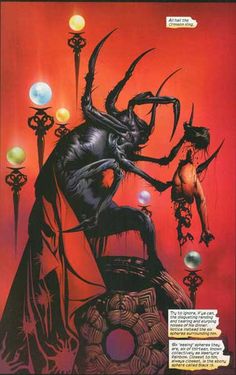
But the biggest character improvement was The Crimson King. Fans of the series have lamented the fact King’s arch enemy of the universe fell flat in “The Dark Tower,” the last book of the series. Even someone like me, who loved the books, can concede that. He’s different here – finally changed by Furth, David and Lee into a truly frightening enemy. He’s both better written and gorgeously illustrated. Here, “The Dark Tower Omnibus” actually improves on its source material.

Unfortunately, the same cannot be said of Randall Flagg. I felt his characterization here was way off. He resembles little of the Flagg that we know and loathe from “The Stand” and other books. He doesn’t seem terribly much like “The Man in Black” introduced in “The Gunslinger.” Instead, he sometimes seems like a mere stock character – the cartoonish evil magician. He even has what sometimes resembles a handlebar mustache! I was surprised that the creative team here excelled everywhere else, yet fumbled the ball with this extremely unique and popular character.

There were other aspects of the stories here that may have been less than perfect. I was surprised at how little the writers sought to exploit comic books as a medium. The stories are extremely dialogue-heavy for a comic series. The entire series seems to have missed opportunities to show the incredibly varied monster, mutants, cyborgs and demons of Stephen King’s dangerous, Kafkaesque universe.

There were also at least two anticlimaxes. We’re given tremendous foreshadowing and tension building up to The Fall of Gilead. Then … we’re shown it in only a few pages. After countless pages of conversations about how to wage the battle, the battle itself is … hardly shown. I wonder if some sort of mistake was made in the editorial process. Did they deliberately try to avoid showing too much action? The Battle of Jericho Hill is also seen as an incidental standoff after Farson surprises Roland’s forces, with little other relevance to the destruction of Mid-World or the planned destruction of The Dark Tower.

The second volume in the set is a wealth of supplementary information, mostly penned by Furth, composed as addendums to the comic stories when they were originally published. It almost seems like “The Dark Tower” series’ equivalent of Tolkien’s “Silmarillion,” with a broad and interesting spectrum of biographies, vignettes, maps, history and theology that make up not just Mid-World, but also the god and the demons who gave rise to The Tower and its parallel universes. All sorts of questions are answered here comprehensively – not the least of which is where and how Flagg came to be. There are even classifications of the mutants, cyborgs and robots with which Roland and his Ka-Tet tangled throughout the books. Mixed with those are tons of additional art, as well as interviews with the creators.

Again, this was a fantastic set, and a sheer treasure for any fan of the book series.
darktwrv3002_cov_col
207752_10150162284952472_3683764_n
1827373-battle_of_jericho_hill_no2
darktower5
darktwrv3006_cov
dt3cover_425
e287c69c40d6eeb25a0ba4d7cd91ec12
[Artwork by Jae Lee, Marvel Comics’ “The Dark Tower Omnibus.”]