Tag Archives: W.H. Auden

“Gonzalo,” by W. H. Auden (recited by Eric Robert Nolan)

“Gonzalo”

— from W. H. Auden’s “The Sea and the Mirror”

Evening, grave, immense, and clear,
Overlooks our ship whose wake
Lingers undistorted on
Sea and silence; I look back
For the last time as the sun
Sets behind that island where
All our loves were altered: yes,
My prediction came to pass,
Yet I am not justified,
And I weep but not with pride.
Not in me the credit for
Words I uttered long ago
Whose glad meaning I betrayed;
Truths to-day admitted, owe
Nothing to the councilor
In whose booming eloquence
Honesty became untrue.
Am I not Gonzalo who
By his self-reflection made
Consolation an offence?

There was nothing to explain:
Had I trusted the Absurd
And straightforward note by note
Sung exactly what I heard,
Such immediate delight
Would have taken there and then
Our common welkin by surprise,
All would have begun to dance
Jigs of self-deliverance.
It was I prevented this,
Jealous of my native ear,
Mine the art which made the song
Sound ridiculous and wrong,
I whose interference broke
The gallop into jog-trot prose
And by speculation froze
Vision into an idea,
Irony into a joke,
Till I stood convicted of
Doubt and insufficient love.

Farewell, dear island of our wreck:
All have been restored to health,
All have seen the Commonwealth,
There is nothing to forgive.
Since a storm’s decision gave
His subjective passion back
To a meditative man,
Even reminiscence can
Comfort ambient troubles like
Some ruined tower by the sea
Whence boyhoods growing and afraid
Learn a formula they need
In solving their mortality,
Even rusting flesh can be
A simple locus now, a bell
The Already There can lay
Hands on if at any time
It should feel inclined to say
To the lonely – “Here I am,”
To the anxious – “All is well.”



“Yet, in an Autumn nightmare trembled …”

This isn’t the best reading of a poem, but I had fun last Fall when I recorded it.  I’m not sure why I sound like Christopher Walken at the start of the piece: “He WATCHED with all his organs of concern …”


“I was as mystified as Frodo at Gandalf’s failure to appear on September 22.”

39786174_10156109995007772_1325126783820890112_n

“Adventure,” by W. H. Auden

“Adventure,” by W. H. Auden (Part XVII of “The Quest”)

Others had found it prudent to withdraw
Before official pressure was applied,
Embittered robbers outlawed by the Law,
Lepers in terror of the terrified.

But no one else accused these of a crime;
They did not look ill: old friends, overcome,
Stared as they rolled away from talk and time
Like marbles out into the blank and dumb.

The crowd clung all the closer to convention,
Sunshine and horses, for the sane know why
The even numbers should ignore the odd:

The Nameless is what no free people mention;
Successful men know better than to try
To see the face of their Absconded God.


Excerpt from “The Cave of Making,” by W. H. Auden

You hope, yes,
your books will excuse you,
save you from hell;
nevertheless,
without looking sad,
without in any way
seeming to blame
(He doesn’t need to,
knowing well
what a lover of art
like yourself pays heed to),
God may reduce you
on Judgment Day
to tears of shame,
reciting by heart
the poems you would
have written, had
your life been good.


2015092023090232623

“W. H. Auden — Tell Me The Truth About Love” (BBC Four)

This is another superb documentary produced by BBC Four about W. H. Auden.


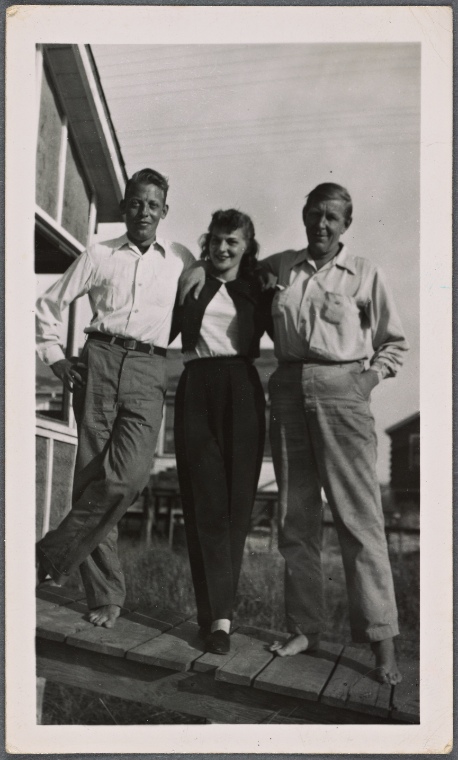
Chester Kallman, Rhoda Jaffe and W. H. Auden, Fire Island, NY, 1950

Source: New York Public Library Digital Collections.


index

“The Addictions of Sin: W. H. Auden in His Own Words” (BBC Four)

I’m linking here to a terrific documentary produced by BBC Four to celebrate the centenary of W. H. Auden’s birth in 1907.  It’s a superb biopic — thanks to Youtube user Andrey Shulyatyev for uploading this.

One thing that occurred to me as I watched this was the resilience of Auden’s pursuit of love and beauty despite his first-hand witness of the most terrible and ugly things — the violent rise of fascism in Germany, the Second Sino-Japanese War, and the devastation of post-World War II Germany. And this resilience was reflected in his work ethic even until his death in 1973.


W. H. Auden reads “The More Loving One”

Youtube user ScientificUnity created and uploaded this.  It’s a beautifully edited video and the audio of W. H. Auden is quite clear.


“Gonzalo,” by W. H. Auden (recited by Eric Robert Nolan)

A selection from “The Sea and the Mirror.”