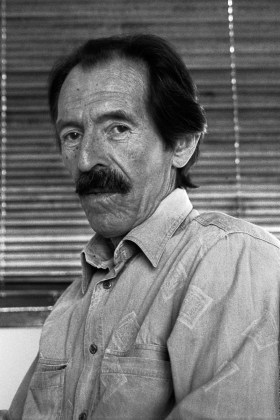
Eric Robert Nolan graduated from Mary Washington College in 1994 with a Bachelor of Science in Psychology. He spent several years a news reporter and editorial writer for the Culpeper Star Exponent in Culpeper, Virginia. His work has also appeared on the front pages of numerous newspapers in Virginia, including The Free Lance – Star and The Daily Progress. Eric entered the field of philanthropy in 1996, as a grant writer for nonprofit healthcare organizations.
Eric’s poetry has been featured by Dead Beats Literary Blog, Dagda Publishing, The International War Veterans’ Poetry Archive, and elsewhere. His poetry will also be published by Illumen Magazine in its Spring 2014 issue.
“Dark City” (1998) maybe wasn’t quite as perfect as its most ardent fans make it out to be, but it was still a damned good film — creative, original and caliginously artistic. (It occasionally suffers somewhat in comparison with its spiritual cousin, “The Matrix,” which changed the very medium of movies only a year later.) And what a cast — William Hurt, Jennifer Connelly, Kiefer Sutherland and Rufus Sewell!
I saw this movie on VHS around … 2001, I think. I remember being eager at the time to see the inimitable Hurt — I’d grown up with films like “Gorky Park” (1983) and “The Accidental Tourist” (1988). It was only later in life that I really became a fan of Sewell — after his tour-de-force performance as the Nazi villain in “The Man in the High Castle” (2015-2019).
And how can you beat Connelly as a nightclub crooner? My girlfriend sent me a gem that she found on Youtube — Connelly singing an alternate version of her musical number in the movie, Giovanni Polimeni’s “Sway.” (It’s the second video below.)
“This artist’s concept shows a view across a mysterious disk of young, blue stars encircling a supermassive black hole at the core of the neighboring Andromeda Galaxy (M31). The region around the black hole is barely visible at the center of the disk. The background stars are the typical older, redder population of stars that inhabit the cores of most galaxies. Spectroscopic observations by the Hubble Space Telescope reveal that the blue light consists of more than 400 stars that formed in a burst of activity about 200 million years ago. The stars are tightly packed in a disk that is only a light-year across. Under the black hole’s gravitational grip, the stars are traveling very fast: 2.2 million miles an hour (3.6 million kilometers an hour, or 1,000 kilometers a second) Object Names: M31, Andromeda Galaxy, NGC 224.” — NASA