I was chatting here with a friend last week about the “Aliens,” “Predator” and “Aliens vs. Predator” comics produced by Dark Horse Comics in the 1990’s. While Marvel, DC and Image Comics all specialized in their superhero universes, Dark Horse tended to corner the market on hot properties in science fiction and horror. (The company actually did try to compete by launching its own superhero line, but its unsuccessful “Comics’ Greatest World” universe lasted a mere three years.)
Dark Horse acquired the rights to the biggest science fiction movie characters of the first half of the decade, including “Aliens,” “Predator,” “Terminator,” “Robocop,” and “The Thing.” It also produced great books in other genres too, like Frank Miller’s legendary “Sin City” series, Matt Wagner’s brilliant “Grendel,” and “Indiana Jones” comics. (I never actually saw “Indiana Jones” on the shelves; the two retailers in my smallish Virginia college town never carried it.)
Perhaps strangely, I don’t remember any regular ongoing series for “Aliens,” “Predator” or “Aliens vs. Predator.” Instead, the company published limited series on an ongoing basis.
Dark Horse had been a young company back then — it had started only four years earlier, in 1986. But I’ll be damned if the people running the company didn’t know their stuff. Not only did they snatch up big-name properties, they did a great job in producing consistently high-quality “Alien” and “Predator” books. (Maybe “Aliens: Genocide” wasn’t as good as the other series, but it was really more average than flat-out bad.) I honestly don’t know how they managed to publish such uniformly excellent comics that drew from a variety of creative teams. The “Big Two,” Marvel and DC, produced their share of mediocre comics — even for tentpole characters or major storylines. (See the “Batman” chapters of DC’s “Knightfall,” for example, or Marvel’s “Maximum Carnage” storyline for Spider-Man.)
Was Dark Horse’s track record better because their target audience was adults? Did they just have really good editorial oversight? Or did they maybe share such oversight with 20th Century Fox, which had a vested interest in its characters being capably handled? I’m only guessing here.
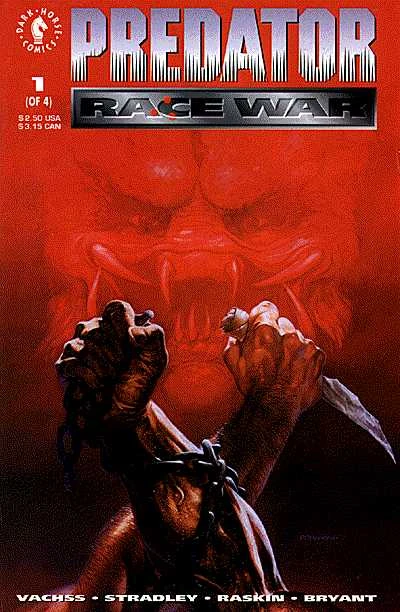
I’ve already blathered on at this blog about how I loved “Aliens: Hive,” so I won’t bend your ear yet again. An example of another terrific limited series was “Predator: Race War,” which saw the title baddie hunting the inmates of a maximum security prison. And yet another that I tried to collect was “Aliens vs. Predator: the Deadliest of the Species.” The series had a slightly annoying title because of it was a lengthy tongue twister, but, God, was it fantastic. I think I only managed to lay hands on four or five issues, but the art and writing were just incredibly good.
Take a gander at the covers below — all except the first are from “The Deadliest of the Species.” I think they are some of the most gorgeous comic covers I’ve ever seen, due in no small part to their composition and their contrasting images. And I’ve seen a lot of comic covers. I think the very last cover you see here, for Issue 3, is my favorite.
I would have loved to collect all 12 issues … I still don’t know how the story ended. (It was partly a mystery, too.) But at age 19, I absolutely did not have the organizational skills to seek out any given limited series over the course of a full year.
In fact, this title may well have taken longer than that to be released … Dark Horse did have an Achilles’ heel as a company, and that was its unreliable production schedule. Books were frequently delayed. To make matters worse, these were a little harder to find in the back issues bins. (I don’t know if retailers purchased them in fewer numbers or if fans were just buying them out more quickly.)
I suppose I could easily hunt down all 12 issues of “The Deadliest of the Species” with this newfangled Internet thingy. But part of being an adult is not spending a lot of money on comic books. Maybe I’ll give myself a congratulatory present if I ever manage to get a book of poetry published. Yeah … I can totally rationalize it like that.