All posts by Eric Robert Nolan

Eric Robert Nolan graduated from Mary Washington College in 1994 with a Bachelor of Science in Psychology. He spent several years a news reporter and editorial writer for the Culpeper Star Exponent in Culpeper, Virginia. His work has also appeared on the front pages of numerous newspapers in Virginia, including The Free Lance – Star and The Daily Progress. Eric entered the field of philanthropy in 1996, as a grant writer for nonprofit healthcare organizations. Eric’s poetry has been featured by Dead Beats Literary Blog, Dagda Publishing, The International War Veterans’ Poetry Archive, and elsewhere. His poetry will also be published by Illumen Magazine in its Spring 2014 issue.

I have the PERFECT tagline for Season 6 of “The Walking Dead!”

“I’M RICK GRIMES, BITCH!!”

(Young people absolutely will not get this joke.)

S5_Rick_Close-Up

You’re a schmuck, Julio.

You’re … in TEXAS.  And you vandalized … the ALAMO.  You’re probably lucky an ordinary passing private citizen didn’t draw a hand cannon on you and fire.

Pee Wee Herman embarrassed himself less when he asked about the basement.

I will never understand what pathology drives people to carve their names into landmarks.  (Wasn’t it not too long ago that two people were arrested in Rome for carving their initials into the Coliseum?)

Click here for Michael Marks’ article on Friday in the San Antonio Current:

Man Arrested For Carving His Name On Interior Wall Of The Alamo

Separated at birth?

This is just plain nuts.  One of the photos you see below is of Dennis Villelmi, my good friend, an outstanding poet, and my co-author in the horror anthology “All Hail the New Flesh.”  Another is of Vladimir Mayakovsky, the famed early 20th Century Russian poet, playwright, artist and actor.

AND I’M PRETTY SURE THEY’RE THE SAME GUY.  Seriously.

Please.  Skip the nonsense about reincarnation.  Wiser minds will agree — science dictates that the only logical conclusion here is that Dennis is Highlander.  (In the end, there can be only one.)

Check out Dennis’ blog, “a death’s head in green light,” right here:

a death’s head in green light

vladimirmayakovsky

get-attachment

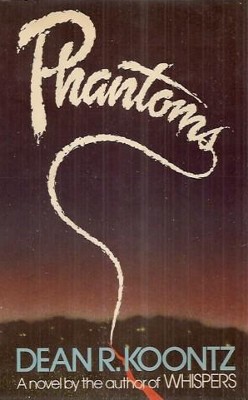
Quick book tip: “Phantoms,” by Dean Koontz

I can’t resist plugging a certain excellent Dean Koontz novel here, as I know a few friends in particular who would love “Phantoms.”  I’ve only read a tiny fraction of Koontz’ novels.  (Dear Lord, that guy writes a lot.)  But I’ve always loved the ones that I have read.  They’re quickly paced, they’ve got fun, creative horror-sci-fi premises, and I like stories where the good guys have guns and guts and just fight right the hell back.

“Phantoms,” in my humble opinion, is the scariest Koontz book I’ve ever read.  I think my favorite will always be “Lightning,” with its terrific surprise plot device.  But “Phantoms” is the Koontz novel that best amped up the fear factor.

I can’t describe the story’s antagonist … or even its overall plot, for fear of spoilers.  Suffice to say, a small Colorado town goes off the grid, and investigators arrive to find that something horrible and mysterious has happened there.  Despite that cliche’ setup, the reveal is darkly inventive, detailed, and wickedly illustrated.

The book might also induce smiles because it is such a right-leaning Cold War period novel.  (It was written in 1983.)  Upon discovering Very Bad Things, our Middle American heroes wonder if it’s the work of “the Russians.”  (Terrorism isn’t mentioned, if I recall.)

It’s damn fun.

[UPDATE:  Blog correspondent Len Ornstein just told me he was unhappy with my recent recommendation after he read this book!  Your mileage may vary, I guess.  My rule for this blog is Caveat Reador.]
Phantoms_cover_Dean_Koontz

“Hey, Girl.”

The new haircut worked out for once.  Take your victories where you can, right?

WIN_20150904_20_13_19_Pro419276_479718905381309_1008164919_n

Illustration of comet over Florence before the plague, by Conrad Lycosthenes, 1340

L0005342 C. Lycosthenes, 1340 comet in sky and plague at Florence Credit: Wellcome Library, London. Wellcome Images images@wellcome.ac.uk http://wellcomeimages.org Comet seen in the sky: 1340 and plague at Florence in which 16,000 people died Printed Text with Illustration Prodigiorum ac ostentorum Chronicon Lycosthenes, Conradus Published: 1557 Copyrighted work available under Creative Commons Attribution only licence CC BY 4.0 http://creativecommons.org/licenses/by/4.0/

Throwback Thursday: Brown Bag Book Covers

Why the hell were the public schools so zealous back in the day about requiring book covers?  In the Longwood School District, you actually got in trouble if your invaluable, publicly issued tome was without one.

Seriously, why?  Hardcover textbooks were sturdy; they weren’t the frikkin’ Dead Sea Scrolls.  Nor did the average student throw them off of overpasses or in front of passing trains or whatever.  (In college, I threw my “Statistics of Psychology” textbook out of a second story window once, but that was a political statement.)

In retrospect, the practice of converting brown paper grocery bags to book covers seems a little ghetto.  But you know what?  I think most of the kids I knew did it, instead of using store-bought book covers.  (We WERE the 99 Percent.)

My Longwood High School Alum Tim Gatto posted on Facebook recently about how a bunch of the guys wrote their favorite quotes and song lyrics on their books.  (I picked up on that trend from him.)  As Tim pointed out, it was Facebook before there was Facebook.

unnamed

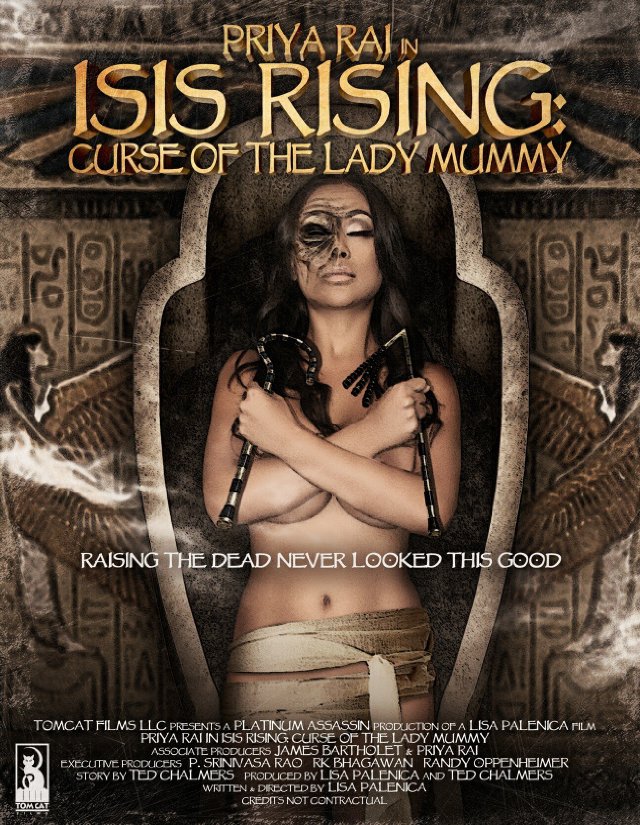
“ISIS Rising” (2013) might be the stupidest documentary ever.

“ISIS Rising” (2013) is a film with no educational value, and I can’t believe anyone could find it helpful in understanding the terrifying events connected with ISIS in Iraq and Syria.  Throughout this film’s entire running length, it yields no genuine insight into the international crisis.  Indeed, it doesn’t even provide the viewer with any information whatsoever!  I’d rate it at a 0 out of 10.

The filmmakers here made a truly bizarre major creative decision in trying to inform the viewer via … metaphor?  We are actually introduced early on to a character name “ISIS.”  She is, inexplicably, a buxom female mummy.  No … you read that right.  ISIS is represented by a major character who is a big-bosomed, female mummy.  She fights a male mummy (presumably representing Western democracies?!).  In fact, the entire film plays out like a low-budget pageant set in ancient Egypt.  Why was that choice made?  How does the pantheon of ancient Egyptian Gods relate to radical Islam in the modern world?  Isn’t that a bit like employing Roman mythology as a metaphor for contemporary Christianity, Judaism, or another modern religion?

There is a preponderance of breasts.  What did they symbolize?  Iraq and Syria?  When ISIS the lady mummy clutches her breasts, does that represent the terrorist army clutching the two countries in its grip?  And what about the barely dressed male mummy?  Should I be offended that the United States and her allies are represented by some guy’s giant schvantz?

Skip this.

Isis-Rising-Movie

“Footprints.”

“He said that there were no traces upon the ground round the body. He did not observe any. But I did – some little distance off, but fresh and clear.”

“Footprints?”

“Footprints.”

“A man’s or a woman’s?”

Dr. Mortimer looked strangely at us for an instant, and his voice sank almost to a whisper as he answered: “Mr Holmes, they were the footprints of a gigantic hound!”

—  from Sir Arthur Conan Doyle’s “The Hound of the Baskervilles”

Cover_(Hound_of_Baskervilles,_1902)

“The song of mercy is the Devil’s Waltz.”

“The Third Temptation” (Part VIII of “The Quest”), by W.H. Auden

He watched with all his organs of concern
How princes walk, what wives and children say,
Re-opened old graves in his heart to learn
What laws the dead had died to disobey,

And came reluctantly to his conclusion:
“All the arm-chair philosophies are false;
To love another adds to the confusion;
The song of mercy is the Devil’s Waltz.”

All that he put his hand to prospered so
That soon he was the very King of creatures,
Yet, in an autumn nightmare trembled, for,

Approaching down a ruined corridor,
Strode someone with his own distorted features
Who wept, and grew enormous, and cried Woe.

W.-H.-Auden-001