The bad news is — I’m one of those goddam heads from Easter Island.
#@%$.
This would at least explain my math skills.
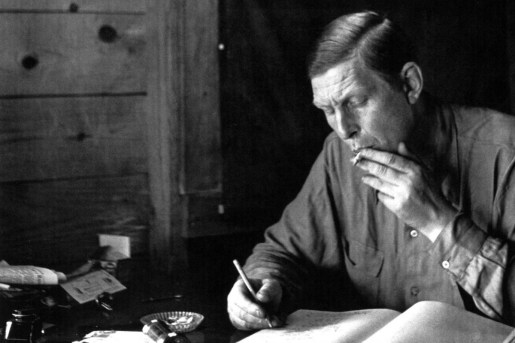
“Lady, Weeping at the Crossroads,” by W H. Auden
Lady, weeping at the crossroads,
Would you meet your love
In the twilight with his greyhounds,
And the hawk on his glove?
Bribe the birds then on the branches,
Bribe them to be dumb,
Stare the hot sun out of heaven
That the night may come.
Starless are the nights of travel,
Bleak the winter wind;
Run with terror all before you
And regret behind.
Run until you hear the ocean’s
Everlasting cry;
Deep though it may be and bitter
You must drink it dry,
Wear out patience in the lowest
Dungeons of the sea,
Searching through the stranded shipwrecks
For the golden key,
Push on to the world’s end, pay the
Dread guard with a kiss,
Cross the rotten bridge that totters
Over the abyss.
There stands the deserted castle
Ready to explore;
Enter, climb the marble staircase,
Open the locked door.
Cross the silent ballroom,
Doubt and danger past;
Blow the cobwebs from the mirror
See yourself at last.
Put your hand behind the wainscot,
You have done your part;
Find the penknife there and plunge it
Into your false heart.

That has a nice alliterative ring to it, doesn’t it? It’s the count at which the Toronto Star has currently arrived in its tally of Donald Trump’s false claims as president.
Why does it sound poetic? Does it just remind me somehow of Martin Luther’s 95 Theses?
Quick site update — if you happen to enjoy this here bloggity-type thing, and you’re following me on Google+, then please be aware that Google is shutting down that platform on April 2. If you’re not a WordPress subscriber (and therefore can’t follow me in its newsfeed), then you can always just bookmark my site. Or you can sign up for e-mail notifications with the button bottom left under the menu bar at this site.
Or, if it’s easier to follow me on social media, then you can find me on Facebook, Twitter, Pinterest and LinkedIn.
Finally, my author’s page at Amazon.com is right here, and I also participate in the Goodreads Authors Program here.
I’m not really clear about why Google selected April 2 as a termination date for its social media platform. (The 1st falls on a Monday.) It occurs to me now that if they’d chosen April 1, then at least some people would think it was an April Fool’s Day joke. (People see hoaxes and conspiraciese everywhere these days.) I myself am looking forward to Jordan Peele’s reboot of “The Twilight Zone,” and that’s scheduled to debut on April 1. But that show sounds too good to be true, and at least part of me is suspicious that it’s all an elaborate April fool’s joke.

Today’s agenda — pet-sitting for my buddy Schrodinger while he’s out of town:
1) Let the dogs out;
2) Ascertain why the caged bird sings; and
3) Take special care of the little cat, but also kill it.

Photo credit: Meathead Movers [CC BY-SA 2.0 (https://creativecommons.org/licenses/by-sa/2.0)%5D
Dark Horse Comics.

At last the secret is out,
as it always must come in the end,
the delicius story is ripe to tell
to tell to the intimate friend;
over the tea-cups and into the square
the tongues has its desire;
still waters run deep, my dear,
there’s never smoke without fire.
Behind the corpse in the reservoir,
behind the ghost on the links,
behind the lady who dances
and the man who madly drinks,
under the look of fatigue
the attack of migraine and the sigh
there is always another story,
there is more than meets the eye.
For the clear voice suddently singing,
high up in the convent wall,
the scent of the elder bushes,
the sporting prints in the hall,
the croquet matches in summer,
the handshake, the cough, the kiss,
there is always a wicked secret,
a private reason for this.

“Thus fortified I might take my rest in peace. But dreams come through stone walls, light up dark rooms, or darken light ones, and their persons make their exits and their entrances as they please, and laugh at locksmiths.”
― Joseph Sheridan Le Fanu, “Carmilla,” 1872

“The Evil Mothers,” by Giovanni Segantini, 1894
Rudyard Kipling’s “Just So Stories” was one of my favorite childhood books — a gem I found in my elementary school library. (I seem to remember the nuns just sort of setting us loose there during reading class with the instructions to find something we liked. It was the kind of unstructured activity that I don’t often remember from Catholic School.)
It’s basically a short collection of fables that Kipling concocted for his daughter about how certain animals got their key traits (“How the Elephant Got His Trunk,” “How the Leopard Got His Spots,” etc.). This was one of two favorite books that were consistently a magnet for me in the tiny, tidy library beside the principal’s office. The other was the collection of Arabian folktales, “One Thousand and One Nights.”
Growing up, I never realized that Kipling was the same author who wrote “Gunga Din” — both the 1890 poem and the eponymous 1939 war film with Cary Grant and Douglas Fairbanks, Jr. (That movie was beloved by my father and brother, and later by me.) I just never made the connection.