Category Archives: Uncategorized

Throwback Thursday: I WAS A TEENAGE NINJA.

As an adult, I am absolutely not prone to fads.  (I bought that fidget spinner last week IRONICALLY, people.)  But, as an adolescent, I was truly swept up in the 1980’s ninja craze.

I mentioned “Ninja” magazine here not too long ago — this was precisely the sort of periodical that fueled the misguided ambitions of tweens and young teenage boys everywhere.  (We also had movies like “Enter The Ninja,” “Revenge of the Ninja” and the “American Ninja” series.  If you’re a Mystery Science Theater 3000 fan, and you’ve seen the show skewer Lee Van Cleef’s “The Master” TV movie, that was an unfortunate product of the 1980’s ninja obsession.)

“Ninja” magazine was published by Condor Books between 1983 and 1995.  I had a bunch of issues, including all those shown below, if memory serves.  They were fun.  Those covers you see doubled as pullout posters at the middle of each magazine.  There were a lot of martial arts magazines like this.  (I seem to remember a rival entitled “Ninjamania,” but Google isn’t much help with that.)

It must have been tough for the writers here to generate ideas.  (They were writing a periodical magazine about what was basically supposed to be “an ancient art form.”)  One of the go-to story ideas was to portray different kinds of historically dubious theme-ninjas.  Hence the “Earth Ninja” and the “Fire Ninja” headlines you see on the covers below.  There was even a modern “Rainbow Ninja” — some real, enterprising martial artist had emblazoned his traditional black outfit with rainbows across his chest.   Even an impressionable kid liked me knew that was pretty dopey.  It looked like something you would see today in a pride parade, and I can’t imagine it helped the ninja “blend into the shadows.”

I … wanted to become a ninja, when I was 12 or so.  I figured I would have to eventually travel to Japan to do it.  In the meantime, I studied my magazines, and constructed what weapons I could — including a pretty nifty crossbow (which I’m pretty sure historical ninja never used) and some surprisingly workable nun-chucks.  (My “nunchaku” were crafted by two sawed-off lengths of broomstick, connected by a short chain.)  My mother had forbidden me to purchase any of the ninja knives (“tanto”) or throwing stars (“shuriken”) from the ads at the back of every magazine, so I had to improvise.  She did allow me to have a ninja mask, though.

Hey — I wasn’t the only one doing this.  I had a lot of company — as evidenced by the demand for these products. The fellow members of my “ninja clan,” “The Nightcrawlers,” lived right on my suburban street.  And the fad lasted a lot longer than parachute pants or hacky sacks, people.  It actually lasted longer than Atari.  And it arguably helped get kids reading or (God forbid) outside exercising.

Anyway, not all of “Ninja” magazine’s content was pure cheese.  I actually remember reading a quite decent short story in one issue.  It was called “The Sparrow that Feeds on Hawks.”  It featured, perhaps predictably, a young boy who became a ninja in order to defeat a cruel group of adult samurai.  But it was surprisingly thoughtful and well constructed for a what was essentially the 80’s equivalent of the 1950’s pulp magazines.   If I ever find it on the Internet, I’ll link to it here.


6457330933_a748f99253


Mary Washington College, Fredericksburg, VA, June 2017 (3)

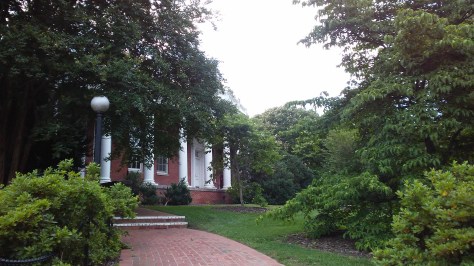
Pictured are the Amphitheater, Mason Hall, The Link, Randolph Hall, Russell Hall, Brent House and Marshall Hall.

*****

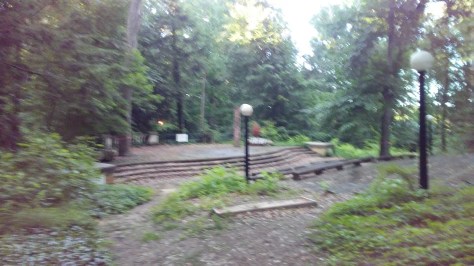
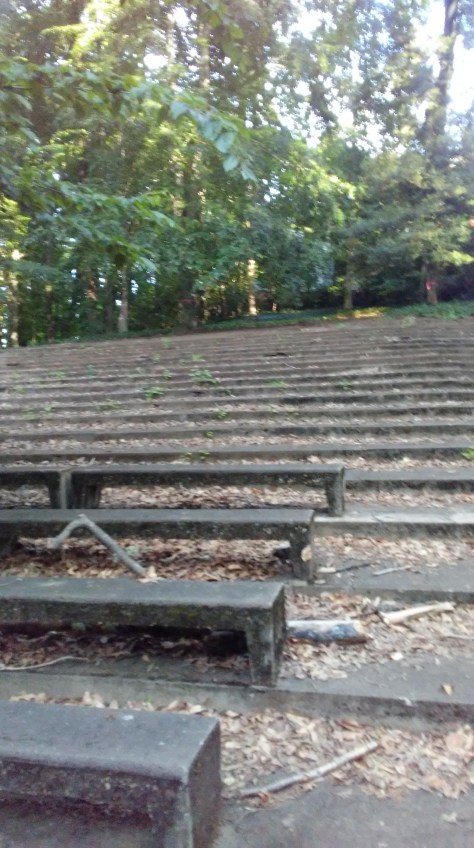
The Amphitheater.  Sorry the first picture is so blurry.

20170606_191642

Me, performing “Richard III.”  “NOW IS THE WINTER OF OUR DISCOVFEFE.”  I was the toast of Sunken Road.  The performance was brief; I only know two lines of “Richard III” — one, if I get stage fright.

Seriously, though, if you people haven’t checked out David Morrissey’s treatment of its famous monologue, then you don’t know what you’re missing.  You can find it on Youtube.

20170606_191723

I have no idea who I am supposed to be saluting here.  My Alumbud taking the picture?  Any competent commanding officer would take one look at that gut of mine and then BUST ME RIGHT DOWN DOWN TO PRIVATE.
20170606_191729

20170606_191755


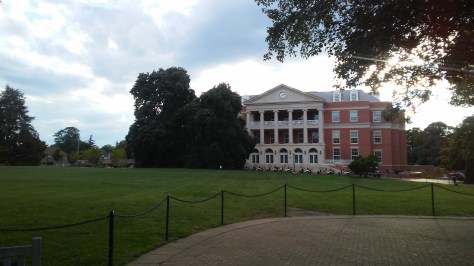
Mason Hall and Randolph Hall, with the above-ground “Link” between them — a new product of the campus-wide remodeling.  Previously, there was a line of dorm rooms unofficially known as “The Tunnel,” beneath a massive stone porch overlooking Fredericksburg.  That porch was a great place to read, and I’m sorry to see it gone.

20170606_192015 (1)

20170606_192000


Another blurry picture — this one of Russell Hall.  The old steps have been upgraded.

20170606_192156


Seen from Russell is … Brent Hall?  Is it weird if I have no memory of that building — and I lived right across the way over at Bushnell Hall?

20170606_192302


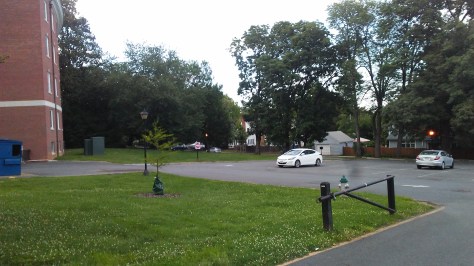
The parking lots at the southeast corner of campus, behind Russell and Marshall Hall.  Running behind those is Sunken Road, where a few of my friends had off-campus housing.  There was a smallish apartment building (north of this spot) where various classmates of mine in the early 1990’s could be found residing or visiting … was it called Sunrise Apartments?

20170606_192352

20170606_192329


Marshall Hall.

20170606_192400


Cover to “Green Lantern Corps” #22, Pat Broderick, 1992

46d71dc5b5d063f7c7e798ee70d6f4d1

Saffire’s “Nobody’s Fool,” 1992

From their album, “Broad Casting.”


Mary Washington College, Fredericksburg, VA, June 2017 (2)

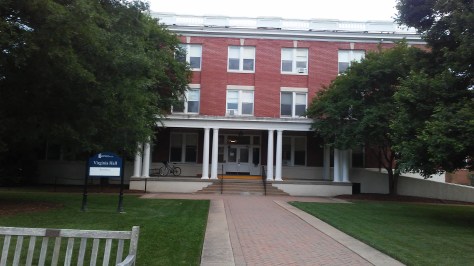
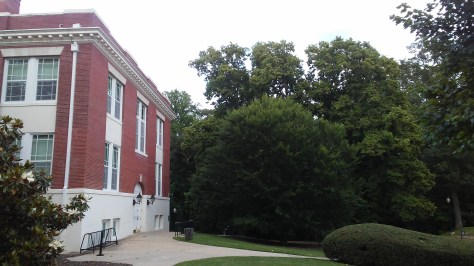
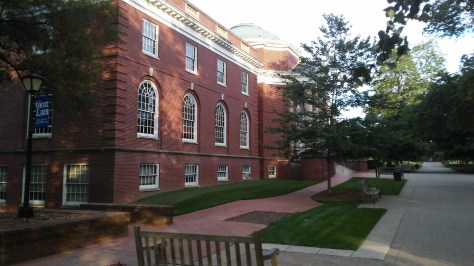
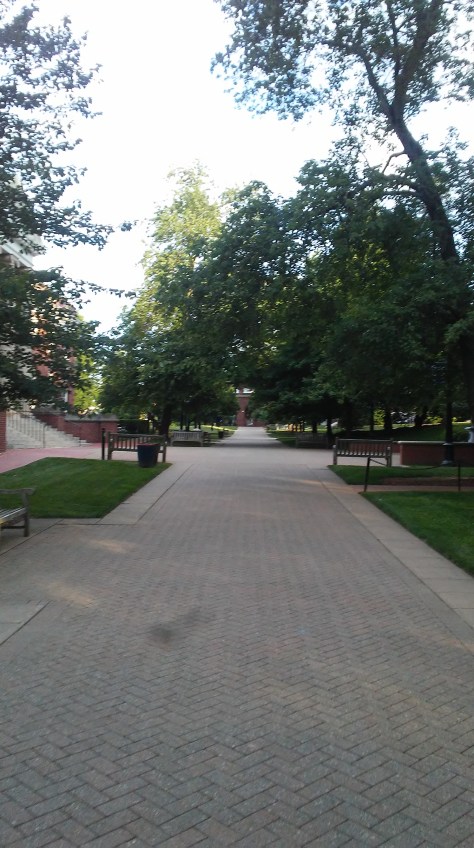
Pictured are Monroe Hall, Virginia Hall, Campus Walk, Lee Hall, and Trinkle Hall.

*****

The Mary Washington College Campus looked as beautiful as ever last week — it was only marred by the occasional sign bearing an embarrassing misprint.  (They perplexingly refer to the misnomer “University of Mary Washington.”)

At first I hesitated to visit the campus during my stop in Fredericksburg, Virginia on my way to Washington, D.C.  I asked my Alumbud if two men in their 40’s would look suspicious there, given the increased security on today’s college campuses.  He told me to relax — people would assume we were two fathers scouting the school for their respective offspring.  That made me feel really, really old.


Monroe Hall and The Fountain.  When I went to school at MWC, that fountain was occasionally doused with either detergent or dye as a prank.

20170606_191016

20170606_191038


Virginia Hall.  In the early 1990’s, this was a dorm exclusively for freshmen girls; I don’t know if that’s still the case today.

20170606_191031


You can’t see it here, but beyond that hedge and beside Monroe is Campus Drive, curving down past the amphitheater to Sunken Road.  The long hill is still entirely wooded, and is still arguably the prettiest part of campus.

20170606_191114


Campus Walk and Lee Hall.

20170606_191156

This is cute.  I’m guessing it was a product of the recent remodeling?  But which way to Winterfell?  Metropolis?  Which way is Caprica City?  I have tickets for a Buccaneers game next week.

20170606_191215

20170606_191228

Here is where the College Bookstore used to be (beside the Campus Police Station in the lower part of Lee); I’m told now that it’s in a vastly larger space upstairs.

And The Underground has returned!  It closed after my freshman year in 1990-91.  I met a lot of good friends there, and I heard my first live blues at The Underground, too, performed by Saffire, The Uppity Blues Women.  (I only just now learned that Saffire’s Ann Rabson sadly passed away in 2013.)

[Update: an alumna just told me that she can remember when The Underground was called “The Pub.”]

20170606_191310


Campus Walk and Trinkle Hall.  My Alumbud reminded of what seemed like a big issue back in the day — the students’ desire to have a 24-hour study hall.  They successfully petitioned the college administration for it, and at some point toward the end of my college career, Trinkle began staying open all night.  If that sounds incredibly nerdy, it was.  But it was also a pretty big quality-of-life issue for the dorms.  A lot of people needed a place to go to cram before finals, in order to keep the peace with a sleeping roommate.

The “computer pods” were also located here, downstairs, in a basementish-type space that was air-conditioned to the point where it felt freezing.  You always had to bring a jacket or sweater to do your work there.

20170606_191334

Looking south on Campus Walk, you can just barely make out the Bell Tower, a product of the campus remodeling.  You used to be able to see Bushnell Hall, my freshman-year dormitory.

20170606_191342

20170606_191405

The bust of Dr. James L. Farmer, Jr. that the school erected opposite Trinkle Hall in 2001.  He was one of the nation’s foremost leaders in the Civil Rights movement, founding the Congress on Racial Equality (CORE) and organizing the “Freedom Rides” to desegregate interstate bus travel.  Dr. Farmer was my Civil Rights professor in 1992, and he was universally admired by his students.

Some weird old guy wandered into the photo here — sorry about that.

20170606_191436


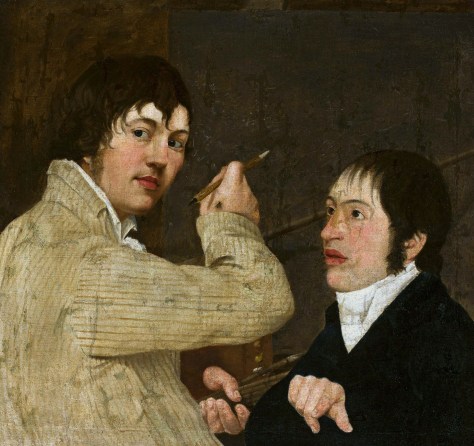
“Self-portrait with a Friend and a Fly,” Jan Antoni Blank, 1806

Oil on canvas.

Blank_Self-portrait_with_a_friend

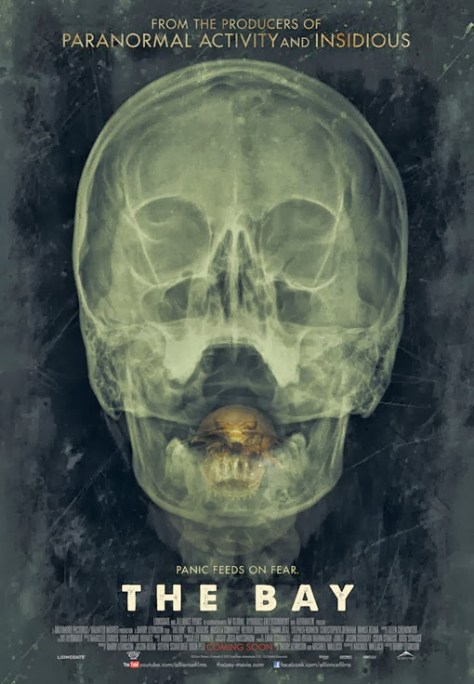
A short review of “The Bay” (2012)

“The Bay” (2012) deserves credit for its effort to give viewers a detailed and well developed, found-footage science fiction-horror movie.  In depicting a brutal parasitic infection eradicating a small coastal town, writers Barry Levinson and Michael Wallach appear familiar with the basics of epidemiology and public health.  And they make nice use of a time-honored sci-fi standby — pollutants causing small organisms to mutate into large ones.
Levinson and Wallach are ambitious too.  “The Bay” follows a number of intertwining narratives winding through the entire town,  making use of more than a dozen actors and innumerable extras.  Some of those actors are quite good — especially those portraying emergency professionals, like the local emergency room doctor, the staff for the Centers for Disease Control and the bureaucrat from the Department of Homeland Security.  I think a story with this scope, and with this many characters, would have made a fine ecological techno-thriller novel.  The filmmakers really do serve up a thoughtful, serious cautionary tale that is sometimes frightening.

Despite its strengths, however, “The Bay” is still encumbered by some noticeable flaws.  There’s little structure to it, the pacing feels off, and we follow so many characters that it is hard for the viewer to get to know any one of them.  There is a news reporter whose point of view serves as a framing device, but she’s performed with little energy by the main actress, and her character isn’t scripted to be terribly likable to begin with.  Parts of the film feel redundant, too.  Levinson (who is also the director here) keeps replaying footage and key dialogue, and it’s a poor choice.

All things considered, I’d rate “The Bay” a 7 out of 10.


TheBay

Cover to “Kingdom Come” #3, Alex Ross, 1996

Kingdom_Come_3

Mary Washington College, Fredericksburg, VA, June 2017

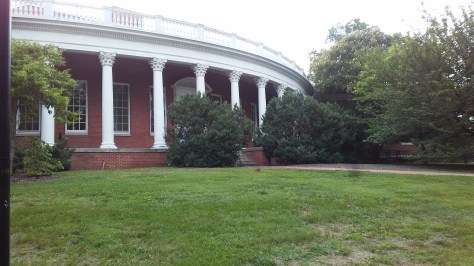
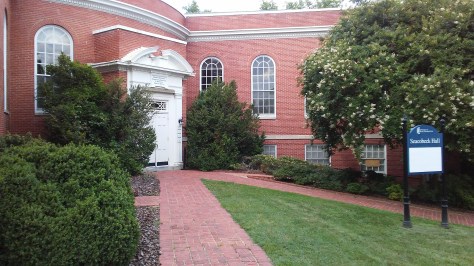
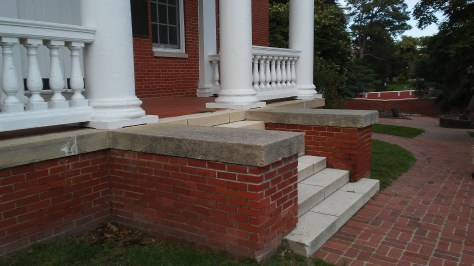
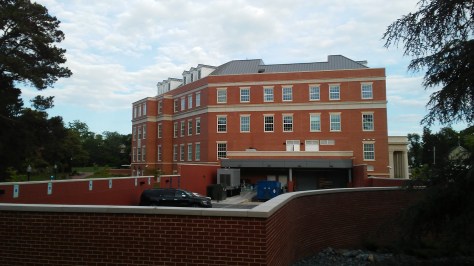
Seacobeck Hall and the University Center.

*****

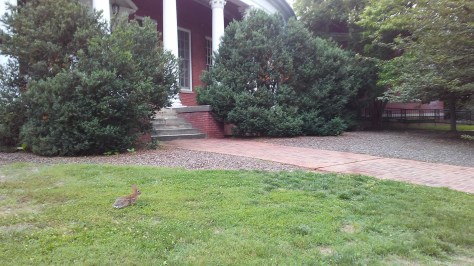
This Seaco-rabbit (lower left) outside Seacobeck Hall was one of many overrunning campus this past Tuesday. Between them and the myriad groundhogs, it was like an invasion, or at least “Soylent Green” meets “Night of the Lepus.” Were these the secret ingredient for Rose Room’s delicious cheeseburgers?  (Seacobeck Dining Hall was the school’s cafeteria — and one of the places where I worked — when I attended in the early 1990’s.)

I’m lucky the rabbits things weren’t so omnipresent when I was a student. I would have inevitably spent many hours trying to catch one, so I could bring it in for a “Waiter, there’s a hare in my soup” joke.

20170606_190750

20170606_190715

20170606_190657

20170606_190636

20170606_190548

Here’s the spot facing College Avenue where I would relax after working a shift — eating Rose Room cheeseburgers and fries.  All jokes aside, we had a really decent head chef back in the day.  The food was often quite good.

20170606_190530


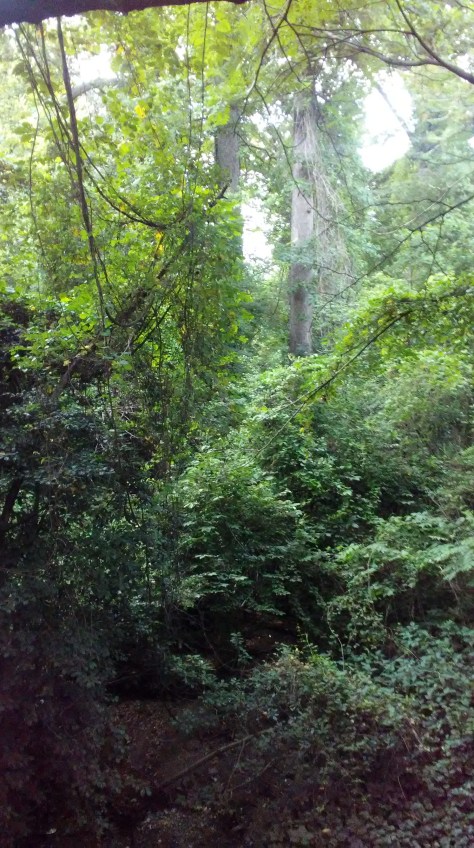
The ravine beneath the Seacobridge is almost entirely invisible under Spring growth.

20170606_190907


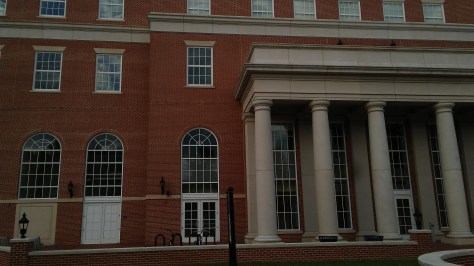
Chandler Hall (where I took both my psychology and my writing classes) was razed years ago.  In its place is the gigantic “University Center.”  There is still an interior “Chandler Ballroom.”

20170606_191251

20170606_190618

20170606_190343


Depiction of the sacrifice of a boar, circa 510 B.C.

Depiction of the sacrifice of a young boar, with kalos inscription (ΕΠΙΔΡΟΜΟΣ ΚΑΛΟΣ). Tondo from an Attic red-figure cup, ca. 510 BC–500 B.C.


Sacrifice_boar_Louvre_G112