The first group of photos here is from the “Bulletin of the State Normal School” in 1915. The last one was captioned “The Cannon Pits.” Wikimedia Commons, from which I took all of these, often includes the original yearbook texts.
I wonder if the mounds of dirt we see as “the cannon pits” here are the same ones that still existed in the woods just south of Bushnell Hall in 1990. I lived at Bushnell my freshman year and wandered over there a few times; it hid a nice vantage point overlooking William Street heading downtown — it was where I smoked my first cigarette.
A few of the kids said those mounds were the remains of Civil War gun emplacements; at least one reported speaking with a ghost. The site was overgrown and entirely unrestored when I was a student. Are these the same?
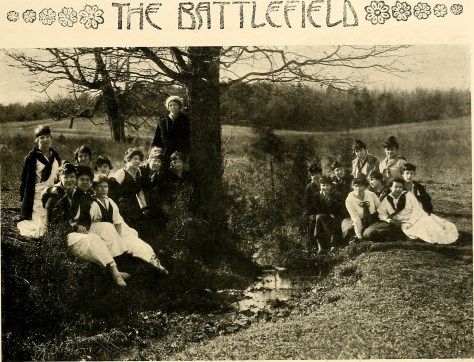
This photo was taken from the 1916 “Battlefield” yearbook. This is “the Dramatic Club,” and the caption for the photo appears to include a reference to the World War I occupation of Belgium by Germany: “Since its organization, the Dramatic Club has presented, on an average,two plays a year. The proceeds have usually been given to the Deco-rative Committee to be used in decorating the School. Last year, one-third of the proceeds was sent to the Belgians. The aim of the Club is to studyas well as present plays. We have joined the Drama League of America, from which we hope to gain beneficial results.”
These photos are taken from “the Bulletin” in 1917. I get the sense my “Generation X” alumnae studied slightly different curricula.
The girls in 1917 also had a far more generous assessment of the City of Fredericksburg than the kids that I remember: “Its climate is ideal, and we know of no city that has a more favorable health record. It is progressive in its government, and has recently adopted thecommission form of government. The city is favored with superior telegraph and telephone facilities, ample mail service, water supply,gas, electric lights, and all the usual city conveniences.”
Here’s what they had to say about their dorms: “The buildings, as the photographs show, are large, convenient, and handsome, and are equipped with all modern conveniences for the comfort of the students and the work of the school. The dormitoriesare of the Ionic and Doric types of architecture and are the shape ofthe letter H. The students and several members of the faculty livein the buildings. Every students room is well lighted and ventilated.In fact, there is no dark room in the building except a few rooms used exclusively for storage purposes.”
A couple of Facebook posts last night cheerfully proclaimed the 30th Anniversary of The Beastie Boys’ “Licensed to Ill.” That’s mostly right, I guess … the album was released in 1986, although it came out on November 15, not the end of February.
I remember “Licensed to Ill” being a phenomenon when I was a freshman at Longwood High School — reverence for it transcended a lot of high school subcultures. (And at Longwood, I think those subcultures overlapped considerably more than your typical John Hughes film would suggest.) The preppie kids loved the album, the jocks loved it, and a lot of the honors kids were into it too — not to mention just mainstream kids and random weirdos like me. My favorite song was “Brass Monkey;” I was thrilled whenever it was played at parties. (I can’t feature it here, as there are no authorized videos of it online.)
This album had what I remember as a unique vibe to it in 1986. People online call the Beastie Boys “the first white rappers.” I don’t know if that’s true. (Some people said the same thing about Vanilla Ice only four years later). And I’m guessing such a distinction shouldn’t be important. But the Beastie Boys were different.
Previously, rap was perceived only as a kind of counterculture art form for disaffected, young, urban African-Americans. The Beastie Boys were a rap group specifically with which suburban white kids could identify. I hope I’m not saying anything politically incorrect here — of course we all realize that any music can be appreciated by anyone, according to their tastes. (People are occasionally surprised when I myself can recite the Geto Boys as easily as W. H. Auden’s poetry.) And all sorts of kids in the mid-80’s liked Run-D.M.C. and The Fat Boys — they just didn’t have the huge, visible mainstream appeal that the Beastie Boys had.
The Beastie Boys had a wider appeal. Their music was irreverent — they sang about “Girls,” liquor, and the “Right to Party,” in a manner suggesting that they’d probably never been altar boys. They were drunken, pot-smoking malcontents, and expressed some not terribly progressive attitudes toward women. Yet it was perfectly natural, or culturally expected, to hear them blasted at a parentally approved, non-alcoholic party for young teenagers at a suburban, middle class home. The same preps who wore “Ocean Pacific” and played with hacky sacks also played the Beastie Boys. So did some kids in Key Club and the honors classes. A couple of cheerleaders I knew had crushes on Mike D. And it never seemed unusual or ironic, like that time when a nearly all white, suburban crowd chanted along to Boogie Down Productions’ “South Bronx” at a Longwood Junior High School dance.
For some reason, the Beastie Boys’ broad fan base was never really evident among the student body at Mary Washington College — although The Jerky Boys and the Geto Boys both had their share of fans there. I don’t remember them being played once. I think maybe it was because that small southern college subculture leaned so heavily on classic rock and the new “alternative,” with new wave and punk having strong, visible minorities of fans. (Man … if I had a dime for every time time I heard The Allman Brothers in college, I could have paid off my student loans a day after graduation.)
Strangely, I wound up listening to “Licensed to lll” the most often about two decades later, when I was in my mid-30’s. I was going through two weird phases in my life. The first was a newfound love of hip-hop and rap, because I am a weird guy, and I’m always late to the party with these things. The second was a bizarre, temporary sense of financial responsibility. I was constantly saving money. (I think maybe I wasn’t eating right or something. It didn’t last.) But I was constantly listening to old or cheap secondhand CD’s, instead of buying new ones or one of those newfangled mp3 players. (At the time, the iPod’s antecedents seemed just too high-tech and opulent to me.) So there was always a leather case of 80’s and 90’s music CD’s riding shotgun with me in my 1992 Ford Taurus.
I was driving frequently between Whitestone, Queens and my girlfriend’s apartment in Park Slope, Brooklyn, rocketing up and down “the 278,” the Brooklyn-Queens Expressway. The Beastie Boys were my miscreant co-pilots; “No Sleep till Brooklyn” was both a kick-ass song and situationally apropos. I played the album constantly, along with L.L. Cool J.’s “Mama Said Knock You Out,” and the “MTV Party To Go Volume 2.” Then I’d swap those out with Toad the Wet Sprocket’s more mellow, sensitive “Fear,” just to remind myself that I really was just a softspoken college boy who’d grown into a nerdy thirtysomething (“nerdysomething?”).
I found out recently that Adam Yauch (the Beastie Boys’ member “MCA”) died of cancer. This happened four years ago, I just hadn’t heard. For some reason, it was especially unsettling to learn that a rebellious entertainment figure from my teen years had died from an illness that I usually associate with people older than me. I never loved the Beastie Boys as much as I loved U2, Depeche Mode or Tori Amos, but I found it more troubling than I would have expected. I’m not sure why, but I’ve decided not to dwell on it.
At any rate, if you still love Ad-Rock, Mike D. and MCA, you can play the embedded videos below. But you absolutely should pull up “Brass Monkey” on Youtube to get your full 80’s vibe on.
I don’t know if this is real or not. But if they made a monolith toy that hummed or vibrated when you touched it? That would be the frikkin’ GREATEST collectible ever and I SWEAR I would fork over so much cash for one.
Can you imagine having writer’s block, or trouble concentrating, and using this plus black coffee to get your game back?
If it doesn’t hum or vibrate, though, this would fall firmly into “pet rock” territory.
For now, any extra money I might have for fanboy squandering will be saved for a nice Green Lantern ring. (They appear to be sold in abundance from multiple sources — whether or not with DC’s blessing remains unclear to me.)
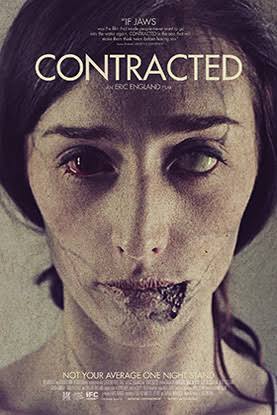
“Contracted” (2013) actually begins with a creative, compelling premise for a zombie-horror movie — what if the zombie contagion began as a sexually transmitted disease, and we viewers followed the horrifying experiences of patient zero at the pandemic’s inception?
Unfortunately, any praise this movie deserves ends there. It’s poorly written. I get the sense that writer-director Eric England has only the vaguest ideas about what a primary care physician does or says, or how any medical professional might react to an unidentified contagion. He also shows us a world in which the local police are evidently responsible for investigating disease outbreaks, and where 20-somethings are sexually attracted to partners who are visibly, violently ill with what looks like some kind of flesh-eating plague.
England’s direction is also lackluster, as is most of the acting. (An exception is that of lead actress Najarra Townsend.)
This story actually gets interesting when the viewer finally sees its events in tragic context — but that takes places less than two minutes before the credits roll. (You’ll understand what I mean if you manage to sit through this.)
I’d give “Contracted” a 2 out of 10 for a creative story idea, and I’d recommend you skip it.
[THIS POST CONTAINS SPOILERS FOR THE MID-SEASON PREMIERE OF “THE WALKING DEAD,” AS WELL AS THE ORIGINAL COMIC BOOK SERIES.]
Okay, I am almost always wrong in my TV prognostications, but I can’t resist sharing my newest “Walking Dead” fan theory, as it seems like something nobody else has picked up on.
In the (quite outstanding) Season 6 mid-season premiere this past Sunday, Daryl Dixon receives a minor knife wound from one of Negan’s men. It isn’t a dramatic moment; it occurs off screen. It also isn’t a plot point, as it affects nothing else that occurs during the episode’s story.
Yet the writers do make an effort to show that it happened. We see it below his left shoulder, Sasha talks to him about it, and we see him being treated by Denise at the show’s ending. It seems to have been placed there for a reason.
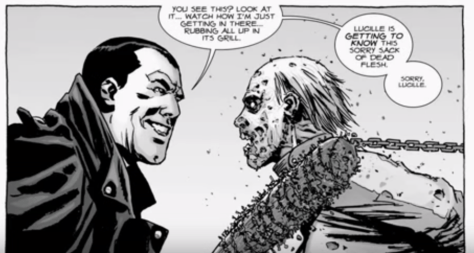
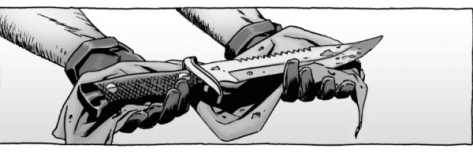
Well … in the comics, something similar happens to certain minor characters. After a pitched battle with Negan’s forces, they succumb to the zombie contagion after receiving minor wounds from knives or crossbow bolts. (Daryl isn’t a character in the comics, but a bad guy wields a crossbow.) They die, to the surprise of their friends and the doctor treating them. That’s because Negan has instructed his men to contaminate all of their blunt or bladed weapons with tissue from the zombies. (It’s a particularly nasty plot development in a pretty brutal comic series.)
Of course, I am nearly always wrong on these things. And it could just be a red herring — it wasn’t too long ago that we saw Rick nursing a wounded hand throughout an episode or two, leading to fan speculation that he’d been bitten and infected.








 Eric Robert Nolan, Author