I’m calling it. Historians will look back on the advent of social media as a key escalating factor in international crises.
It actually isn’t always a very good thing when heads of state can spontaneously interact in real-time, at any moment, without their staffs vetting or tempering their messages, even when those heads of state are tired or upset or under the influence of drugs or alcohol.
And there’s more here to consider. If you’re in your 40’s, as I am, you can remember that good friend from high school who you got along swimmingly with if you occasioned to speak with them twice a year — maybe on the phone, maybe when you visited the old neighborhood. You held diametrically opposed views on politics or religion, but those things seldom arose in conversation.
Then Facebook and Twitter brought all of those differences front and center. You could be reminded of them every day — in a platform of interaction that is manifestly habit-forming. The ease and availability of that interaction paradoxically drove you apart. (Recall, please, the old adage that “high fences make good neighbors.”) You woke up one day and realized that your good friend from high school wasn’t such a good friend any more.
What we are witnessing today is a case of technology having disastrous unintended consequences.
“The Door” (Part I. of “The Quest”), by W. H. Auden
Out of it steps our future, through this door
Enigmas, executioners and rules,
Her Majesty in a bad temper or
A red-nosed Fool who makes a fool of fools.
Great persons eye it in the twilight for
A past it might so carelessly let in,
A widow with a missionary grin,
The foaming inundation at a roar.
We pile our all against it when afraid,
And beat upon its panels when we die:
By happening to be open once, it made
Enormous Alice see a wonderland
That waited for her in the sunshine and,
Simply by being tiny, made her cry.
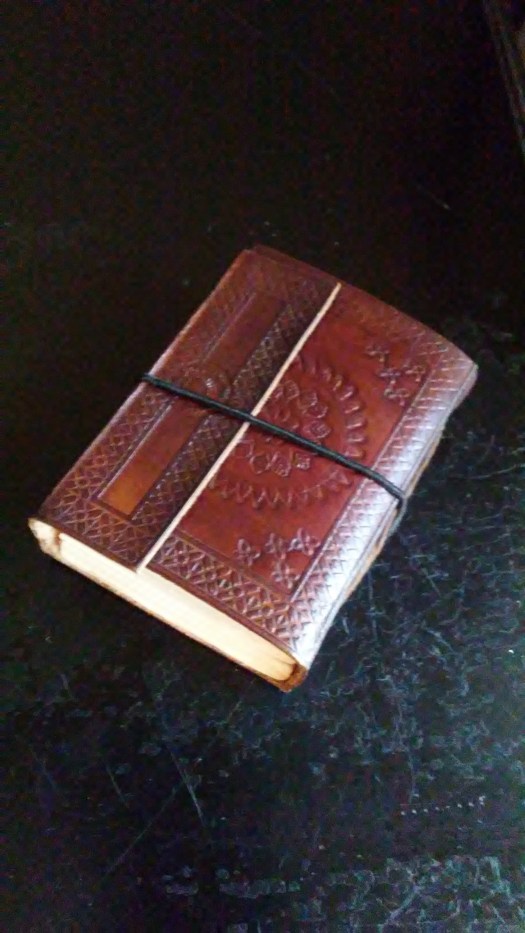
This handemade leather-bound volume is about the length of my forefinger; it was an especially cool Christmas present from a writer friend of mine. She picked it up for me at a Renaissance Faire. She told me I could write all my “secret thoughts” here. (I’ve got a lot of ’em.)
I personally like to think that it looks like something out of Stephen King’s “The Dark Tower” universe, like maybe the place where Roland inscribes clues about his quest. (I know he doesn’t need to search for clues in any of the books, but still.) Or maybe it’s a convenient pocket-tome for the vengeance-driven Arya Stark from “Game of Thrones” to keep her “list.”
I haven’t yet decided precisely what I will record here. I quite love it, though. It’s sitting on my desk as a reminder for me to write. (You know what would fit perfectly on a single page? All the progress I’ve made on my novel in the past six months. Maybe I’ll start with that.)
“An Ode to the Paintings of a Newly Discovered Artist”
In smoke-tones
as only oldest memories will slow their burns to smolder,
her visions sift
as softly as ash,
breeze-blown and balmy,
will filter forward noiselessly in palling ebon fingers:
the dim ellipses of faces, our silhouetted lost,
their bewitching figures now remembrances unlit, all
ordered under odor of the flare.
Silently out of the late-day hearth,
the spent fire’s sigil on the floor
angles out of chance into her portraitures of soot.
Below are the trailers for all four major film iterations of “Invasion of the Body Snatchers.” Though these movies enjoy varying degrees of fame, they all remain close to my heart. There is just something about Jack Finney’s original paranoia-inducing story idea that’s timeless and frightening. (Finney’s 1955 novel served as the basis for the first film, directed by Don Siegel, a year later.) And I always thought that the identity-stealing, alien body snatchers were an elegant monster concept too, because they can be rendered effectively on film with little or no special effects.
The first trailer is for the original 1956 classic, which still holds up surprisingly well. (If you haven’t seen it, then you might discover that it’s got more urgency and less camp than you’d expect from a typical 1950’s alien invasion flick.) The second trailer is for the genuinely frightening 1978 remake, which is, quite simply, one of the top science-fiction/horror films of all time.
I was introduced to both of these movies by my “movie uncle,” Uncle John. I remember thinking the original was far better than I’d expected for an “old black-and-white.” (I’d had a an adolescent’s predictable skepticism about old movies.) And the dour 1978 masterpiece got under my skin and stayed there forever.
The 1993 installment, simply titled “Body Snatchers,” is probably the least well known — I’ve never heard it mentioned outside of horror fan circles. I myself had never heard of it until I stumbled across it in a video store more than a decade following its release. It had a very limited theatrical release, and it sometimes feels like the most generic of the “Body Snatchers” movies — like maybe a made-for-television movie or an especially good entry for the first revival of “The Twilight Zone” (1985-1989).
I love it. You could tell it was a labor of love for its screenwriters and its director, Abel Ferrara … it was obvious that they truly “got” Finney’s concept, and that they set out to deliver just what genre fans wanted. This “Body Snatchers” was freaky, fast-paced and unsettling, and I still feel it deserves a broader following.
The fourth trailer is for the most maligned and recent adaptation of Finney’s novel, 2007’s “The Invasion.” (My god, was this really made 13 years ago? Tempus fugit.) People really dislike this movie, despite a cast led by Nicole Kidman and Daniel Craig. It was generally panned by both critics and audiences, and I sorta understand why. It’s got its share of flaws — most notably a hasty happy ending that feels tacked on by the studio. I don’t quite love it, but I really like it quite a lot — it’s stylish and ambitious and has a lot of creepy moments. And if you think Nicole Kidman is easy on the eyes, as I do, you’ll see that she looks like a million bucks here.
If you really enjoy these films and are hungry for more, there are two other alien invasion movies that seem to channel the same muse as Finney’s. The first is 1994’s “The Puppet Masters” by Stuart Orme. (It should not be confused with its soundalike contemporary, the “Puppet Master” (singular) horror franchise, which depicts demonic dolls.) “The Puppet Masters” is campy, but still very cool, and it adapts the eponymous 1951 novel by Robert A. Heinlein.
The second recommendation I’d offer is 1998’s “The Faculty.” It’s an even campier horror-comedy aimed more at mainstream audiences, but it’s still a lot if fun.




 Eric Robert Nolan, Author