“One link is missing, Prospero,
“My magic is my own;
“Happy Miranda does not know
“The figure that Antonio
“The Only One, Creation’s O,
“Dances for Death alone.”
— from Antonio’s refrain, in W. H. Auden’s
“The Sea and the Mirror”


“One link is missing, Prospero,
“My magic is my own;
“Happy Miranda does not know
“The figure that Antonio
“The Only One, Creation’s O,
“Dances for Death alone.”
— from Antonio’s refrain, in W. H. Auden’s
“The Sea and the Mirror”
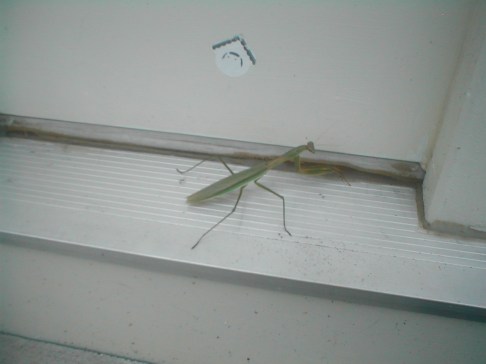
Known also as the praying mantis.
We’ve got ’em in New York. But they are both larger and far more numerous in Virginia.
Apparently, the ancient Greeks regarded them as magical creatures who could tell lost travelers the way home.


“Oh mother,
“What tree is this?
“What wounds are these?
“I am Attis on the pine.
“Christ on the cedar.
“Odin on the world ash.”
— from “Arkham Asylum: A Serious House On Serious Earth,” by Grant Morrison and illustrated by Dave McKean
People tend to think of either “The Dark Knight Returns” of “The Killing Joke” as the seminal “dark” Batman graphic novel.
I suggest that this trounces both of them.

Well, this is pretty meta … Dead Snakes has featured two poems about “Dead Snakes,” by author Mary Bone. And they’re both quite good.
http://deadsnakes.blogspot.com/2015/10/mary-bone-two-poems.html
I visited the gardens at Dumbarton Oaks in Georgetown the other day — after a cruise down Wisconsin Avenue past a couple of old haunts I frequented in my 20’s with characters like Nickolai Butkevich and Rhett Carlson.
The gardens were beautiful, and a sharp fir smell greets entrants like a rarefied, ethereal, quiet host. It reminded me of Brooklyn Botanical Gardens, another quiet place to which I’d like to return one day.
If you’re in the Washington area, and you’d like to see for yourself, check out Dumbarton Oaks’ website here:






Photo credit: http://www.ForestWander.com [CC BY-SA 3.0 us (http://creativecommons.org/licenses/by-sa/3.0/us/deed.en)%5D, via Wikimedia Commons.
La Fe Pulpo es deliciosos, en cualquiera marinara o aceite vegetal.
Octopus is a little harder to find in Virginia, but you can find it in specialty supermarkets. Le Fe is a brand I haven’t seen in New York, but it’s damn good.
Anyway, what’s up with the weird rumor going around word nerd circles? Turns out the correct plural for “octopus” actually IS “octopuses,” and not the Latin-sounding “octopi?”



What is the definition of serendipity?
You JUST finish figuring out how to operate your new digital camera that arrived in the mail, you lie back on your bed, and, right at the very moment, AN EAGLE SOARS PAST YOUR WINDOW.
I was so thrilled when I snapped this yesterday. Yeah, I know that you kind of have to squint to see the eagle here. (You can click twice to really enlarge the photo — then you can see it better.)
My Virginia friends probably think I’m nuts for getting so excited about this. But this kind of thing just doesn’t happen every day to a New Yorker.


I rarely have time to write book reviews and, when I do, they tend to be brief.
But I have a few reviews up over at Amazon, including a couple of rundowns of comic book collections in trade paperback. If you’re curious, click here:
Amazon.com book reviews by Eric Robert Nolan
Photo credit for image above: Detail of arch outside the Duomo, in Milano, photo by Giovanni Dall’Orto G.dallorto (Own work) [Attribution], via Wikimedia Commons.
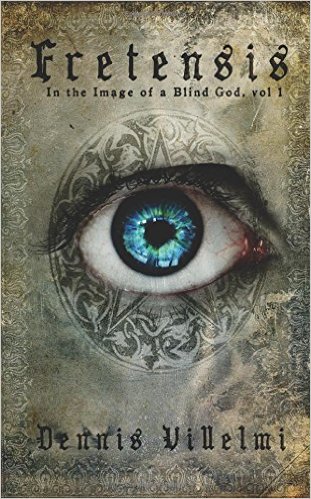
With “Fretensis: In the Image of a Blind God, volume 1” Dennis Villelmi expertly enmeshes the reader in a twisting, troubling narrative that is both mythic and tragically personal for the poem’s speaker. It’s a unique work, employing both arcane myth and personal impressions in equal measure. And it’s a hell of a ride.
“Fretensis” is a 56-page book of dark, modernist poetry divided into three parts and baroquely illustrated with medieval woodcuts and other images of the monstrous and the grotesque. The narrative it presents is like nothing else I’ve discovered reading poetry. Its protagonist is a rich intellect and a troubled soul. The mood of “Fretensis” throughout is striking; the overall work expertly conveys sadness, desperation and an enervating sense of struggle. (In the interest of full disclosure here, Villelmi is a valued friend and a poet whose work I have long admired.)
“Fretensis” might be challenging for the average reader. It might take a seasoned academic to understand all of its references and allusions while also understanding their significance within the poem. Villelmi draws on what appears to be an encyclopedic knowledge of ancient history, myth and religion. (He studied philosophy at Old Dominion University, but his expertise is visibly far more expansive in all of his work.) The title of this story, “Fretensis,” is the name of the Tenth Roman Legion, employed at the start of the Fall of the Roman Empire. As with Villelmi’s other published poetry, this debut book is linked intricately to those myths and symbols from which he draws inspiration.
But this is a good thing. Villelmi’s dark and antiquated iconography makes his work unique and unusually rich. This is a poem that begs for rereading and further scrutiny. I myself gleaned so much more from my second reading.
If I could name one thing about Villelmi’s style that makes his work distinctive to me, it would be how he meaningfully interweaves his esoteric symbols and references with the narrator’s personal experience. That duplexity characterizes the entire book, and it makes “Fretensis” remind me of a personal favorite, W.H. Auden’s “September 1, 1939.” That famous poem and its “accurate scholarship” also uses classical references to frame the narrator’s personal experience in context. (In Auden’s case, he called upon Thucydides, Luther and others to frame his own reaction to the 1939 German invasion of Poland.)
Villelmi’s resulting juxtaposition, which is consistent throughout the book, makes for an excellent poetic device. Memphis, Egypt, is made interchangeable with Memphis, Tennessee. References to Jeudayn are used to provide context for the death of a prostitute. A small boy plays “Deity” in “a grey dirt patch behind [a] garage.”
Consider the context that he employs to describe ravens feeding upon a dog’s carcass:
“Driving, I find it ironic, even inappropriate, that as the roadside augur is a dog on which the forest ravens have come to feast on the meat pulled out from under the fur, courtesy of other scavengers, the convent isn’t named after St. Paul. Paul and ravens both know how to seize an opportunity. Rather, it’s named for Fiacre, an old Irish woman-hater of the woods. I once read there were other Fiacres predating Christ’s arrival on Irish soil; they were warlords, predators by serendipity, much like those ravens chowing down on the mutt.”
And Villelmi’s mastery of the language is truly enviable. I found myself most immersed in “Fretensis’” prose-poetry sections. I’m not sure why, but here is where I best felt that I could identify with the narrator. These seemed the most personal to me. They’re so beautifully illustrated by the narrator’s sad, resigned voice that they have the feel of a genuine vignette spoken by a real person.
Consider the opening of “Part II: The Whore’s Afternoon.”
“On my ongoing canvas, there’s only been caricatures and carcasses, with a highway torture dividing the two. Somewhere, I took a detour of forgeries and virgins, and lost the rest of the America I was meant to see …
“Every time I try to measure the time I get a case of dry mouth. That’s how I met Ettey, Ettey Roth. She, too, had a memoir, not unlike mine, and it was over slugs in Seire’s Tavern time and again that we found the mutual souring of our lives to have been rooted in the hems of our birthplaces.”
All in all, “Fretensis” depicts a universe that is both twisting and twisted – a byzantine existence where an eloquent narrator’s darkness is informed by far greater forces that are divine, demonic or both. It’s an accomplished book of poetry that deserves not only to be read, but reread and reconsidered … assuming that you are willing to take that winding, redoubtable journey more than once.
Bravo.
 Eric Robert Nolan, Author