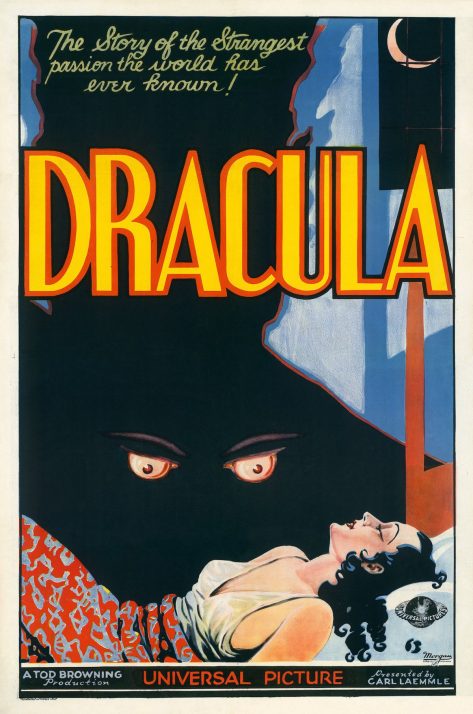
So I finally saw the entirety of “Dracula” (1931) last night, after being alive on this planet for nearly half a century. The iconic image of Bela Lugosi was something I’d grown up with in the 1980’s … most boys back then hadn’t actually seen the original Universal Pictures movie from 50 years’ prior (and of course we hadn’t read Bram Stoker’s 1897 novel), but everyone knew who Dracula was. The character still saturated popular culture via everything from toys to comic books to cartoons to breakfast cereals to countless emulations in contemporary movies. You weren’t a boy in the 1980’s if you didn’t dress proudly as Dracula at least once for Halloween.
But … despite it being such a cultural touchstone, this 1931 film might have been overhyped. That’s just my humble opinion, and I do realize it might get me in trouble with horror fans — or even just film buffs in general. I personally found Lugosi’s performance underwhelming. Look — I understand that he looked and sounded the part, especially with his height of 6’1, and his unique and intimidating stare. But he was a pretty staid and even low-energy actor, at least here, I think. For me, he was quickly overshadowed by the wide-eyed Dwight Frye, in his supporting role as the manic, psychopathic Renfield. Frye was an expressive physical actor, and he looked and sounded absolutely nuts. That man could be genuinely scary, if this story was presented in a more natural fashion.
Which brings me to my overall concern about the movie — it has a slow pace and a stationary feel to it that are unfortunately derived from its immediate source material — the film was adapted from a 1924 stage play adaptation of Stoker’s book. The book, in contrast, was actually an epic journey, with imperiled characters with lots of agency who reacted quite energetically against its title antagonist.
The difference here is most painfully obvious with a clipped, seemingly bowdlerized anti-climax, where Dracula is killed offscreen. When he’s finally (SPOILER WARNING) staked through the heart, we don’t see it. Instead, we’re treated to a clumsy reaction shot by David Manners, in his milquetoast turn as Jonathan Harker. It’s awkwardly staged. It even feels as though the scene could have been added in post-production, after Van Helsing’s dispatch of the monster was deemed too much for audiences. (Van Helsing himself is played with admirable gravitas by Edward Van Sloan.) It’s weird that so little thought appears to have gone into this denouement, given the detail that seems to have gone into things like the movie’s great sets.
If you want to see a truly impressive antique Dracula movie, I’d recommend the unauthorized (but far superior) adaptation of the famous book — F. W. Murnau’s “Nosferatu: ein Symphonie des Grauens” (1922). Even that historic film can be divisive, though. People like me find it delightfully creepy, while others describe it as flat-out boring.
Oh, well. I still enjoyed “Dracula.” It’s moody and lavish to look at, even in black and white. You can tell that the filmmakers took it seriously — it’s nicely atmospheric, when it isn’t being pulled down by ham-handed comic relief or (sigh) terrible bat puppetry. (They should have known even in 1931 to omit the effect altogether). Sloan’s performance kind of redeems it as a serious horror film, and Frye really shines. (Among other things, he’d go on to become an even more infamous horror henchman later that same year. He was none other than Fritz, the doctor’s hunchbacked assistant, in Universal’s “Frankenstein.”)
“Dracula” can be a lot of fun. It will help you enjoy it if you watch it after dark, if your hopes aren’t too high for being scared, and if you’re curious about what Depression-era audiences might have found frightening. You might really find it interesting if you’re a serious fan of the genre. What I’d suggest is a double-feature, with this movie followed by a no-holds-barred modern vampire movie like “30 Days of Night” (2007) for a point of comparison. That could be an interesting vibe for the night.



 Eric Robert Nolan, Author