Tag Archives: 1939

Cover to “Weird Tales,” Virgil Finlay, September 1939

Weird Tales, Inc.

Weird_Tales_September_1939

Cover to “Weird Tales,” Virgil Finlay, August 1939

Weird_Tales_August_1939

Cover to “Detective Comics” #31, Bob Kane, 1939

det31

“Fear the Walking Dead Poets Society?” With music by Glenn Miller?

Besides its references to Charles Bukowski, Sunday’s episode of “Fear the Walking Dead” also referenced Hughes Mearns’ haunting poem, “Antigonish.”  I might have run this poem on the blog before; it is often referred to as “I Met a Man Who Wasn’t There.”  (This is the piece that the character Phil is reciting when he is found by the search party.)

Strangely enough, I discovered just now that Mearns’ poem was set to music by none other than Glenn Miller himself.  Miller entitled his 1939 jazz adaptation “The Little Man Who Wasn’t There,” which is another individual line in the poem.

Now all we need is zombie prep school lit students in the next episode.


Antigonish,” by Hughes Mearns

Yesterday, upon the stair,
I met a man who wasn’t there
He wasn’t there again today
I wish, I wish he’d go away…

When I came home last night at three
The man was waiting there for me
But when I looked around the hall
I couldn’t see him there at all!
Go away, go away, don’t you come back any more!
Go away, go away, and please don’t slam the door… (slam!)

Last night I saw upon the stair
A little man who wasn’t there
He wasn’t there again today
Oh, how I wish he’d go away…


AMCs-Fear-the-Walking-Dead-Season-3-Episode-5-Madison-Clark-gets-attacked-by-an-infected-inmate-670x388


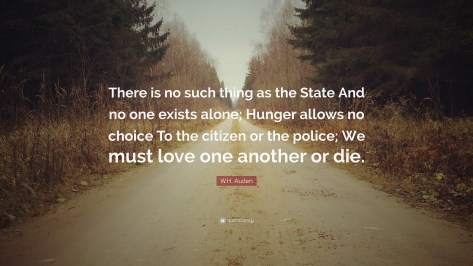
“There is no such thing as the state.”

quotefancy-265966-3840x2160

“Ironic points of light/ Flash out wherever the Just/ Exchange their messages.”

There is no such thing as the State
And no one exists alone;
Hunger allows no choice
To the citizen or the police;
We must love one another or die.

Defenceless under the night
Our world in stupor lies;
Yet, dotted everywhere,
Ironic points of light
Flash out wherever the Just
Exchange their messages:
May I, composed like them
Of Eros and of dust,
Beleaguered by the same
Negation and despair,
Show an affirming flame.

— excerpt from W.H. Auden’s “September 1, 1939”


Nolanferatu’s tip for a trippy vintage horror double feature!

Well there’s one thing I can cross off my bucket list.  (There’s a lot on there, and some of it’s weird.)  I finally saw F.W. Murnau’s “Nosferatu: ein Symphonie des Grauens” (1922).

And am I damn glad I did!  I actually enjoyed it more than I thought I would.  I love plenty of classic movies; “The 39 Steps” (1939) and “To Have and Have Not” (1944) are among my all-time favorites.  But I’m accustomed to modern horror — my tastes generally extend only as far back as “The Birds” (1963) and “Night of the Living Dead” (1968).

I waited until I was in just the right mood.  (This is the first silent film I’ve ever seen from start to finish — the only exception being Mel Brooks’ 1976 parody, “Silent Movie.”)  Then I began it shortly before midnight.

The movie just worked for me. It was sublimely creepy.

I think it helped that the grainy, flickering, black-and-white period footage made this expressionist movie utterly atmospheric for a modern viewer.  These, combined with the shots of Max Schreck superbly made up as “Count Orlok,” were damned unsettling.  Schreck also appeared to be a great physical actor, with his gaunt stance and stilted, inhuman movements.  (Was he unusually tall too?)

The vintage footage also enhanced my enjoyment of the movie in a way that Murnau probably couldn’t have expected.  I know this is strange, but … nearly a century later, the thought that occurred to me several times during this movie was this: “Everyone involved in this production is long dead by now.”  Yes, I know that is a morbid thought — I’ve never done that before!  I think it was just the film itself that did that to me — it’s about undeath and immortality, after all.

It also helped that I’d read Bram Stoker’s “Dracula” (1897), of which this film is an unauthorized adaptation.  The resulting lawsuit by Stoker’s estate is interesting reading: supposedly all copies of the movie were ordered by the courts to be destroyed, bankrupting Prana, the production company.  But a permanent cult following developed for the few surviving prints.

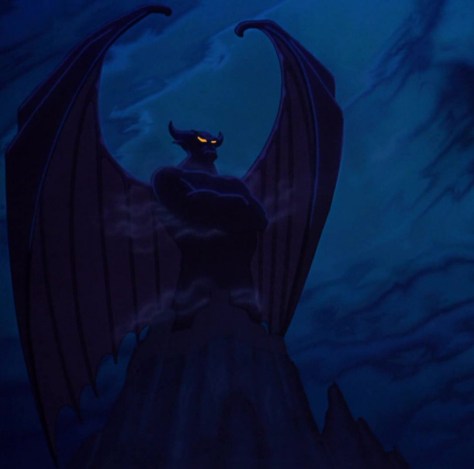
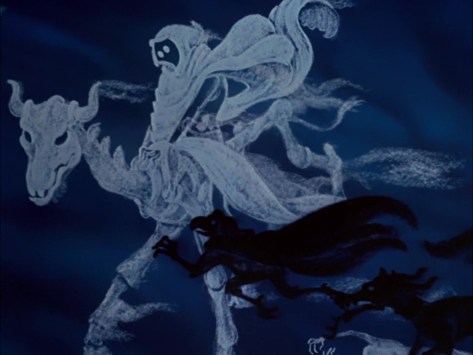
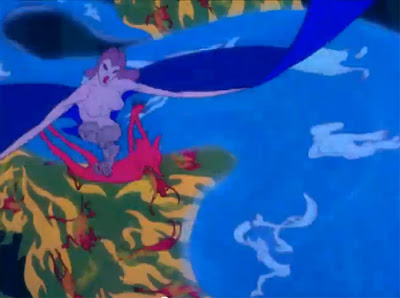
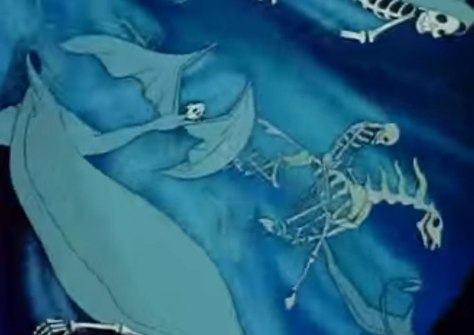
Anyway, I followed this up with the palate-cleansing “Night on Bald Mountain,” the final segment of Disney’s “Fantasia” (1944).  That combination, too, totally worked for me — I followed up the black-and-white nightmare-fuel of the seminal vampire film with some vivid, incongruously hellish Disney nightmare-fuel.

“Nosferatu” is in the public domain.  You can view the entire film on Youtube at the link below.


nosferatu

c1402340b6a518f114e12da99fefa1e8

download

nosferatu10

nosferatu-1922

Fantasia-Night-on-Bald-Mountain-864x855

night-on-bald-mountain-ave-maria-078

bald-mountain_harpy2

night-on-bald-mountain


https://www.youtube.com/watch?v=rcyzubFvBsA

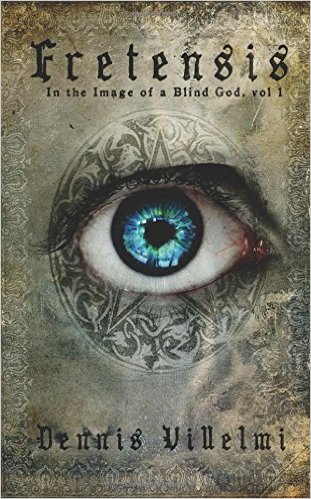
A review of “Fretensis: In the Image of a Blind God, volume 1,” by Dennis Villelmi

With “Fretensis: In the Image of a Blind God, volume 1” Dennis Villelmi expertly enmeshes the reader in a twisting, troubling narrative that is both mythic and tragically personal for the poem’s speaker. It’s a unique work, employing both arcane myth and personal impressions in equal measure. And it’s a hell of a ride.

“Fretensis” is a 56-page book of dark, modernist poetry divided into three parts and baroquely illustrated with medieval woodcuts and other images of the monstrous and the grotesque. The narrative it presents is like nothing else I’ve discovered reading poetry. Its protagonist is a rich intellect and a troubled soul. The mood of “Fretensis” throughout is striking; the overall work expertly conveys sadness, desperation and an enervating sense of struggle. (In the interest of full disclosure here, Villelmi is a valued friend and a poet whose work I have long admired.)

“Fretensis” might be challenging for the average reader. It might take a seasoned academic to understand all of its references and allusions while also understanding their significance within the poem. Villelmi draws on what appears to be an encyclopedic knowledge of ancient history, myth and religion. (He studied philosophy at Old Dominion University, but his expertise is visibly far more expansive in all of his work.) The title of this story, “Fretensis,” is the name of the Tenth Roman Legion, employed at the start of the Fall of the Roman Empire. As with Villelmi’s other published poetry, this debut book is linked intricately to those myths and symbols from which he draws inspiration.

But this is a good thing. Villelmi’s dark and antiquated iconography makes his work unique and unusually rich. This is a poem that begs for rereading and further scrutiny. I myself gleaned so much more from my second reading.

If I could name one thing about Villelmi’s style that makes his work distinctive to me, it would be how he meaningfully interweaves his esoteric symbols and references with the narrator’s personal experience. That duplexity characterizes the entire book, and it makes “Fretensis” remind me of a personal favorite, W.H. Auden’s “September 1, 1939.” That famous poem and its “accurate scholarship” also uses classical references to frame the narrator’s personal experience in context. (In Auden’s case, he called upon Thucydides, Luther and others to frame his own reaction to the 1939 German invasion of Poland.)

Villelmi’s resulting juxtaposition, which is consistent throughout the book, makes for an excellent poetic device. Memphis, Egypt, is made interchangeable with Memphis, Tennessee. References to Jeudayn are used to provide context for the death of a prostitute. A small boy plays “Deity” in “a grey dirt patch behind [a] garage.”

Consider the context that he employs to describe ravens feeding upon a dog’s carcass:

“Driving, I find it ironic, even inappropriate, that as the roadside augur is a dog on which the forest ravens have come to feast on the meat pulled out from under the fur, courtesy of other scavengers, the convent isn’t named after St. Paul. Paul and ravens both know how to seize an opportunity. Rather, it’s named for Fiacre, an old Irish woman-hater of the woods. I once read there were other Fiacres predating Christ’s arrival on Irish soil; they were warlords, predators by serendipity, much like those ravens chowing down on the mutt.”

And Villelmi’s mastery of the language is truly enviable. I found myself most immersed in “Fretensis’” prose-poetry sections. I’m not sure why, but here is where I best felt that I could identify with the narrator. These seemed the most personal to me. They’re so beautifully illustrated by the narrator’s sad, resigned voice that they have the feel of a genuine vignette spoken by a real person.

Consider the opening of “Part II: The Whore’s Afternoon.”

“On my ongoing canvas, there’s only been caricatures and carcasses, with a highway torture dividing the two. Somewhere, I took a detour of forgeries and virgins, and lost the rest of the America I was meant to see …

“Every time I try to measure the time I get a case of dry mouth. That’s how I met Ettey, Ettey Roth. She, too, had a memoir, not unlike mine, and it was over slugs in Seire’s Tavern time and again that we found the mutual souring of our lives to have been rooted in the hems of our birthplaces.”

All in all, “Fretensis” depicts a universe that is both twisting and twisted – a byzantine existence where an eloquent narrator’s darkness is informed by far greater forces that are divine, demonic or both. It’s an accomplished book of poetry that deserves not only to be read, but reread and reconsidered … assuming that you are willing to take that winding, redoubtable journey more than once.

Bravo.
51HuLmHrseL._SX309_BO1,204,203,200_

“Not universal love, But to be loved alone.”

The windiest militant trash
Important Persons shout
Is not so crude as our wish:
What mad Nijinsky wrote
About Diaghilev
Is true of the normal heart;
For the error bred in the bone
Of each woman and each man
Craves what it cannot have,
Not universal love
But to be loved alone.

— from W. H. Auden’s “September 1, 1939”

auden

“Hunger allows no choice to the citizen or the police.”

All I have is a voice
To undo the folded lie,
The romantic lie in the brain
Of the sensual man-in-the-street
And the lie of Authority
Whose buildings grope the sky:
There is no such thing as the State
And no one exists alone;
Hunger allows no choice
To the citizen or the police;
We must love one another or die.

— from W. H. Auden’s “September 1, 1939”

f05c9-auden3