Tag Archives: 1968

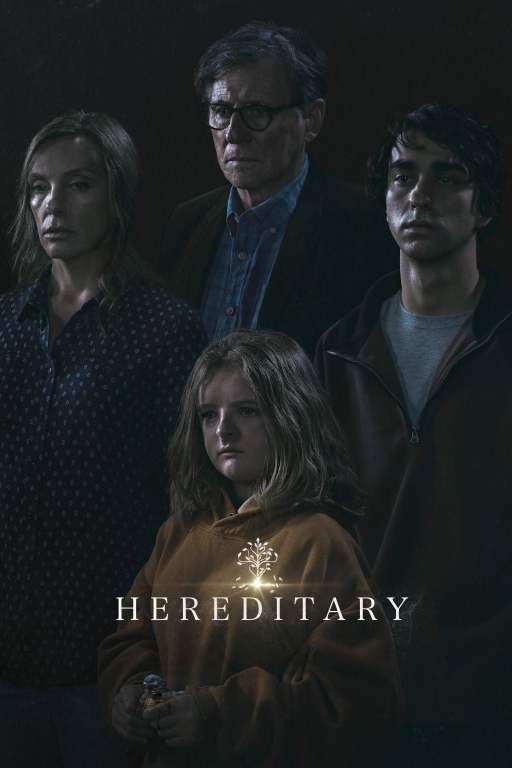
“Hereditary” (2018) is an expert horror film that I’m not sure you should see.

“Hereditary” (2018) is a difficult movie to review.  It’s an exceptionally well made horror film, enough for me to rate it at least a 9 out of 10.  But its content is so disturbing that I’m not sure that I can actually recommend it to others.

From a technical standpoint, the movie is almost perfect.  It’s an astonishingly good first feature film for writer-director Ari Aster, it’s gorgeously shot in the hills and deserts of Utah, and it’s masterfully directed.  The performances are uniformly perfect.  If I were to name each actor who hands in a fantastic performance, I’d simply be reading its cast list.  I can’t remember the last time I watched a feature film in which every single major performance was exemplary.  And “Hereditary” gets damned scary in its third act.   (Seriously, give it time.)

The only flaws that I can think of are extremely minor.  The pacing isn’t perfect.  (The story occasionally seems to slow when events should be accelerating.)  I had problems with the way that one key character was portrayed, and there was one plot point that gave me trouble.  (I can’t say more for fear of spoilers.)  But these things are so forgivable that they hardly merit a mention here.  You simply can’t argue that this movie was expertly assembled.

Yet I didn’t always enjoy “Hereditary.”  I’d be lying by omission if I didn’t state that.  I shut it off more than once, and then came back to it when I felt more able to stomach the brutal events it depicted.

“Hereditary” is more than a “dark” movie; it’s gut wrenching.  Even if you have read its reviews and you’ve seen the movie’s marketing, then you still aren’t anticipating what will transpire on screen.  (I’d even go so far as to say that the film’s marketing was misleading, but I can’t specify why here.)  Yes, there’s a obvious “Rosemary’s Baby” (1968) vibe, and it’s sometimes reminiscent of “The Exorcist” (1973), but the movie pushes well past the boundaries of those films, and it does so fairly early on.  If I, a lifelong horror fan, was turned off by this, then I’m willing to bet that it would also be too much for a lot of casual film goers.  (And indeed, while critics loved this film, audiences last year generally hated it.)

I’m closing with a little bit of trivia.  Toni Collette gives a tour-de-force performance here as the troubled mother.  If she looks familiar to you, that might be because she’s also the mom in another well known supernatural horror film — M. Night Shyamalan’s “The Sixth Sense” (1999).
 

p9fmuz2Oj3HtEJEqbIwkFGUhVXD-0

And here is the latest thing that makes me feel old.

What’s with all the people in music videos looking so damn young these days?  Did they change the child labor laws?

There was a time when I was daily viewer of MTV (the sedate stuff on VH-1 was for old people), and I rocked hard, people.  It seemed to me that whenever I watched a video, I saw people who were my own age.

Now these videos are inhabited only by people who look young enough to be my kids. And that makes sense, because … they kinda are young enough.  (Yes, I realize the video below for The Calling’s “Wherever You Will Go” was made 18 years ago, but that’s beside the point.)  If the performers in a video today were in their very early 20’s, then they’d be about the right age, if I’d fathered kids when I was 26.

Furthermore, some astute commentators pointed out online Monday night that 2019 is the year in which the original “Blade Runner” (1982) was set.  The opening title card names “November, 2019” as the time when all things Fordesque turn angsty and existential and killer-androidy.  Am I … older than Harrison Ford’s character? I am six years older than Ford was when he made the film.

Now I just feel weird.  Why do I write these blog posts, anyway?

[Update: Today I am learning that “Akira” (1988) and “The Running Man” (1987) also set their stories in 2019?! That’s ironic, given that the future we’ve come closest to is that of 2006’s “Idiocracy.”

I wonder how people in our parents’ generation felt when 2001 arrived, if they’d happened to see “2001: A Space Odyssey” in theaters in 1968.]


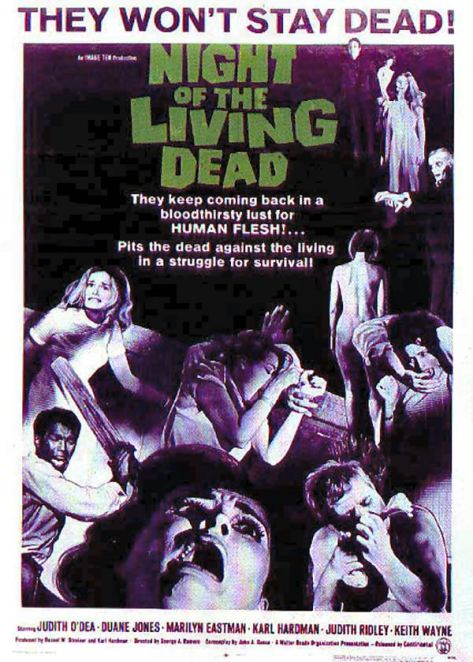
George A. Romero’s “Night of the Living Dead” (1968)

So I raised a few eyebrows a while back when I praised the 2004 colorized version of the late George A. Romero’s “Night of the Living Dead” (1968).  A couple of horror fans gave me flack for it — I hope people realize that I was talking about the last (and best) colorization, adapted by Legend Films.  (There were several prior color versions, and the 1986 attempt by Hal Roach Studios was broadly and justifiably condemned.)

I also hope that people realize that my preferred version will always be Romero’s black-and-white original.  And it just so happens that I found an unusually good copy of it online, over at the Timeless Classic Movie Youtube channel.  (There are actually some really clean copies of a few great classics there, including 1964’s “The Last Man on Earth”).


Last night I watched a colorized version of “Night of the Living Dead.”

There are actually several colorized versions of George A. Romero’s 1968 classic floating around out there — the one I watched was the quite decent 2004 revision by Legend Films.  (I believe it’s the truly crude 1986 Hal Roach colorized version that is so widely reviled by fans — and with good reason.  Those green-skinned zombies looked awful in that one clip I watched.)

I had a blast with the Legend Films outing.  I cheerfully recommend it.  The colorization isn’t perfect, and it’s a little strange seeing the start of the zombie apocalypse rendered in occasionally pastel hues.  But this was a fun way to revisit a beloved film I’ve seen so often before, but only in black and white.  You can also finally fully appreciate how beautiful Judith O’Dea was.  (And, in my opinion, she and Duane Jones were damned terrific in this movie.)

Check out the clip below.


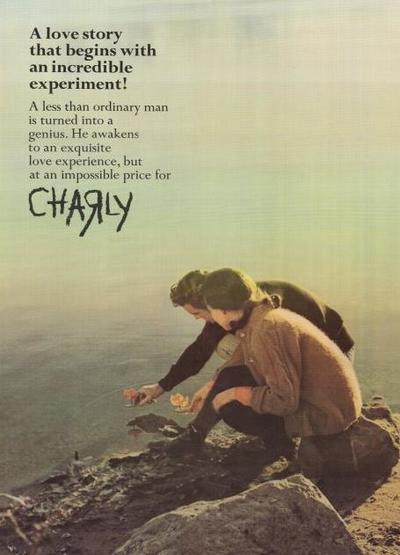
Poster for “Charly” (1968)

ABC Motion Pictures.

large_t6vIuw1OnOd8ef5j2zl2f2zc9Mk

Throwback Thursday: “Get your stinkin’ paws off me, you damned dirty ape!!!”

“Planet of the Apes” (1968) is a half century old; today is the 50th anniversary of the film’s premiere at the Capitol Theater in Manhattan.  (Thanks to Blog Correspondent Pete Harrison for pointing out the date for us.)  The movie’s original trailer is below.  I actually learned something new looking for it — Rod Serling co-wrote the screenplay.  (I wasn’t aware of that, but it makes sense.)

I’ve already written at length about how the “Planet of the Apes” franchise was a part of my childhood.  (No, I wasn’t alive in 1968, but these films were broadcast periodically on television in the late 70’s and early 80’s.)  So I won’t blather on yet again about it.

But I will say that the iconic line of dialogue you see in the above headline made a pretty big impression on me as a kid.  (And Charlton Heston’s delivery of it was unforgettable.)  When I was in the second or third grade,  I once growled that line at a girl at recess who kept poking me and smacking me on the head.  She was really taken aback by it.


Ki: Theory’s “Stand By Me” video is brutal.

Below is one of the most powerful music videos I’ve ever seen, and I’ve seen a lot of music videos.  (80’s kid here.)  It’s Ki: Theory’s cover of Ben E. King’s 1968 “Stand By Me.”

Not only is it a terrific cover, but the video combined with the music make it an intense, atmospheric short film.  It’s surprising how much storytelling and emotion the actors and director convey — and all in under three and a half minutes.

Be warned — it’s pretty dark stuff, and a little graphic.


Poster art for George A. Romero’s “Night of the Living Dead,” 1968

Night_of_the_Living_Dead_(1968)_theatrical_poster

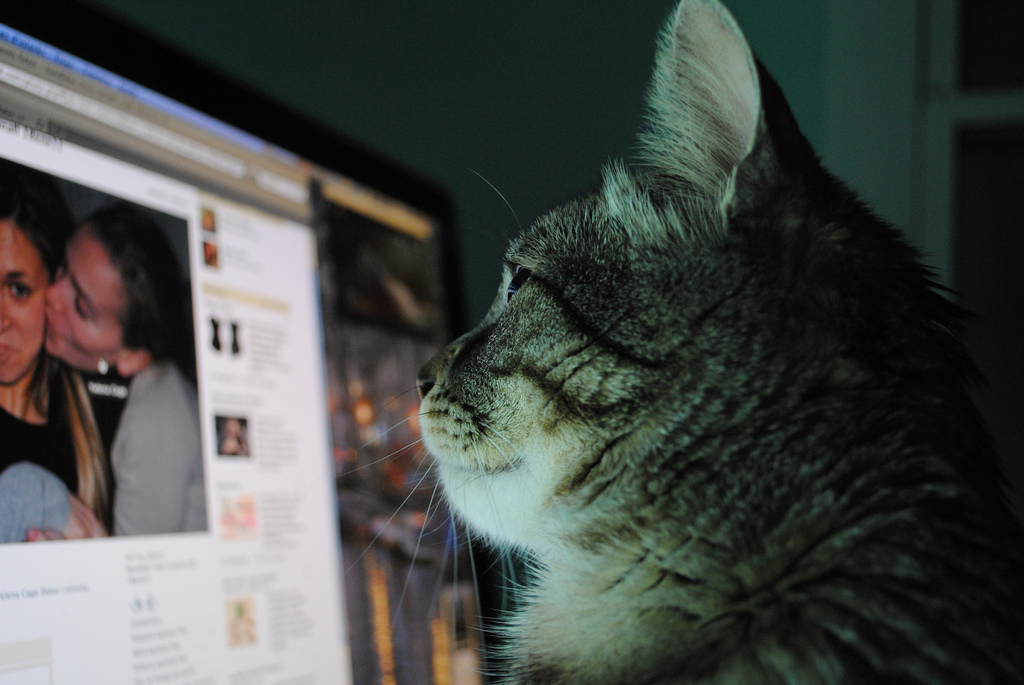
“An Ode for Fellow Replicants,” by Eric Robert Nolan

(Dedicated to Philip K. Dick)

What if the Internet is an android’s dream,
and we are the electric sheep?

Dick would know at once
our artificial people:
every boy a Roy,
every girl a pleasure model,
trying to pass as real,
inwardly concerned with their design —
“Morphology. Longevity. Incept dates.”

On Facebook,
“More Nolan than Nolan”
is my motto.

If I, in my genuine moments,
could greet my jpeg face
hiding in his electronic words,

he’d go offworld or die.
After all,
“It’s not an easy thing to meet your maker.”

[Author’s note — the film quoted and paraphrased above is Ridley Scott’s “Blade Runner” (1982), to which this poem is an homage.  “Blade Runner” is itself an adaptation of Dick’s 1968 novel, “Do Androids Dream of Electric Sheep?”]

(c) Eric Robert Nolan 2016

Facebook engancha.jpg

Photo credit: By olga.palma – facebook enganchaUploaded by JohnnyMrNinja, CC BY 2.0, https://commons.wikimedia.org/w/index.php?curid=16525385

Nolanferatu’s tip for a trippy vintage horror double feature!

Well there’s one thing I can cross off my bucket list.  (There’s a lot on there, and some of it’s weird.)  I finally saw F.W. Murnau’s “Nosferatu: ein Symphonie des Grauens” (1922).

And am I damn glad I did!  I actually enjoyed it more than I thought I would.  I love plenty of classic movies; “The 39 Steps” (1939) and “To Have and Have Not” (1944) are among my all-time favorites.  But I’m accustomed to modern horror — my tastes generally extend only as far back as “The Birds” (1963) and “Night of the Living Dead” (1968).

I waited until I was in just the right mood.  (This is the first silent film I’ve ever seen from start to finish — the only exception being Mel Brooks’ 1976 parody, “Silent Movie.”)  Then I began it shortly before midnight.

The movie just worked for me. It was sublimely creepy.

I think it helped that the grainy, flickering, black-and-white period footage made this expressionist movie utterly atmospheric for a modern viewer.  These, combined with the shots of Max Schreck superbly made up as “Count Orlok,” were damned unsettling.  Schreck also appeared to be a great physical actor, with his gaunt stance and stilted, inhuman movements.  (Was he unusually tall too?)

The vintage footage also enhanced my enjoyment of the movie in a way that Murnau probably couldn’t have expected.  I know this is strange, but … nearly a century later, the thought that occurred to me several times during this movie was this: “Everyone involved in this production is long dead by now.”  Yes, I know that is a morbid thought — I’ve never done that before!  I think it was just the film itself that did that to me — it’s about undeath and immortality, after all.

It also helped that I’d read Bram Stoker’s “Dracula” (1897), of which this film is an unauthorized adaptation.  The resulting lawsuit by Stoker’s estate is interesting reading: supposedly all copies of the movie were ordered by the courts to be destroyed, bankrupting Prana, the production company.  But a permanent cult following developed for the few surviving prints.

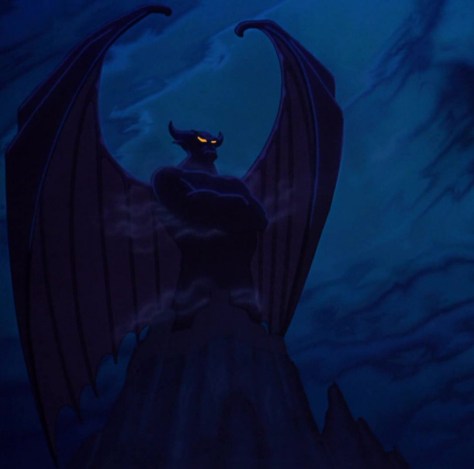
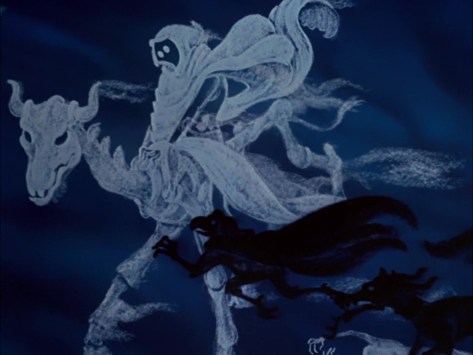
Anyway, I followed this up with the palate-cleansing “Night on Bald Mountain,” the final segment of Disney’s “Fantasia” (1944).  That combination, too, totally worked for me — I followed up the black-and-white nightmare-fuel of the seminal vampire film with some vivid, incongruously hellish Disney nightmare-fuel.

“Nosferatu” is in the public domain.  You can view the entire film on Youtube at the link below.


nosferatu

c1402340b6a518f114e12da99fefa1e8

download

nosferatu10

nosferatu-1922

Fantasia-Night-on-Bald-Mountain-864x855

night-on-bald-mountain-ave-maria-078

bald-mountain_harpy2

night-on-bald-mountain