Tag Archives: 2014

“Operation Staffhound,” by Philippe Atherton-Blenkiron (read by Eric Robert Nolan)

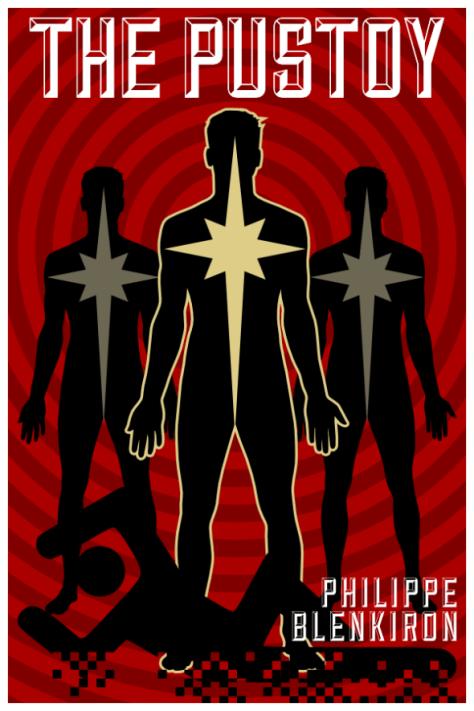
I’m happy today to be able to share The Bees Are Dead’s release of my audio recording of “Operation Staffhound,” by Philippe Atherton-Blenkiron.  This truly excellent poem is an excerpt from his 2014 dystopian novel in verse format, “The Pustoy.”  (I quite positively reviewed the book both here at the blog and over at Amazon, where it can be purchased — “Operation Staffhound” might be my favorite poem in the complete work.)

“The Pustoy” is a particularly dark science fiction epic that imagines a genocidal dictator, Lev Solokov, ruling a nightmarish future Britain.  The brutal “Staffhounds” are his fascist foot-soldiers in the streets.

I had great fun reading the poem.  I’m grateful to Philippe for allowing me to interpret it, and to The Bees Are Dead for sharing my recording with its audience:

Philippe Atherton-Blenkiron’s “Operation Staffhound” at The Bees Are Dead


10313810_651969161562567_8191427288958458823_n1


A review of Season 2 of “Black Mirror” (2013)

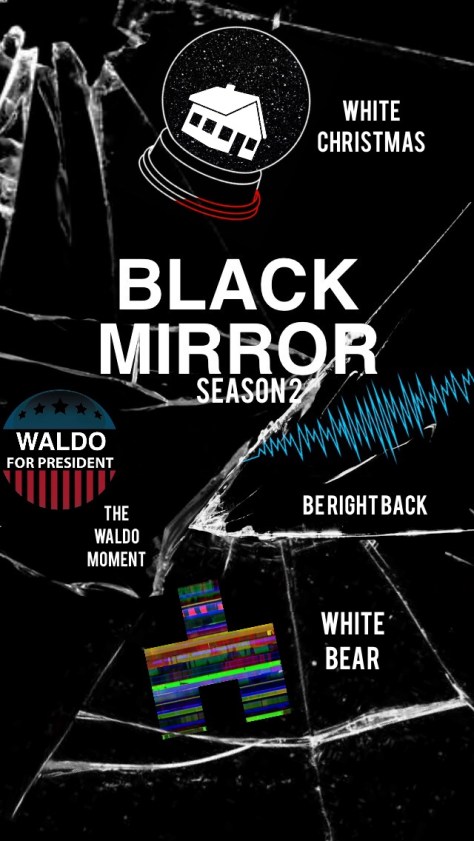
“Black Mirror” seems to me to be  the best science fiction show on television; I’d rate Season 2 (2013) a 9 out of 10.  (I’m never quite certain whether to group British shows by “season” or by “series,” as they do.  I’m also a little uncertain why the fourth and final episode here, “White Christmas,” is included in Season 2, as it aired nearly two years later as a 2014 holiday special.)

I commented to a friend of mine after seeing “White Christmas” the other night that the show was “brave” — it just isn’t afraid to alienate mainstream audiences by being too dark.  Not all of “Black Mirror’s”  episodes have “twists,” but they typically have an unexpected plot development, and their outcomes and implications are arguably depressing.

It’s just such a damned good show, though, in terms of its writing and acting.  My friend told me she wasn’t aware of anyone who had seen it and disliked it.

“White Christmas,” for example, was one of the best hours of science fiction television I’ve ever seen.  It consists of three blackly tragic vignettes seamlessly woven withing a wraparound story, and it employs a sci-fi plot device that is mind-bending and brutal.  I believe this is the first time I’ve seen its lead actor, Jon Hamm, and I was extremely impressed with his performance.

My only quibbles with the program are extremely minor.  As with the first season, I think that not every episode truly requires a 44-minute running length.  I thought two episodes  (“Be Right Back” and “The Waldo Moment”) seemed like they could have been tightened up into one, maybe with tighter writing allowing for shorter segments.

I’ve noticed another minor relative weakness with “Black Mirror” in general as well — the show does not always present the viewer with likable protagonists.  Occasionally, the various characters we’re asked to identify with are either slightly off-putting or even annoying.  Again, “Be Right Back” and “The Waldo Moment” spring to mind.  This wasn’t enough to greatly affect my enjoyment of the episodes, though.

What an incredible show.


black_mirror_season_2_poster_by_clarkarts24-daug6i3


Cover to “Superman” #35; John Romita, Jr.; 2014

Variant cover for Halloween.

What an image.  That looks like Kal-El crossed with Cthulhu crossed with Pinhead.


980175

Cover to “Catwoman” #35, Joshua Middleton, 2014

(Variant cover.)

4170547-catwoman+02

Season 1 of “Mr. Mercedes” (2017) was astonishingly good.

It amazes me how little fanfare that “Mr. Mercedes” is getting.  Season 1 was not only one of the best Stephen King adaptations ever, I think it has the rare distinction of being even better that its source material.  (I really liked 2014 novel, but I loved the show.) I might have a couple of minor quibbles about the ten-episode season, but they’re not enough to stop me from rating it a perfect 10.

I tend to think of this as more “mainstream King.”  As with the book, the story here is devoid of the supernatural elements that usually characterize King’s work.  It also doesn’t have any overt connection to King’s overarching, interconnected “Dark Tower” multiverse.  It’s a depressingly real-world story about a mass murderer whose weapon of choice is a stolen Mercedes.  (There is a plot-driving horror set-piece at the start of the pilot episode in which he mows down a crowd lined up for a job fair.)

What follows is a drama of surprising depth and authenticity.  We see the extended aftermath of slaughter, throughout the lives of people connected to it — including one victim’s family, the now-retired investigating detective (Brendan Gleeson), the young killer himself (Harry Treadway) and his alcoholic, incestuous mother (Kelly Lynch).  Gleeson was who first made me interested in the show, and his performance is outstanding.  Lynch is amazing and perfect in her role, and is even talented enough make her onerous character truly sympathetic.  But even they are outshined by Treadway’s frighteningly goddam perfect portrayal of the titular “Mr. Mercedes.”  The guy is incredible.

The script was nothing short of terrific.  There is certainly enough horror here — including one particularly cringe-inducing plot twist late in the game.  (It was so disturbingly presented that I almost had to switch the episode off — and I knew it was coming, as I’d already read the book.)  But the horror punctuates the unexpectedly touching drama among the story’s protagonists — and the sad relationship between the killer and his disordered mother.  There were also some great moments of humor, and the subtexts here dealing with friendship and loyalty were surprisingly moving.

The rest of the cast was quite good.  The directing shined as well — especially for a key sequence in Episode 7, “Willow Lake.”  Even the soundtrack was excellent.  Hell, they even referenced W. H. Auden in one episode.

My quibbles were minor.  One was the story’s pacing.  It’s actually quite slow for the first eight episodes — enough, I think to lose some viewers.  This didn’t bother me much — I took it as “slow-burn” horror, and it matched the very slow pace of the book.  Then the story seemed to move forward at a breakneck pace during episodes 9 and 10.  I can’t help but wonder if it could have been scripted differently, as that felt odd.

My second quibble lies with Mary-Louise Parker’s portrayal of Janey, the sister of one of the killer’s victims.  Parker is an excellent actress, but I found her version of the character to be remarkably detached for someone bereaved in such a horrifying fashion — to me, it seemed like a strange creative choice on the part of the actress.

I’d obviously recommend this; it’s currently the best horror show that I’m aware of.


b54392d2b586b944ad0af2c9fe59082f

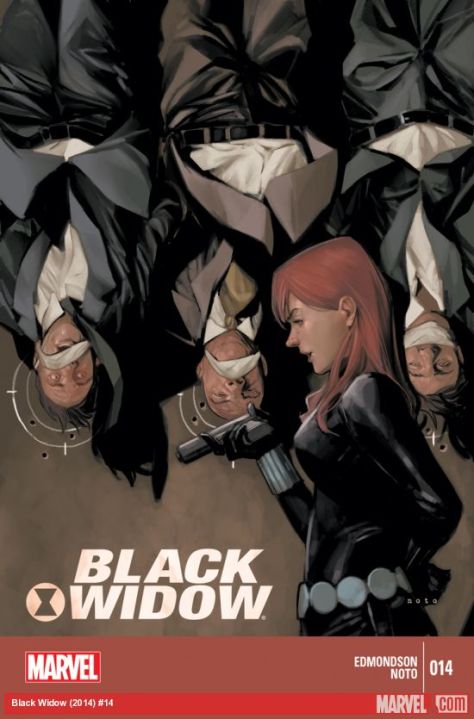
Cover to “Black Widow” #14, Phil Noto, 2014

Marvel Comics.

Just a picture of three American businessmen being strung up by a female Russian spy.  No political subtext here.


detail

A few quick words on “The Rogue Cut” of “X-Men: Days of Future Past”

If you are a die-hard “X-Men” fan, then I do recommend checking out Bryan Singer’s non-canonical “The Rogue Cut” of “X-Men: Days of Future Past.”  You might enjoy it just for its novelty — it actually is a very different version of the original movie.  It has a lot of scenes that are either entirely new or shot and edited quite differently.  (The most notable difference, obviously, is an entire subplot concerning the rescue of Anna Paquin’s Rogue, which was deleted from the 2014 theatrical release.)

I get the sense that this will come across as a better film to “X-Men” purists.  There is greater attention to a multitude of characters, far more character interaction, and greater detail about the apocalyptic future segments.  (I myself was happy to finally figure out why the dystopian mutants were housed in such a strange looking building.  It turns out they were hiding in a Chinese temple as part of an ongoing global evasion strategy.)  “The Rogue Cut” also has greater continuity with more of the prior films — it feels integral to the films’ ongoing mythos, and less like a standalone adventure.

But “The Rogue Cut” might not be better at pleasing general audiences.  It clocks in at just under two and a half hours, and the overall result did feel far slower to me.  There is a reason why movies are edited down — their unabridged versions have problems with pacing that really can affect the average viewer’s enjoyment.

I will also point out that this version of the film fails to rectify what I’ll reiterate is the theatrical version’s biggest story flaw — why would the shape-shifting Mystique be the key to developing the Sentinels power-stealing technology.  Why not the power-stealing Rogue herself?

Anyway … speaking of what is canon and what is not, there is a damned interesting fan theory floating around about the “X-Men” movies following this year’s release of “Logan.”  That movie stood out for many reasons, but two in particular are relevant here.  The first is the radical change in its tone and storytelling, which makes it feel like it takes place in “the real world.”  The second is its odd, apparently meta-fictional inclusion of the “X-Men” comics themselves within the story.  (Copies of the comic books are discussed by the characters, and even serve as an important plot element; Wolverine complains that they are horribly inaccurate.)

Many fans are having fun wondering if there has, in fact, been only one canonical “X-Men” movie — and that is “Logan” itself.  The brutal, subdued reality of “Logan” alone is “the real world” of the X-Men; all of the fantastical prior films (which occasionally contradict one another anyway) are merely the stories inside the last movie’s comic books.  I thought that was pretty damned clever.


newcut2_by_joseelizondo-d901c11

Cover to “Night of the Living Deadpool” #1, Jay Shaw, 2014

Marvel Comics.

Night_of_the_Living_Deadpool_Vol_1_1

A short review for the pilot of “The Last Ship” (2014)

So I finally got around to checking out “The Last Ship” (2014), and while the pilot didn’t immediately have me hooked, it seems like a decent show.  I’d rate it an 8 out of 10, and I’ll probably continue watching it.

I was surprised I’d heard so little about this program … it’s a big-budget, post-apocalyptic military science fiction series, but none of my fellow horror or sci-fi nerds mentioned having seen it.

The plot setup seems like something that would please horror fans — a virus eradicates 80 percent of the world’s population, and a lone American naval vessel elects to remain at sea.  (They’re fortunate enough to be carrying a civilian virologist who was tasked by the fallen United States government to develop a vaccine.)  And there are hints that the show’s writers would do well scripting a frightening TV series — there are a couple of nice flourishes for a serialized horror show right here in the pilot.

But the story’s horror elements are minimized in favor of a more mainstream, safe-for-general-audiences techno-thriller.  And that’s not a bad thing, because it succeeds as a such.  The show is based on a 1988 novel by William Brinkley, and it’s produced in cooperation with the United States Navy.  (The destroyers U.S.S. Halsey and the U.S.S. Dewey stand in for the fictional U.S.S. Nathan James.)  It seems smartly scripted with respect to both virology and how the military works.  I’m barely literate in either of those subjects, but what I watched seemed coolly authentic, and that entertained me and held my attention. So while I might not recommend this to fellow “The Walking Dead” fans, I’d definitely recommend it to fans of Tom Clancy.

The directing is pretty good, the story moves along quite quickly, and the action scenes in the pilot are surprisingly ambitious and effective for a TV show.

The acting, I suppose, is average — though it’s always fun seeing Adam Baldwin on screen, and the square-jawed Eric Dane seems well cast and shows promise as the ship’s commanding officer.

The dialogue and character interaction are average at best.  This isn’t high art when it comes to human storytelling.  There are some pretty predictable character tropes, and a few exchanges are so cheesily melodramatic that they nearly insult the viewer’s intelligence.  Dane’s commander faces off, for example, against a beautiful, independent, female scientist who doesn’t like following orders … gee, I wonder if we’ll see any romantic tension there?

Still, this looks like a good enough show, if its pilot is any indication.  The good outweighs the bad, and I’m glad I heard about it.


The_Last_Ship_Season_1_poster

A review of “The Conjuring” (2013)

I feel the same way about “The Conjuring” (2013) as I did about its prequel, “Annabelle” (2014) — it has all the earmarks of a bad movie, but it inexplicably succeeds anyway.

Seriously — this film has clunky exposition, cheesy dialogue and over-the-top plot developments (toward the end), not to mention a plot setup that’s in questionable taste.  (The movie suggests that the innocents condemned by the infamous 1692 Salem witch trials were indeed witches.  This feels a bit awkward to anyone who read Arthur Miller’s “The Crucible” in high school.)  “The Conjuring” also plays out like a love letter to Ed and Lorraine Warren, the controversial paranormal investigators who are largely the subject of the film (played by Patrick Wilson and Vera Farmiga).  This last offense is forgivable, I suppose — the film was made with the Warrens’ blessing, and Lorraine Warren was even present as a “consultant” during its production.

Strangely, however, these flaws were barely noticeable to me when I watched it.  I had a good time.  “The Conjuring” just happens to be a decent fright flick that delivers on the scares.

I think James Wan’s skilled directing has a lot to do with that; the film works visually.  (I could name specific instances where it works especially well, but I want to avoid spoilers.)

The acting helped a lot too — Wilson and Farmiga are both damned good, as is Lili Taylor as the afflicted family’s mother.  (I’ve admired Taylor’s acting since her long ago 1998 guest appearance on “The X-Files,” and she was equally good as a bad guy in 1996’s “Ransom.”)  Ron Livingston was also quite good in the role of the father — if you have trouble placing his face, as I did, he also played Captain Nixon in HBO’s “Band of Brothers” (2001).  He seems to have a talent for playing the likable everyman — he’s great here as the somewhat feckless father, and functions well as a kind of viewer surrogate.  I should also mention the young Joey King as one of the family’s daughters — she played the role of a terrified child to perfection, and really raised the stakes emotionally.

Despite really enjoying most of the movie, some of my enthusiasm for “The Conjuring” flagged a bit toward the end.  The denouement here includes an exorcism, and those are almost always boring.  There are only so many ways that scenario can play out, and we’ve seen them all — and I shouldn’t even need to name that certain 1973 film that did it best.  Furthermore, we see our story’s demon do some pretty extraordinary things, even by demon standards.  It can apparently transport itself great distances (using an inanimate object as a kind of fax machine?), and can manipulate both the laws of physics and the area’s wildlife.  It was all a little too much for my willing suspension of disbelief.

Again, though — this was a good movie.  I’d give it an 8 out of 10, and I’d recommend it to anyone looking for a good scare.