Tag Archives: Dennis Villelmi

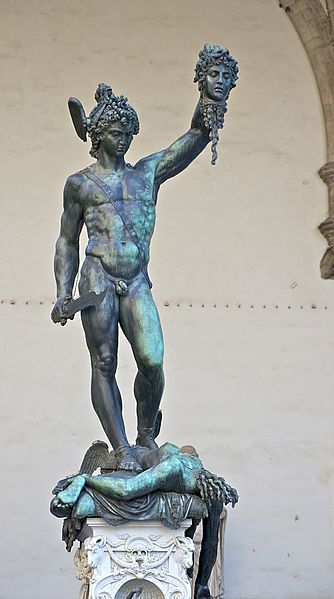
Two depictions of Perseus slaying Medusa (Cellini, 1545; Janson & Tempesta, 1606)

The Florentine bronze sculpture below, by Benvenuto Cellini in 1545, depicts Perseus holding the head of Medusa.  (Thanks to Dennis Villelmi for sharing a picture via Facebook.)

The etching beneath it was published in 1606 by Wilhelm Janson and Antonio Tempesta.

I myself depicted the very same scene in an inspired drawing during a third or fourth grade math class in Catholic School.  When the nuns discovered it during class, holy shit, it did not go over well.


334px-Perseus_Medusa_Cellini_Lanzi_Florence

679px-Perseus_Killing_Medusa_LACMA_65.37.125

“What I Had Stolen For Heaven’s Sake” and “Greenhouse Hot Contempt,” by Dennis Villelmi

Dead Snakes published two new poems by Dennis Villelmi on Monday — “What I Had Stolen For Heaven’s Sake” and “Greenhouse Hot Contempt.”  Read them both at the link below.

http://deadsnakes.blogspot.com/2015/11/dennis-villelmi-two-poems.html

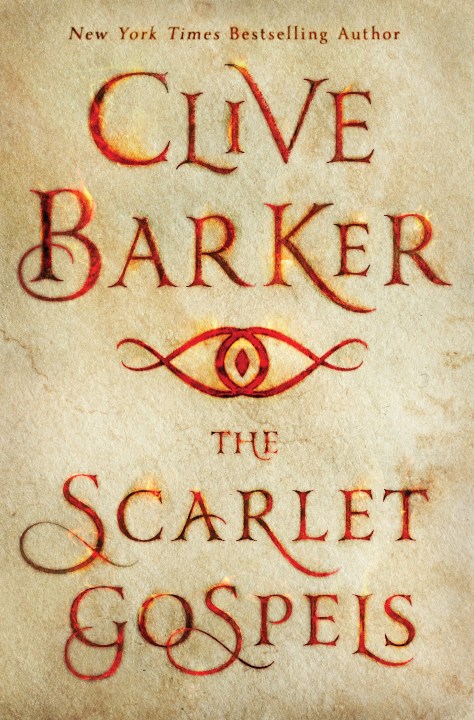
Check out a terrific review of Clive Barker’s “The Scarlet Gospels.”

Dennis Villelmi has published a great review of “The Scarlet Gospels,” by Clive Barker.

Trust me – I’ve known Dennis for a while, and he’s an expert on Clive Barker.

Click the link to see the review over at Gruemonkey.com:

THE GOSPEL ACCORDING TO CLIVE


9781250055804_FC-4

“Spending and Saving,” by Dennis Villelmi

You people need to read “Spending and Saving” by poet Dennis Villelmi, recently published by Dead Snakes.  I swear it’s the best poem I’ve read in a long time.

Damn, I wish I could write like this.

Click here for the link to Dead Snakes:

“Spending and Saving,” by Dennis Villelmi


Greek_Silver_Stater_of_Phaistos_(Crete),_Depictions_of_Herakles_in_Greek_Numismatics


Photo credit:  “Greek Silver Stater of Phaistos (Crete), Depictions of Herakles in Greek Numismatics” by Ancient Art – Flickr: A Rare and Magnificent Greek Silver Stater of Phaistos (Crete), Among the Finest Depictions of Herakles in Greek Numismatics. Licensed under CC BY 2.0 via Wikimedia Commons.


A review of “Fretensis: In the Image of a Blind God, volume 1,” by Dennis Villelmi

With “Fretensis: In the Image of a Blind God, volume 1” Dennis Villelmi expertly enmeshes the reader in a twisting, troubling narrative that is both mythic and tragically personal for the poem’s speaker. It’s a unique work, employing both arcane myth and personal impressions in equal measure. And it’s a hell of a ride.

“Fretensis” is a 56-page book of dark, modernist poetry divided into three parts and baroquely illustrated with medieval woodcuts and other images of the monstrous and the grotesque. The narrative it presents is like nothing else I’ve discovered reading poetry. Its protagonist is a rich intellect and a troubled soul. The mood of “Fretensis” throughout is striking; the overall work expertly conveys sadness, desperation and an enervating sense of struggle. (In the interest of full disclosure here, Villelmi is a valued friend and a poet whose work I have long admired.)

“Fretensis” might be challenging for the average reader. It might take a seasoned academic to understand all of its references and allusions while also understanding their significance within the poem. Villelmi draws on what appears to be an encyclopedic knowledge of ancient history, myth and religion. (He studied philosophy at Old Dominion University, but his expertise is visibly far more expansive in all of his work.) The title of this story, “Fretensis,” is the name of the Tenth Roman Legion, employed at the start of the Fall of the Roman Empire. As with Villelmi’s other published poetry, this debut book is linked intricately to those myths and symbols from which he draws inspiration.

But this is a good thing. Villelmi’s dark and antiquated iconography makes his work unique and unusually rich. This is a poem that begs for rereading and further scrutiny. I myself gleaned so much more from my second reading.

If I could name one thing about Villelmi’s style that makes his work distinctive to me, it would be how he meaningfully interweaves his esoteric symbols and references with the narrator’s personal experience. That duplexity characterizes the entire book, and it makes “Fretensis” remind me of a personal favorite, W.H. Auden’s “September 1, 1939.” That famous poem and its “accurate scholarship” also uses classical references to frame the narrator’s personal experience in context. (In Auden’s case, he called upon Thucydides, Luther and others to frame his own reaction to the 1939 German invasion of Poland.)

Villelmi’s resulting juxtaposition, which is consistent throughout the book, makes for an excellent poetic device. Memphis, Egypt, is made interchangeable with Memphis, Tennessee. References to Jeudayn are used to provide context for the death of a prostitute. A small boy plays “Deity” in “a grey dirt patch behind [a] garage.”

Consider the context that he employs to describe ravens feeding upon a dog’s carcass:

“Driving, I find it ironic, even inappropriate, that as the roadside augur is a dog on which the forest ravens have come to feast on the meat pulled out from under the fur, courtesy of other scavengers, the convent isn’t named after St. Paul. Paul and ravens both know how to seize an opportunity. Rather, it’s named for Fiacre, an old Irish woman-hater of the woods. I once read there were other Fiacres predating Christ’s arrival on Irish soil; they were warlords, predators by serendipity, much like those ravens chowing down on the mutt.”

And Villelmi’s mastery of the language is truly enviable. I found myself most immersed in “Fretensis’” prose-poetry sections. I’m not sure why, but here is where I best felt that I could identify with the narrator. These seemed the most personal to me. They’re so beautifully illustrated by the narrator’s sad, resigned voice that they have the feel of a genuine vignette spoken by a real person.

Consider the opening of “Part II: The Whore’s Afternoon.”

“On my ongoing canvas, there’s only been caricatures and carcasses, with a highway torture dividing the two. Somewhere, I took a detour of forgeries and virgins, and lost the rest of the America I was meant to see …

“Every time I try to measure the time I get a case of dry mouth. That’s how I met Ettey, Ettey Roth. She, too, had a memoir, not unlike mine, and it was over slugs in Seire’s Tavern time and again that we found the mutual souring of our lives to have been rooted in the hems of our birthplaces.”

All in all, “Fretensis” depicts a universe that is both twisting and twisted – a byzantine existence where an eloquent narrator’s darkness is informed by far greater forces that are divine, demonic or both. It’s an accomplished book of poetry that deserves not only to be read, but reread and reconsidered … assuming that you are willing to take that winding, redoubtable journey more than once.

Bravo.
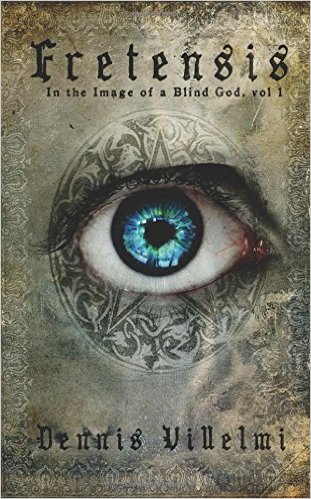
51HuLmHrseL._SX309_BO1,204,203,200_

“We found the mutual souring of our lives to have been rooted in the hems of our birthplaces.”

“On my ongoing canvas, there’s only been caricatures and carcasses, with a highway of torture dividing the two.  Somewhere, I took a detour of forgeries and virgins, and lost the rest of America I was meant to see …

“Every time I try to measure time, I get a case of dry mouth.  That’s how I met Ettey, Ettey Roth. She, too, had a memoir, not unlike mine, and it was over slugs in Seire’s Tavern time and again that we found the mutual souring of our lives to have been rooted in the hems of our birthplaces.”

— from “Fretensis, in the Image of a Blind God, Volume 1,” by Dennis Villelmi

51HuLmHrseL._SX309_BO1,204,203,200_

“Kick back and attack.”

“If writing isn’t subversive, then it’s the most monotonous wallpaper, hung in a country club stocked with equally two-dimensional people. Subversion and blasphemy are where the really potent existence is. Kick back and attack.”

—  Dennis Villelmi

Perfect.  The above quote contains more meaningful advice than my entire English composition course in college.

11053473_10204511136879262_8670554188344622460_n

Separated at birth?

This is just plain nuts.  One of the photos you see below is of Dennis Villelmi, my good friend, an outstanding poet, and my co-author in the horror anthology “All Hail the New Flesh.”  Another is of Vladimir Mayakovsky, the famed early 20th Century Russian poet, playwright, artist and actor.

AND I’M PRETTY SURE THEY’RE THE SAME GUY.  Seriously.

Please.  Skip the nonsense about reincarnation.  Wiser minds will agree — science dictates that the only logical conclusion here is that Dennis is Highlander.  (In the end, there can be only one.)

Check out Dennis’ blog, “a death’s head in green light,” right here:

a death’s head in green light

vladimirmayakovsky

get-attachment

“Vermilion,” by Dennis Villelmi

Dennis Villelmi’s latest.

0d936b633fe66ff409d418ba5d79fd25

“Bumblebee,” by Eric Robert Nolan

There has simply been way too much pathos of late among the blogosphere’s poets.  In the past few days, our own little online circle has labored to describe houses full of empty picture frames (Dennis Villelmi), nightmare airports (me), sick children (Anna Martin), and even Old Yeller (SAZL).

It’s summer.  Let’s lighten the mood.  “Bumblebee” was first published by Every Day Poets in September 2013.

It’s a poem about a bee.  No, the bee is not a metaphor for childhood guilt or lost loves, and, no, it does not attack the narrator like one of Cthulhu’s minions.  (I’m not always such a surly duck.)

Anyone who catches the Kevin Smith reference in this blog post will be made an honorary correspondent.  And that’s a coveted distinction.  Just ask Len Ornstein about his newfound fame and renown.

**********


“Bumblebee,” by Eric Robert Nolan


Bumbling along a bit close to me

Is busy Mister Bumblebee

He inventories dandelions

With prodding, plush black legs.


I inventory carcinogens

With unfiltered cigarettes,

My legs, in bluejeans, lazily

Crossed in the grass.


He buzzes, I puff.

A mute truce transpires

I won’t stomp if he won’t sting.

Just two fellas


Mindin’ their own business.


© Eric Robert Nolan 2013

Bee001

Photo credit: “Bee In a Dandelion,” Busangane, own work, via Wikimedia Commons.