Care to hear the convoluted worldview of a pathological poet? Then be sure to stop by this site’s My musings page. I promise you that my random ravings are truly infused with strangeness. (Or you get your money back.)

Care to hear the convoluted worldview of a pathological poet? Then be sure to stop by this site’s My musings page. I promise you that my random ravings are truly infused with strangeness. (Or you get your money back.)

Grendel’s mother wanted murder; but we all knew that,
you knew that just by looking at her:
the green and odorous skin like dark olive parchment over her cheeks’ low bones,
the blackening teeth where the stale blood caked
and dried in her receding gumlines
like burgundy ink on her molars and incisors,
and a blackening-scarlet
stain on her canines.
Remember when we first saw her —
her flaccid breasts like flour-sacks,
her womanhood a stagnant moss,
the cadaverous, driving
lime of her hips,
her labia in livid lines
of bitter water lilies?
Remember the rising, putrid moon of her —
her green, sour form arching over ours in her ascent,
burning up from the green lake, a gangrene flame from the brackish water,
her profane grin adorning her,
and algae tracing her lips?
Remember the wet weeds
trailing the viridian strait of her throat
like silt-laden necklaces,
and all the mud and water rolling off her knuckles?
The spoiled laurel of her sinewed shoulders,
her outspread arms and their
parody of embrace?
Remember her mocking our own mothers?
Her derisive voice was like
the crack of splitting emeralds, asking,
“Am I so strange to young eyes?”
Remember the boiling fat on her tongue and
her victims’ burning skin there?
The scalps she held in her upturned palms
were like watery garments.
Her talons were as black
as snapping-turtle shells.
We all knew at once that we were quarry.
Remember her
sorrel-colored cataracts?
Her eyes were as green seas
boiling under Ragnarok.
Remember their ruptured capillaries
like collapsing red galaxies?
Remember her very irises bleeding?
But what if evil appeared
not as the face of Grendel’s mother,
but, rather, the ordinary boy in her maw —
as unexotic and as common
as we are?
If we were boys and girls again
and bored in English class —
maybe at Beowulf’s strangeness,
or maybe the strangeness of Jung —
and he were next to us,
with neither green skin
nor blood along his molars,
if he wanted murder, could we tell?
His face was as a clock’s face — prosaic and round.
Neither silt nor sinew lined his frame.
His gaze did not depict a grisly cosmos;
no galaxies had hemorrhaged in his eyes.
Would the difference be perceptible there
between wanting to kill time
and wanting to kill ten?
Would we know that we were quarry?
Tonight we’d like to believe
that the young are strange to old eyes
for any resemblance would kill us,
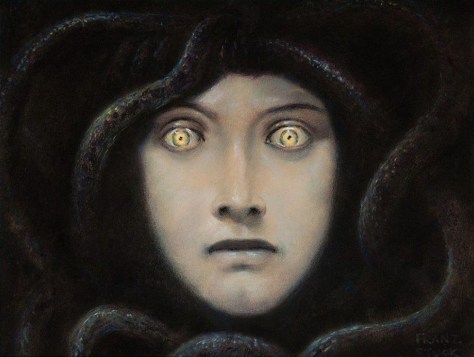
as Medusa’s own face was fatal
to her upon the shield.
As adults, we understand
that Beowulf is only fable —
but that Jung’s reservoir
is a fatal green lake.
Better an Idis than likeness —
if a monster looks like us, it stands to reason
that maybe he could BE us,
we’d nag in our primordial minds.
It might make us envision
a kind of reverse baptism:
our own plain faces
cresting the flat, green waters
to glide across the lake,
but bearing the eyes of strangers,
emerald and seething,
irises bleeding,
crushed green reeds in our jaws, like captive verses …
And we could not suffer the thought.
Better to be quarry, or be drowned.
We’d know that, and so
we would run mad, we would run weeping, we would run forward and ravening to the green, forgiving lake,
where we could sink like Beowulf,
and our silenced lungs would fill with water.
(May 19th, 2018)
(c) 2018 Eric Robert Nolan

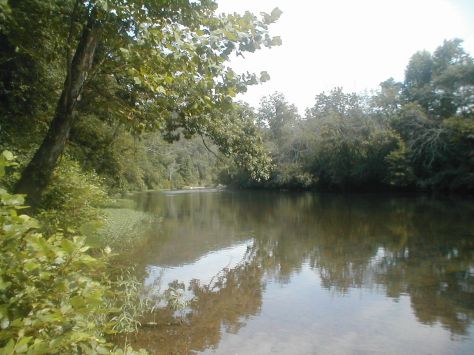
Here are a few more pictures of our campsite on the Cowpasture River in Iron Gate, in Virginia’s Alleghany County. The river snakes and winds throughout its 84 miles until it combines with the Jackson River to make the James River. The Native Americans called it the “Walatoola,” or “Winding River.” The arriving British renamed it, Wikipedia informs me — there are “Bullpasture” and “Calfpasture” rivers too, and they are all apparently named according to some confusing early American folklore involving stolen cattle.
The water was perfectly clear, and as warm as a mild bath after the late July sun hit it for a little while in the morning. I remember thinking that my friends and I had an endlessly stretching hot-tub beside the place where we slept.
The riverbed and the hills through which it cuts are composed of jagged, gigantic jigsaw pieces of sedimentary rock — shale, sandstone and limestone — tilted askew. They’re slippery. But above those, in most places, are scattered wide beds of perfectly smooth, smaller stones that are comfortable to walk on.
There are often scores of small fish that hug the bank or quietly dart about the ankles of visitors wading in. These are a staple for the eagles. Flycasters, too, pursue larger quarry on the western bank, while people swimming and tubing stay to the right — I suppose this is river etiquette?
Upriver from our campsite, there are also “riffles” — miniaturized rapids that offer a bumpy but easy ride to anyone “tubing.”


House Stark’s invading army bivouacs on its way south to King’s Landing. NOBODY GET MARRIED.

I found the ancient Native American Magic Machete of Legend beneath the river’s clear waters. Because I am strong and pure of heart. (I also found the ancient Native American stone cell phone.)
Wielding the legendary blade allowed me to walk on water, as you can see. Having thus conquered it, I then claimed the river for New York.


I tried unsuccessfully to prank a friend by placing a Blair Witch stickamajig outside his tent. Unfortunately, it kinda unraveled. I even managed to position it outside the wrong tent, actually leaving it for a nice girl who had never seen “The Blair Witch Project.” I was really off my game.

The quick, shy skink. After nearly two years in Virginia, I finally snapped a pic. I indeed mean “skink,” and not “skunk.” It’s a lizard. It’s got a glittery blue tail, though you can hardly tell in these pictures.


“As Silver as the Stars You Tried to Rival”
The
world grows
darker in increments,
earlier every evening,
as Autumn’s arcing swallow bends to curve
at long last, rounding down, to the hardening ground, where only brown
leaves outlast November’s burning rug of reds and flaming footprints,
cast-off scarlets,
now giving way
to the gunmetal gray
of winter’s coarse eagle, its ash-gray and annual, slow,
feathered rule of sky ascends hemispheres, its lead belly
groaning for hare or softer birds, its slate eyes searching, yet ridden with hints of silver —
— thin silver threads in the breast of the lead predator,
ascending
screaming “December,”
slow, as slow as frost, as cold as loss,
frigid, frigid like a still photo and its forever frozen face there,
black and white, its timeless smile a lie, exposed by common calendars and your indifference.
If those blacks and whites were shaken up in a glass bottle, the jumbled shades under glass might make
silver:
— thin silver threads out of memory:
— as silver as the slimming minnows that you kicked
out of shallow water onto sand at 9
with the other boys
birthing, then returning swimming platinum
to the warm-womb mine of that black lake, you knew
that summer would never end —
— as silver as your father’s hair, when you were 13, the last time that you thought
your father would never end —
— as silver as the cross you gave to your first love,
kissing you at 16, there in the stairwell at school.
She laughed at your
accidental piety.
You thought it was a curving swallow;
it was a tiny crucifix.
And you told her
love would never end —
–as silver as the stars you tried to rival, drunk at 21, drunk at Cape Hatteras during the storm, drunk at the face of the Universe.
At “Kill Devil Hills” you balked at God.
The stars shouted with light, the violet-sable sky reeled and vaulted purple-black, interminable, drunk in its excess of self, the rhythmic, clutching sea its unforgiving son.
Your friends
warned you away from the sea.
The curving waves would swallow you.
They warned you, “You get dark when you are drunk.”
“And, besides, you’ll die.”
You laughed and stormed the waves against their wishes.
And you were dark. Your violet-sable heart
reeled and vaulted purple-black. You laughed
and shouted back at the stars,
young-mad and piss-drunk,
the freezing forward ramparts stung you but
you stormed in headfirst, headstrong, and interminable:
this night would never end,
and if it never ended, how could you?
(c) Eric Robert Nolan 2015
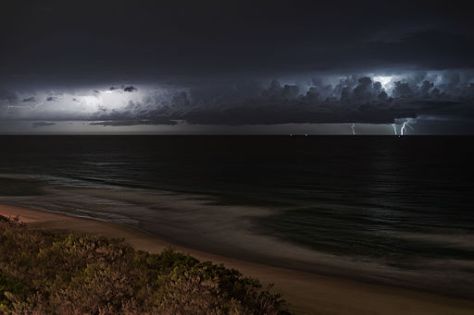
Photo credit: bigwavephoto / Wikimedia Commons, via Wikimedia Commons.

Or even a proper razor.
Hey! Comic books and Milwaukee’s Best cost a lot of money, people!!
Thanks to Mary Washington College Alumnus Rick Slagle for sending this along. (The nice young lady beside me was my girlfriend at the time. She’s a lovely person, so I’ll spare her the ignominy of naming her here.)
When your high school friends start to sound like your parents.
“Hey! You kids! GET OFF MY LONGWOOD.”
Well, here is some nice news today — the good folks over at Dead Snakes have published my latest poem, “hens staring upward.” (I know that its whimsical sounding title suggests another one of my joke poems, but this is definitely a darker piece, and does contain some disturbing imagery.)
Here’s the link:
“hens staring upward,” by Eric Robert Nolan
Thanks to Editor Stephen Jarrell Williams for graciously allowing me to share my voice once again over at Dead Snakes!
Following up on yesterday’s blog post about Nathan Hale for July 4th — I actually wrote briefly about Hale and New York’s revolutionary history in “The Dogs Don’t Bark In Brooklyn Any More.” It was background information about Brooklyn’s Prospect Park; the novel’s story, of course, takes place in a fictional future.
I actually made up the “local legend” about Hale’s ghost brooding around the arch. I have no doubt that the park has its share of ghost stories, but this one was only a bit of poetic license on my part:
“[Prospect Park] is a haunted place. Many men have died in the vicinity of its gently rolling hills, though the occasion of their passing predates the park’s mid-nineteenth century creation. The area around Prospect Park is the site of the Revolutionary War’s first and largest major battle, fought in the waning summer of 1776, not two months after the signing of the Declaration of Independence.
“The fledgling United States fielded its first official army there, with heartbreaking results. The Battle of Brooklyn was a disaster for America, whose sons were outnumbered two-to-one by 22,000 English and Hessian soldiers. George Washington, flush with his victory at Boston, found his forces routed. He barely escaped to Manhattan in a desperate, stealthy evacuation of more than 9,000 troops. On the morning of August 30, he and his retreating men were met along the Brooklyn hills with a miraculous surprise – a dense morning fog that concealed their perilous exit. To Washington and his war-weary comrades, it must have seemed like nothing short of divine intervention.
“Those were the dark days of America’s infancy – Nathan Hale would not long after be captured on a mission of espionage in Manhattan, disguised as a Dutch schoolteacher, and would be hanged, after his immortal lament that he had but a single life to give for his country. The defeat in Brooklyn also cleared the way for the Crown’s capture of all of New York City. The Great Fire of 1776 would ravage Manhattan. And the city would remain in England’s hands until the end of the war.
“Ironically, the park’s principal monument is devoted to another war entirely – one in which America turned upon itself. This is the Soldiers’ and Sailors’ Memorial Arch, a massive structure dedicated to the Union Army during the Civil War. If there is an afterlife, then perhaps it might break Washington’s heart – and Hale’s – to see the Arch as it stands today, a memorial to Americans killing Americans. Indeed, a local legend holds that Hale’s ghost occasions the site of the Arch and hangs his gaze upon it, glum with the knowledge of a nation divided and torn.”
Let’s try this again … after wrestling with formatting issues, I have somewhat better presented my first entry into the 5-Day Poetry Challenge:
“You’re a Broken Phonograph,” by Eric Robert Nolan
You’re baggage.
You’re a scratched penny on a gravel street.
Your memory is a cheap souvenir from an ill-advised journey that is wished forgotten. You were purchased drunk on a mercilessly hot noon at a roadside stand. The vendor resembled Browning’s “hoary cripple” — all eager eyes and veiled laughter. His smile is frequented by gold teeth — intermittent shining sentries on a rampart grin. His front pockets are stuffed with bills, like twin plump denim ticks; their fangs are dollars’ corners. Your overpriced bauble shines at midday, but every additional dusk renders it lower into dulling shades of deep sepia. The paint flakes off — it falls to the windowsill now like the dead wings of moths. The wise advise its removal; the paint is toxic.
Your image is the aged face of a staid statesman on a stamp, an unremembered lawmaker.
You’re a broken phonograph.
You’re a photo of a burned out building.
Your presence is a preening blackbird at the lawn.
You’re quick to open your legs, but slow to close your mouth.
You’re easy sex, but difficult company.
You’re a cheap date, but a costly acquaintance.
No matter where and when another man will lie beside you, you’re alone.
Your future is all awkward mornings, sunsets that are calls to arms, disenchanted midnights, men misunderstood,
“friends of friends,” “friends” instead of lovers, men recommended, men paid for,
their loins emptied first, their hearts emptied after, both by your mouth,
men slipping out, at sunrise, stealthily before you wake, like cats smelling better breakfast elsewhere.
(c) Eric Robert Nolan 2015
Photo credit: “Musee Baud,” 2015, by Rama, via Wikimedia Commons