Tag Archives: Matt Wagner

“With Orion’s sword, the Pumpkin arose …”

With Orion’s sword, the Hunter arose
And swept the world with fury and grace.
In him I was born, in him I will die,
In him I will lose name, station and face.

Death over weakness
Death over despair
Death over personal gain.

Death over dishonor
Death over undeath
Death over fire with no flame.

All this I pledge thee
O Grendel, great Khan
To serve and protect
Over death’s endless tide,

With your word in my heart
Your eyes in my face
And your tooth in my hand
By my side.


— from Matt Wagner’s “Grendel”


20171030_200819

“Morning Light,” William McGregor Paxton

Date unknown.  Am I nuts if this piece reminds me a little of Matt Wagner’s work?

William_McGregor_Paxton_-_Morning_light

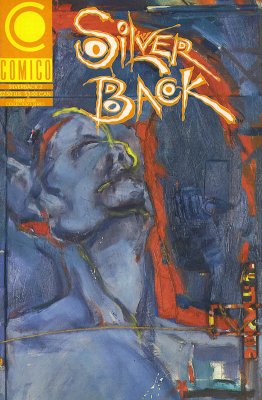
Cover to “Silverback” #2, Ron Turner, 1989

Comico.


fad00f79eb4f43486f8875cd908cb8c3_l

Cover to “Grendel: War Child” #7, Matt Wagner, 1992

Dark Horse Comics.


616525

Cover for “Grendel: War Child” hardcover, Matt Wagner, 1993

953109b

Throwback Thursday: early 1990’s “Aliens” and “Predator” comics.

I was chatting here with a friend last week about the “Aliens,” “Predator” and “Aliens vs. Predator” comics produced by Dark Horse Comics in the 1990’s.  While Marvel, DC and Image Comics all specialized in their superhero universes, Dark Horse tended to corner the market on hot properties in science fiction and horror.  (The company actually did try to compete by launching its own superhero line, but its unsuccessful “Comics’ Greatest World” universe lasted a mere three years.)

Dark Horse acquired the rights to the biggest science fiction movie characters of the first half of the decade, including “Aliens,” “Predator,” “Terminator,” “Robocop,” and “The Thing.”  It also produced great books in other genres too, like Frank Miller’s legendary “Sin City” series, Matt Wagner’s brilliant “Grendel,” and “Indiana Jones” comics.   (I never actually saw “Indiana Jones” on the shelves; the two retailers in my smallish Virginia college town never carried it.)

Perhaps strangely, I don’t remember any regular ongoing series for “Aliens,” “Predator” or “Aliens vs. Predator.”  Instead, the company published limited series on an ongoing basis.

Dark Horse had been a young company back then — it had started only four years earlier, in 1986.  But I’ll be damned if the people running the company didn’t know their stuff.  Not only did they snatch up big-name properties, they did a great job in producing consistently high-quality “Alien” and “Predator” books.  (Maybe “Aliens: Genocide” wasn’t as good as the other series, but it was really more average than flat-out bad.)  I honestly don’t know how they managed to publish such uniformly excellent comics that drew from a variety of creative teams.  The “Big Two,” Marvel and DC, produced their share of mediocre comics — even for tentpole characters or major storylines.  (See the “Batman” chapters of DC’s “Knightfall,” for example, or Marvel’s “Maximum Carnage” storyline for Spider-Man.)

Was Dark Horse’s track record better because their target audience was adults?  Did they just have really good editorial oversight?  Or did they maybe share such oversight with 20th Century Fox, which had a vested interest in its characters being capably handled?  I’m only guessing here.

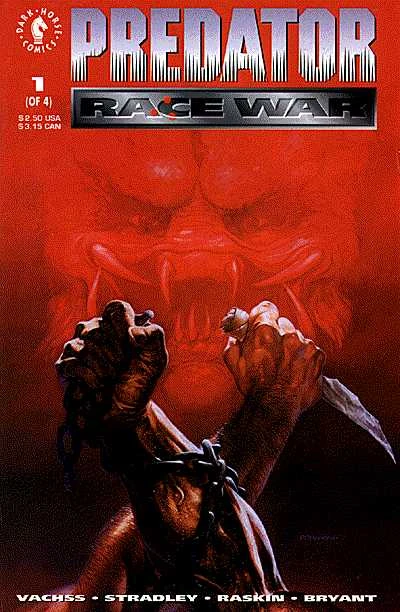
I’ve already blathered on at this blog about how I loved “Aliens: Hive,” so I won’t bend your ear yet again.  An example of another terrific limited series was “Predator: Race War,” which saw the title baddie hunting the inmates of a maximum security prison.  And yet another that I tried to collect was “Aliens vs. Predator: the Deadliest of the Species.”  The series had a slightly annoying title because of it was a lengthy tongue twister, but, God, was it fantastic.  I think I only managed to lay hands on four or five issues, but the art and writing were just incredibly good.

Take a gander at the covers below — all except the first are from “The Deadliest of the Species.”  I think they are some of the most gorgeous comic covers I’ve ever seen, due in no small part to their composition and their contrasting images.  And I’ve seen a lot of comic covers.  I think the very last cover you see here, for Issue 3, is my favorite.

I would have loved to collect all 12 issues … I still don’t know how the story ended.  (It was partly a mystery, too.)  But at age 19, I absolutely did not have the organizational skills to seek out any given limited series over the course of a full year.

In fact, this title may well have taken longer than that to be released … Dark Horse did have an Achilles’ heel as a company, and that was its unreliable production schedule.  Books were frequently delayed.  To make matters worse, these were a little harder to find in the back issues bins.  (I don’t know if retailers purchased them in fewer numbers or if fans were just buying them out more quickly.)

I suppose I could easily hunt down all 12 issues of “The Deadliest of the Species” with this newfangled Internet thingy.  But part of being an adult is not spending a lot of money on comic books.  Maybe I’ll give myself a congratulatory present if I ever manage to get a book of poetry published.  Yeah … I can totally rationalize it like that.


Aliens-Predator_The_Deadliest_of_the_Species_Vol_1_2

Aliens Predator 10

Aliens-Predator_The_Deadliest_of_the_Species_Vol_1_11

avp_deadliest_of_the_species_3


Throwback Thursday: the Launch of Image Comics (1992)

I talked about Todd McFarlane’s “Spawn” in last week’s Throwback Thursday post; these are some very early issues of a few of Image Comics’ other titles when the company launched in 1992.  I remember snapping them up in earnest when I was 19 years old — as I said last week, it was exciting for a comics fan to see a new company challenge the “Big Two,” Marvel Comics and DC Comics, with a new superhero universe.

I and other ambitious collectors also grabbed these off the shelves because we naively expected they all would one day be very valuable.  (Investing in comic books is a little more complicated than that — they’ve generally got to be in extremely good condition to fetch high prices.)

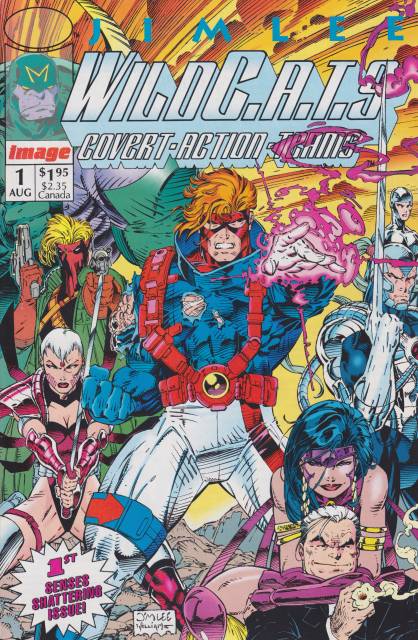
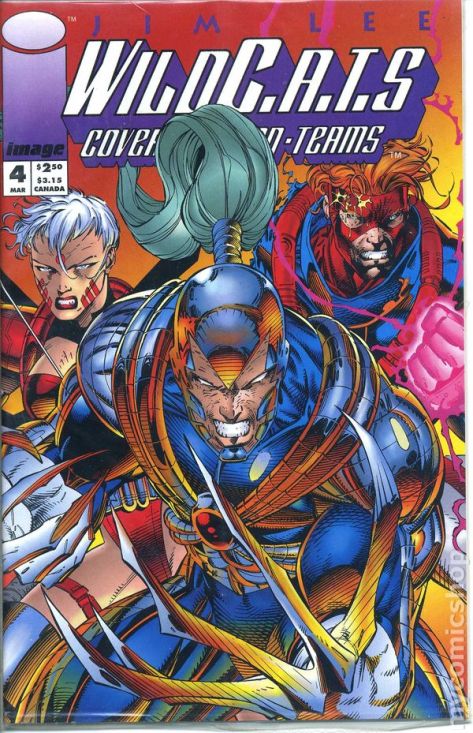
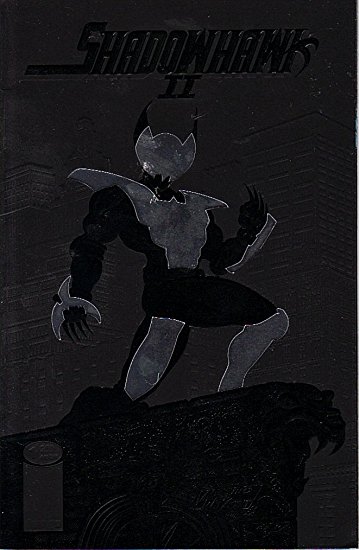
The first Image comics were a mix of good and bad.  If memory serves, Jim Lee’s “WildC.A.T.s” was very good; Rob Liefeld’s “Youngblood” was less so, but was at least interesting.  The art and writing for Jim Valentino’s “Shadowhawk” was truly mediocre.  That didn’t stop me from buying a few issues, though — the novelty of these new books just gave them too much appeal.

There were a lot of creative things going on with early Image titles.  Some of the new characters were pretty neat.  I remember being partial to Youngblood’s “Diehard” for some reason, along with the WildC.A.T.s’ “Grifter.”  (The former has the red, white, and blue full bodysuit; the latter has the trenchcoat and pistols.)  And I definitely liked WildC.A.T.s’ “Warblade.”  He’s the guy below with the ponytail and the shape-changing, liquid-metal hands.  He was a favorite of mine despite the fact that he seemed to borrow a trick or two from the newly iconic liquid-metal terminator.  (“Terminator 2: Judgement Day” had hit theaters a year earlier.)

Image comics were quite different than those produced by Marvel and DC.  (As I explained last week, Image was formed by artists who revolted against their prior employers’ unfair, work-for-hire payment policies — their new company gave them complete creative control over their characters.)  Despite the popularity of Image’s new books, however, they sometimes appeared to have been developed without some needed editorial oversight.

The violence and gore was often far more graphic.  And Image’s creative decisions ranged from the inspired to the strange to just being in questionable taste.  (It all depended on your disposition, I guess.)  WildC.A.T.s, for example, portrayed Vice President Dan Quayle as being possessed by an unearthly “Daemonite.”  (Damn, those Daemonites were wicked-cool bad guys, and Lee Illustrated them beautifully.)  Shadowhawk’s signature move was breaking the spines of criminals.  He was also HIV-positive, the result of some gangsters’ reprisal — they captured him and injected him with infected blood.  The character thereafter spent some of his history trying in vain to locate a cure for AIDS.  (This was 1992, just after the epidemic became fully entrenched in the public’s anxieties in the 1980’s.)

My interest in these titles eventually waned, though I did still pick “Spawn” up when I had the money.  The Image universe was densely crowded with new characters, and it was just too much information to sustain my interest.  (Seriously, look at the first couple of covers below.)  I spent far more money on DC’s various “Batman” and “Green Lantern” titles.  And if I wanted edgy comics, I had discovered the various incarnations of Matt Wagner’s “Grendel” that were available through Dark Horse Comics.  Those boggled the mind.

But Image comics did burgeon into a great success, even if these early titles have since been retired.  “Spawn,” of course, is still being produced.  And today the company’s wide range of books includes Robert Kirkman’s “The Walking Dead.”  It’s hard to imagine either of the Big Two picking up Kirkman’s gory epic masterpiece … so I suppose we have Image to thank for the TV show.

1618179-wildcats_covert_action_teams__1992__01a

ibc25b64d2961mh92d73z

726109

559443

shadowhawk1992series3

61zpMu6Im+L._SY550_

A review of “Grendel Omnibus: Volume 2: The Legacy”

“Grendel Omnibus Volume 2: The Legacy” can’t match its predecessor.  Where the first amazing Omnibus edition focused gorgeously and exclusively on creator Matt Wagner’s first “Grendel” character, the arch-villain Hunter Rose, this second collection focuses mostly on supporting characters and Rose’s successors.  “Devil Child” shows us the cruel fate of an adult Stacy Palumbo, while “Devil’s Legacy” and “The Devil Inside” follow Christine Spar and Brian Li Sung’s turns as both heirs and victims of “Grendel’s” identity.   The “Devil Tales” coda of two stories at the very end are told from the perspective of Albert Wiggins, who was first introduced in the Spar and L Sung story arcs.

There are decent stories throughout; all except the first were written by Wagner himself.  And I do think a serious “Grendel” collector would need to at least read these stories to grasp the overall continuity of Wagner’s seminal work.  (We see for the first time, for example, how “Grendel” is a conscious entity jumping from person to to person.)

But nearly all the stories have great pacing problems.  I get the sense that Wagner wrote these during an experimental stage as a creator.  There are all sorts of departures from standard comic book storytelling, in format, scripting, paneling, and point-of-view.  These departures are interesting, but don’t always pay off.  Some of the stories were cluttered with too much text, too many panels, or even an unnecessary speaker.  (Wagner himself appears to interject as a speaker in one of the closing “Devil Tales;” a distracting kind of narration runs throughout it, in scrawled overhead text that looks like … an author’s outline?)

A few of these felt a little too long.  “Devil’s Legacy,” which follows the career of Christine Spar, was a great tale, and important to the overall mythos.  Yet the otherwise brilliant Wagner seems to struggle structuring it over 12 issues … it is often too slow, with unnecessary dialogue and drama, and with too much attention paid to minor plot points.

A lot of the artwork simply wasn’t my cup of tea.  While Tim Sale and Teddy Kristiansen shine in the first entry, most of the following artists do not.

Ah, well.  Wagner’s brilliance still shines through, particularly with the two closing stories, which he wrote and illustrated.  And all of the stories themselves, with their complex themes of aggression and identity, remain some of the most unique and interesting things in comic books as a medium.  This was a good book — despite its relative failings.  I’d give it an 8 out of 10.


51grycqvdnl-_sy344_bo1204203200_

Cover to “Grendel: Devil’s Legacy,” Issue #6, Matt Wagner, 2000

Dark Horse Comics’ millennial reprint of Comico’s release in the 80’s.


Cover to “Grendel: Devil’s Legacy,” Issue #12, Matt Wagner, 2001

Dark Horse Comics’ reprint of the 80’s original series.