Tag Archives: W.H. Auden

“Precocious children rarely grow up good.”

“I must admit that I was most precocious
“(Precocious children rarely grow up good).
“My aunts and uncles thought me quite atrocious
“For using words more adult than I should.”

— excerpt from W. H. Auden’s “Letter to Lord Byron,” in Letters from Iceland, 1937


LettersFromIceland

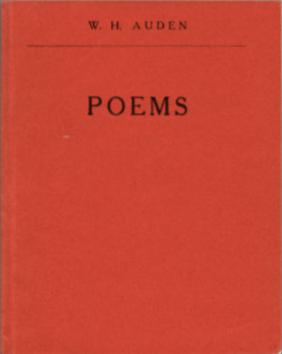
This was W. H. Auden’s first book of poetry.

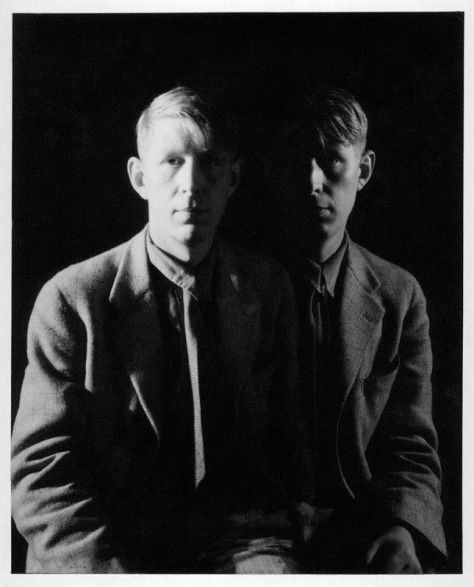
It was hardly more than a chapbook, really — it was a hand-printed pamphlet informally published in 1928 by Auden’s friend and fellow Briton, the poet and essayist Stephen Spender (second photo).  Auden would have been about 21 at the time.  In other words, Auden’s career began in a manner not unlike many indie poets today.

Only about 45 copies of Poems were released.  The book is today considered one of the rarest in 20th Century literature.

To make matters just a bit more confusing, Auden’s next two books of poetry, in 1930 and 1934, were likewise entitled simply Poems.  (And the 1930 book had two editions.)  Oddly, Auden wanted no distinctive title for any of the books because he thought a title might distract the reader from the content of the poems themselves.)  The 1930 volume was accepted for publisher Faber & Faber by none other than T.S. Eliot, who was one of his earliest influences.


Poems1928


Stephen_spender

W. H. Auden reads “Alonso to Ferdinand”

This is my favorite poem of all time — read by my favorite poet of all time.

Once again, this is an excerpt from Auden’s “The Sea and the Mirror: A Commentary on Shakespeare’s The Tempest,” first published in 1944.


“Song of The Master and Boatswain” by W.H. Auden (read by Tom O’Bedlam)

I am linking here to the SpokenVerse Youtube Channel.  This poem is a favorite of mine.

“Tom O’Bedlam” is such a kick-ass name.  It sounds like a man who starts a lot of barfights.  Or some kind of … Irish agent provocateur.  I’d be thrilled if people nicknamed me “Eric O’Bedlam.”


“One face cries nothing, Prospero …”

One face cries nothing, Prospero,

My conscience is my own;

Pallid Sebastian does not know

The dream in which Antonio

Fights the white bull alone.

— from Antonio’s refrain in “The Sea and the Mirror,” by W. H. Auden


800px-Winter_Sky_New_Jersey

“Lullaby,” by W. H. Auden (recited by Eric Robert Nolan)

“Adventure,” by W.H. Auden

“Adventure,” by W.H. Auden (Part XVII of “The Quest”)

Others had found it prudent to withdraw
Before official pressure was applied,
Embittered robbers outlawed by the Law,
Lepers in terror of the terrified.

But no one else accused these of a crime;
They did not look ill: old friends, overcome,
Stared as they rolled away from talk and time
Like marbles out into the blank and dumb.

The crowd clung all the closer to convention,
Sunshine and horses, for the sane know why
The even numbers should ignore the odd:

The Nameless is what no free people mention;
Successful men know better than to try
To see the face of their Absconded God.


aeed7a0fd6b92a669866f8de91e098a5--cecil-beaton-famous-photographers

Season 1 of “Mr. Mercedes” (2017) was astonishingly good.

It amazes me how little fanfare that “Mr. Mercedes” is getting.  Season 1 was not only one of the best Stephen King adaptations ever, I think it has the rare distinction of being even better that its source material.  (I really liked 2014 novel, but I loved the show.) I might have a couple of minor quibbles about the ten-episode season, but they’re not enough to stop me from rating it a perfect 10.

I tend to think of this as more “mainstream King.”  As with the book, the story here is devoid of the supernatural elements that usually characterize King’s work.  It also doesn’t have any overt connection to King’s overarching, interconnected “Dark Tower” multiverse.  It’s a depressingly real-world story about a mass murderer whose weapon of choice is a stolen Mercedes.  (There is a plot-driving horror set-piece at the start of the pilot episode in which he mows down a crowd lined up for a job fair.)

What follows is a drama of surprising depth and authenticity.  We see the extended aftermath of slaughter, throughout the lives of people connected to it — including one victim’s family, the now-retired investigating detective (Brendan Gleeson), the young killer himself (Harry Treadway) and his alcoholic, incestuous mother (Kelly Lynch).  Gleeson was who first made me interested in the show, and his performance is outstanding.  Lynch is amazing and perfect in her role, and is even talented enough make her onerous character truly sympathetic.  But even they are outshined by Treadway’s frighteningly goddam perfect portrayal of the titular “Mr. Mercedes.”  The guy is incredible.

The script was nothing short of terrific.  There is certainly enough horror here — including one particularly cringe-inducing plot twist late in the game.  (It was so disturbingly presented that I almost had to switch the episode off — and I knew it was coming, as I’d already read the book.)  But the horror punctuates the unexpectedly touching drama among the story’s protagonists — and the sad relationship between the killer and his disordered mother.  There were also some great moments of humor, and the subtexts here dealing with friendship and loyalty were surprisingly moving.

The rest of the cast was quite good.  The directing shined as well — especially for a key sequence in Episode 7, “Willow Lake.”  Even the soundtrack was excellent.  Hell, they even referenced W. H. Auden in one episode.

My quibbles were minor.  One was the story’s pacing.  It’s actually quite slow for the first eight episodes — enough, I think to lose some viewers.  This didn’t bother me much — I took it as “slow-burn” horror, and it matched the very slow pace of the book.  Then the story seemed to move forward at a breakneck pace during episodes 9 and 10.  I can’t help but wonder if it could have been scripted differently, as that felt odd.

My second quibble lies with Mary-Louise Parker’s portrayal of Janey, the sister of one of the killer’s victims.  Parker is an excellent actress, but I found her version of the character to be remarkably detached for someone bereaved in such a horrifying fashion — to me, it seemed like a strange creative choice on the part of the actress.

I’d obviously recommend this; it’s currently the best horror show that I’m aware of.


b54392d2b586b944ad0af2c9fe59082f

An excerpt from W. H. Auden’s “Hunting Season,” read by Eric Robert Nolan

This is only 20 seconds long; it consists of just one stanza from Auden’s poem.  Despite their brevity, however, I think that these few lines comprise one of the greatest breakup poems ever.


“The Third Temptation,” by W. H. Auden, read by Eric Robert Nolan

Part VIII of W. H. Auden’s “The Quest.”