“The Lass of Cessnock Banks,” by Robert Burns

“The Lass of Cessnock Banks,” by Robert Burns

On Cessnock Banks a lassie dwells;

Could I describe her shape and mein;
Our lasses a’ she far excels,
An’ she has twa sparkling roguish een.

She’s sweeter than the morning dawn,
When rising Phoebus first is seen,
And dew-drops twinkle o’er the lawn;
An’ she has twa sparkling roguish een.

She’s stately like yon youthful ash,
That grows the cowslip braes between,
And drinks the stream with vigour fresh;
An’ she has twa sparkling roguish een.

She’s spotless like the flow’ring thorn,
With flow’rs so white and leaves so green,
When purest in the dewy morn;
An’ she has twa sparkling roguish een.

Her looks are like the vernal May,
When ev’ning Phoebus shines serene,
While birds rejoice on every spray;
An’ she has twa sparkling roguish een.

Her hair is like the curling mist,
That climbs the mountain-sides at e’en,
When flow’r-reviving rains are past;
An’ she has twa sparkling roguish een.

Her forehead’s like the show’ry bow,
When gleaming sunbeams intervene
And gild the distant mountain’s brow;
An’ she has twa sparkling roguish een.

Her cheeks are like yon crimson gem,
The pride of all the flowery scene,
Just opening on its thorny stem;
An’ she has twa sparkling roguish een.

Her bosom’s like the nightly snow,
When pale the morning rises keen,
While hid the murm’ring streamlets flow;
An’ she has twa sparkling roguish een.

Her lips are like yon cherries ripe,
That sunny walls from Boreas screen;
They tempt the taste and charm the sight;
An’ she has twa sparkling roguish een.

Her teeth are like a flock of sheep,
With fleeces newly washen clean,
That slowly mount the rising steep;
An’ she has twa sparkling roguish een.

Her breath is like the fragrant breeze,
That gently stirs the blossom’d bean,
When Phoebus sinks behind the seas;
An’ she has twa sparkling roguish een.

Her voice is like the ev’ning thrush,
That sings on Cessnock banks unseen,
While his mate sits nestling in the bush;
An’ she has twa sparkling roguish een.

But it’s not her air, her form, her face,
Tho’ matching beauty’s fabled queen;
‘Tis the mind that shines in ev’ry grace,
An’ chiefly in her roguish een.

1780

Pictured: Dunnotar Castle


Photo credit: “Castle on the hill” by Macieklew – Own work. Licensed under CC BY-SA 3.0 via Wikimedia Commons.
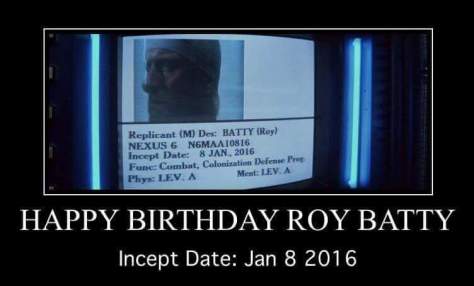
Happy Birthday, Roy Batty!!

Or, rather … Happy Incept Date?

Enjoy it while you can.  “The candle that burns twice as bright burns half as long.”  And you will burn so very brightly.


1237_10208231126753029_7822883704492397397_n

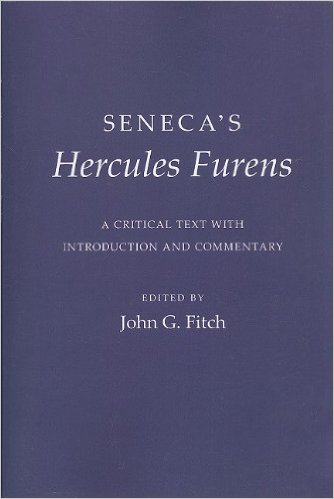
“Who will be a match for Hercules?”

“Who will be a match for Hercules?

“There is no one, except himself.

“Therefore, let him wage war against himself.”

—  Seneca, “Hercules Furens,” 1 AD


41UV0qTiMcL._SX332_BO1,204,203,200_

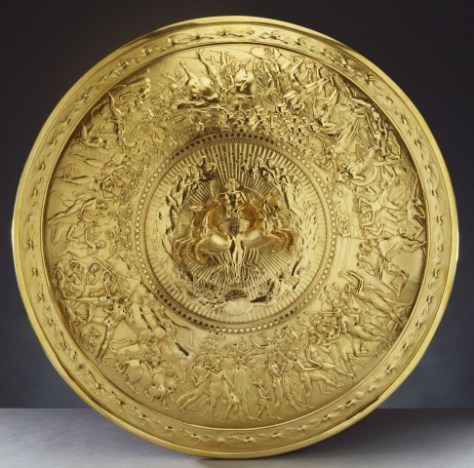
“The Shield of Achilles,” by W. H. Auden

A good buddy of mine in New York is a bit of a classical scholar; he recently finished Homer’s “The Illiad.”  That’s a task that has been beyond me so far.  I tried to read it at age 36, and it was just too thick for me.

Anyway, you and I both know the greatest poetic allegory to “The Illiad” ever written — it’s none other than W.H. Auden’s “The Shield of Achilles.”

Thanks to Poets.org for the text.


“The Shield of Achilles”

  She looked over his shoulder
       For vines and olive trees,
     Marble well-governed cities
       And ships upon untamed seas,
     But there on the shining metal
       His hands had put instead
     An artificial wilderness
       And a sky like lead.

A plain without a feature, bare and brown,
   No blade of grass, no sign of neighborhood,
Nothing to eat and nowhere to sit down, 
   Yet, congregated on its blankness, stood
   An unintelligible multitude,
A million eyes, a million boots in line, 
Without expression, waiting for a sign.

Out of the air a voice without a face
   Proved by statistics that some cause was just
In tones as dry and level as the place:
   No one was cheered and nothing was discussed;
   Column by column in a cloud of dust
They marched away enduring a belief
Whose logic brought them, somewhere else, to grief.

     She looked over his shoulder
       For ritual pieties,
     White flower-garlanded heifers,
       Libation and sacrifice,
     But there on the shining metal
       Where the altar should have been,
     She saw by his flickering forge-light
       Quite another scene.

Barbed wire enclosed an arbitrary spot
   Where bored officials lounged (one cracked a joke)
And sentries sweated for the day was hot:
   A crowd of ordinary decent folk
   Watched from without and neither moved nor spoke
As three pale figures were led forth and bound
To three posts driven upright in the ground.

The mass and majesty of this world, all
   That carries weight and always weighs the same
Lay in the hands of others; they were small
   And could not hope for help and no help came:
   What their foes like to do was done, their shame
Was all the worst could wish; they lost their pride
And died as men before their bodies died.

     She looked over his shoulder
       For athletes at their games,
     Men and women in a dance
       Moving their sweet limbs
     Quick, quick, to music,
       But there on the shining shield
     His hands had set no dancing-floor
       But a weed-choked field.

A ragged urchin, aimless and alone, 
   Loitered about that vacancy; a bird
Flew up to safety from his well-aimed stone:
   That girls are raped, that two boys knife a third,
   Were axioms to him, who’d never heard
Of any world where promises were kept,
Or one could weep because another wept.

     The thin-lipped armorer,
       Hephaestos, hobbled away,
     Thetis of the shining breasts
       Cried out in dismay
     At what the god had wrought
       To please her son, the strong
     Iron-hearted man-slaying Achilles
       Who would not live long.


349471-1356022189

The Shield of Achilles: Supplied to George IV by Rundell, Bridge and Rundell, 1821


Just a few quick shots of I-95 between Delaware and Washington, DC yesterday.

The first is from the Delaware Bridge; the second is from the Millard E. Tydings Memorial Bridge in Maryland.

The last is Union Station in Washington.


OLYMPUS DIGITAL CAMERAOLYMPUS DIGITAL CAMERA

OLYMPUS DIGITAL CAMERA

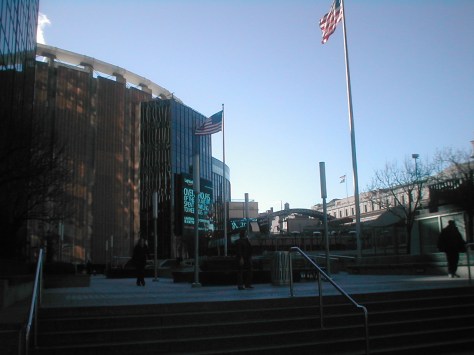
West 34th Street today and views of the NYC skyline.

I never claimed to be a famous photographer.  (Okay, once I actually did claim to be a famous photographer, but I was twentysomething and hitting on an amazing girl in one of Long Island’s tawdrier bars “out east.”  Was it … Bawdy Barn?)

If my inelegant eye doesn’t put you off too much, then enjoy these shots of West 34th Street today and the NYC skyline.  (I regret not getting a shot of the Freedom Tower.)

A quick thanks to the U. S. Army for making me feel safer in Penn Station, really.  Those guys look tough as nails, and just as sharp.  They were visibly scanning every passerby right in the middle of the station, a task I can’t imagine is easy.  But they were at the top of their game.

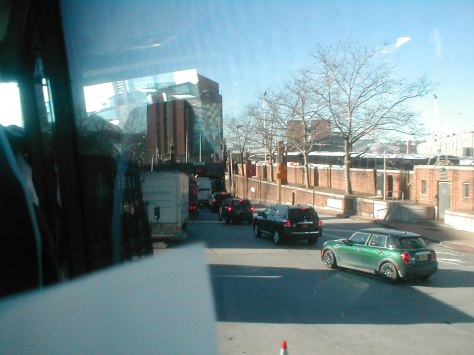
Hey Stephen King fans — you see that poorly taken snaphot that is second to last?  That’s none other than the NYC entrance to The Lincoln Tunnel.  Our good friend Larry Underwood had a particularly hard time entering and traversing that tunnel, didn’t he?  (It was much easier for me, as I inhabit a different level of The Tower.)

“Baby, can you dig your man?”

OLYMPUS DIGITAL CAMERA

OLYMPUS DIGITAL CAMERA

OLYMPUS DIGITAL CAMERA

OLYMPUS DIGITAL CAMERA

OLYMPUS DIGITAL CAMERA

OLYMPUS DIGITAL CAMERA

“All sorrows can be borne if you put them in a story …”

“All sorrows can be borne if you put them in a story, or tell a story about them.”

— Isak Dineson (Karen Blixen)


3472-161545


A friend of mine put this 80’s-tastic decal on her car.

She apparently thinks it’s the Death Star, but I SWEAR I am seeing Pac-Man after a lengthy meth addiction.

[UPDATE: Remember being a kid in 1985, and thinking the 1950’s were just a really weird part of history before you were born?  THAT’S HOW KIDS RIGHT NOW THINK OF THE 80’S.  Good Lord.]


12507625_10101293075822758_2110510284499770392_n

An untitled poem by Pete Harrison

Pete Harrison has long been a valued contributor to this blog.  Tonight I’m fortunate enough to feature a poem he’s authored himself — one which I happen to like a lot.

Thanks, Pete!

*****

We had just made love
There was enough light to see her
So I looked at her
Under the soft light
She smiled and asked what I was looking at
I said I was looking at her
Every part
Every mark
Every mole
She said she wished I would not do that
She said she had parts of her that she did not like
She said she had been told that they were imperfections
And when I told her it was all these parts I loved
Because they were all parts of her
And to me she was perfection
She laughed quietly
And looked away from my eyes
I will never be with her again
And I still don’t know
If she believed it was true
For me about her
Or about her for herself
And I still don’t know
Why she would believe anyone or anything else


1924307_10153147426340388_7345817369746798962_n

Publication Notice: Peeking Cat Poetry Magazine to feature “Confession”

I just got some nice news from Samantha Rose over at Peeking Cat Poetry Magazine.  They’ve selected my most popular poem, “Confession,” for publication in the upcoming Issue 10.

“Confession” first appeared in Dead Beats Literary Blog on October 9th, 2013.

I’ll post information about how to purchase copies of Issue 10 when it becomes available.

Thanks, Peeking Cat!