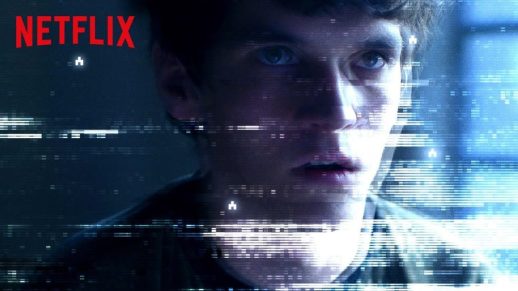
“Bandersnatch” is a difficult episode of Netflix’ “Black Mirror” to review — it isn’t really an “episode” or a “movie;” it’s more of an interactive online game that is reminiscent of the “Choose-Your-Own Adventure” young-adult books of the 1980’s. (I believe they are actually name-checked in “Bandersnatch’s” main narrative, before it branches off into multiple stories.) This main narrative follows a troubled young computer programmer (expertly played by Fionn Whitehead) as he begins to question his own reality while struggling with demons from his past.
From there, “Bandersnatch” unfolds according to the viewer’s choices. (Netflix has configured the episode so that viewers control the protagonist simply by clicking options with their computer’s cursor.) The meta-fictional twist here is that Whitehead’s protagonist is himself developing a groundbreaking multiple-choice style video game for his employer. (The episode is set in 1984, when interactive games had not yet developed alongside arcade-style games.) What follows is a seemingly indeterminate number of stories, with “Black Mirror’s” predictably disturbing surprises.
I’ve read that there are four “main endings” at which the show’s writer, Charlie Brooker, thinks most viewers will arrive. There are supposedly a great number of other endings, as well — and the viewer can reverse the course of a narrative and follow a different path. It’s all interesting stuff, even if it’s a little complicated.
So I’m not sure how to review it. And I’m not sure I’m the best guy to offer such an opinion, as I am not the target audience for an experiment like this. I’ve always been a “movie guy,” and not a “video game guy” — I’m the kind of milquetoast man that would rather be passively entertained by a story than involved, in real-time, in its creation. I want a cohesive story with a clear denoument that was intended by the writer and director — not a mongrelized story that I helped come up with myself. (Yes, I know that makes me sound like the precise opposite of cool and fun and creative, but I’m just being honest.) I trust “Black Mirror” to knock my socks off with it’s storytelling — Brooker is a goddam genius, and this show is nothing less than the 21st Century’s “Twilight Zone.
I certainly liked “Bandersnatch.” A key expository sequence in the first pathway I selected made me smile and laugh (due to the show’s intended black humor, of course). I’d rate this viewing experience an 8 out of 10, for the fun I had with it.
But I do hope this is the only episode of its kind. There are disadvantages that this experimental format probably cannot escape. Pacing, plot structure and story cohesion all typically go right out the window after “rewinding” and story options are introduced. I also had the compulsion, upon completing my first story arc, to return to the action and find an ending that was “correct” or possibly better. And when my next narrative meandered, I wondered whether I was “doing it right.” This lacked the cinematic quality that is characteristic of “Black Mirror” episodes, and ultimately felt like a video game.
I had another quibble too, and it’s admittedly a strange one. Many elements of “Bandersnatch’s” 1980’s setting here are garish, bizarre or unpleasant. (Some of the characters — particularly the father — were so off-putting that they made revisiting a story sequence almost irritating.) I suppose that this was probably a deliberate choice by Brooker and by episode director David Slade — possibly to capture the vibe of the Philip K. Dick stories that are this episode’s obvious inspiration. But I don’t think it was necessary to the plot. Consider how different a story like this might be if it were filmed with the starkly beautiful visuals of the 2017 “Crocodile” episode directed by John Hillcoat.
Postscript — there was one metafictional twist that only I could enjoy. And that’s a shame, because it was pretty neat. When Will Poulter’s character here tells Whitehead’s that they’ve “met before,” that struck a chord with me personally — because Poulter, who has blond hair here, looks a lot like an old pal of mine from college. That was weird.