All posts by Eric Robert Nolan

Eric Robert Nolan graduated from Mary Washington College in 1994 with a Bachelor of Science in Psychology. He spent several years a news reporter and editorial writer for the Culpeper Star Exponent in Culpeper, Virginia. His work has also appeared on the front pages of numerous newspapers in Virginia, including The Free Lance – Star and The Daily Progress. Eric entered the field of philanthropy in 1996, as a grant writer for nonprofit healthcare organizations. Eric’s poetry has been featured by Dead Beats Literary Blog, Dagda Publishing, The International War Veterans’ Poetry Archive, and elsewhere. His poetry will also be published by Illumen Magazine in its Spring 2014 issue.

Detail of a skull necklace and skull from Attributes of Tshans-pa

Detail of a skull necklace and skull from Attributes of Tshans-pa (Brahma, “the pure one”) in a Tibetan “rgyan tshogs” banner.

L0030398 Attributes of Tshans-pa (Brahma, 'The Pure One') in a

A review of Season 2 of “The Strain”

When I favorably reviewed the first season of “The Strain” (2104) last year, I predicted that the show couldn’t sustain its momentum much longer, as the creepy effectiveness of its vampires was already beginning to fade.  I was pleasantly proven wrong.  Season 2 was a creepy, devilishly surprising ride, despite its silliness, and I’d rate it an 8 out of 10.

Let’s get a little killjoy pedanticism out of the way first.  “The Strain” has absolutely not lived up to its promise as an epic horror-movie-meets-technothriller, as suggested by the opening episodes of Season 1.  Those episodes looked like a collaboration between Bram Stoker and Tom Clancy.  Imagine how amazing this show could have been!

What we’ve got instead is more EC Comics horror than intelligent horror.  You’ll enjoy the program more the less that you think it through.  I can’t resist being a know-it-all here and deflating one of my favorite shows with some pretty big things it overlooks.

First, the vampire legions we see laying siege to New York City here are nothing less than invading force.  New York is the financial capitol of the United States, and arguably the world.  Its fall would cripple not only America, but also the world’s economy, and that’s not even considering the more obvious threat of the vampires extending their forces outward from there.

I think that Congress would repeal The Posse Comitatus Act, which prohibits America’s armed forces from occupying U.S. lands.  (Or the president could easily circumvent it.)  We would see large standing armies surrounding and then moving in to New York, with support from the Navy and Air Force.  It absolutely would not just be outnumbered national guardsmen, heroic everyday policemen, and plucky, average New Yorkers rallying together, even if those things are fun to think about.  I think our armies would have plenty of international support as well.

Second, if our vampire forces (and their human collaborators) had any sense at all, they’d try hard to spread their contagion anywhere in the United States, even if they don’t intend to invade beyond New York.  Creating wildfire epidemics anywhere else on the continent would confuse and slow America’s response.

But I’m overthinking things.  “The Strain” is silliness, but it’s sublimely fun silliness.  This show didn’t fail to surprise and entertain me, and from time to time it creeped me out too.  I jumped a few times.  It indeed remains scary, with story devices that were spooky and damned creative.  One such device is the new breed of … what I call the “spider-vampires.”  They’re a different and even more unsettling threat than the baddies we’re used to.  And I can’t say much without spoilers, but the manner of their creation is pure genius horror writing.  Yeesh.  There are other little plot-related or character-related goodies that I’m thinking of, but I can’t specify without spoiling them.

Richard Sammel and Jonathon Hyde still lead the cast in talent; this is definitely a tv show in which the bad guys are the better thespians.  (For a show where Holocaust flashbacks have become stale, Sammel shines especially in fangless flashback that unexpectedly humanizes him.)  Their performances were often good enough to make me overlook the humdrum character of our often boring good guys.

Again, “The Strain” isn’t high art.  But it can be a damn fun time for a horror fan.  Check it out.

season-2-poster-2

You know you’re a Stephen King fan when you have flashbacks to your favorite novels.

Dietz to Stu Redman (“The Stand”): “They’re not such hot orders, but I think you’ll do okay.”

Why am I thinking of this $&*# before my first cup of coffee?

What are these? Exactly? Grapes?

I know grapes are bigger than these, but … are they still growing?

Nobody trick me into poisoning myself.  Please.  That’s bad netiquette.

All I can think of is that “Simpsons” episode where they lampoon William Golding’s “Lord of the Flies.”  The kids are trapped on an island with no food; Ralph Wiggum eats the local berries and gets sick, helpfully reporting that “they taste like burning.”

These things are growing everywhere in this one patch of woods near me.  I know this sounds nuts, but there also appear to be … raspberries growing in the wild down here in Virginia too.  It’s not far from where I’ve spotted that fox and the occasional deer, as well as geese and goslings.

Virginia people, this kind of thing is totally nuts to a New Yorker.

WIN_20151006_19_12_30_Pro

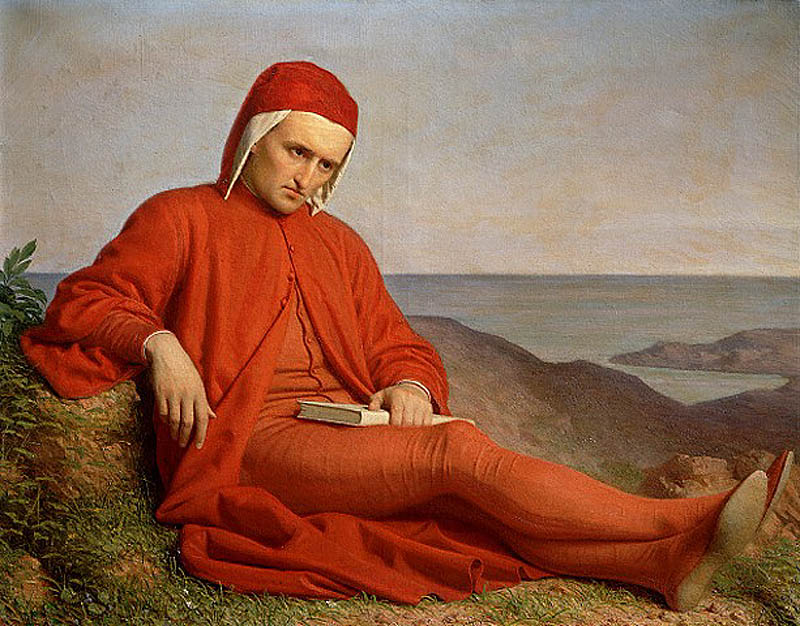
“Dante in Exile,” by Domenico Peterlini, circa 1860

Dante_exile

Photo credit: By Domenico Peterlini (o Petarlini o Peterlin) (1822 – 1891, attribuito) (http://www.stelle.com.br/pt/anonimo1.html) [Public domain], via Wikimedia Commons.

“Fear the Walking Dead” has webisodes.

Should you care?  I dunno.

The first webisode is one minute and 25 seconds long.  That seems like minimal entertainment, even for the little effort required to visit a website and click play.

Remember the plane that we saw over a panoramic shot of Los Angeles in one of the later episodes?  It appeared to be stuck in a dive, but then seemed to correct its course.  I’m pretty sure that it’s the subject of the the webisode series, entitled “Fear the Walking Dead: Flight 462.”

It’s embedded below.

Who was your favorite teacher? (Today is World Teachers’ Day.)

It’s World Teacher’s Day.  Or it was, until the clock struck midnight more than an hour ago.  It is sadly ironic that I am late for this, as I was so often late to class.

If you can, please pass this along to give a little recognition to someone in a uniquely demanding profession.

My single favorite teacher in New York’s Longwood Central School District is a little tough to choose.  I believe it would be a tie between two men.

The first was Mr. Greiner, who taught sixth grade at Ridge Elementary School.  He reined in a very strange, hyperactive boy long enough to actually write down his bizarre monster stories — and to do so legibly.  He could be firm, but also kind.  And the encouragement he offered was priceless.  I wrote my first presentable short story in his class, entitled “When A Bear Growls.”  It was about famous hunter Hank Brown’s deadly battle with a legendary grizzly, and it had enough blood and guts in it (and a shotgun!) to please and surprise my classmates.  They ate it up!  It was the first time in my life I’d ever felt “popular” at school, and it reinforced my love of writing.

The second was Mr. Anderson, who taught AP English to 12th graders at Longwood High School.  I remember him as a soft-spoken man, and I believe that he was simply so articulate that he just never needed to raise his voice in order to get his point across.  He had a visible, genuine love of literature that was contagious.  He knew how to push his students enough to prepare them well for college’s vastly greater demands.  But he was also sublimely easygoing and relatable.  So you could confide in him, for example, that you thought that William Faulkner really sucked.

I hope that both Mr. Greiner and Mr. Anderson are now very happy in retirement, and know that their students still hold them in the highest esteem.

12144952_10153811633133643_3902641543727859654_n

A nice shot of historic Jamestown, Virginia.

I’ve blogged a couple of pictures of historic Jamestown since I arrived in Virginia, simply because it is one of the places here that I’d really like to visit.  (The story of John Smith made a pretty big impression on me long ago as a schoolboy.)

Following my post yesterday, here’s a particularly good photo of the statue of John Smith there, passed along to me today by Mary Washington College Alumnus Nick Miller.  Nick is pictured below with his wife, Robin; they were there in August.  That’s the 1639 Jamestown Church behind them.  (I’m not sure if those crosses are the same one that I posted yesterday.)

11822314_10206633154242668_2299795073836066090_n

A review of “Fear the Walking Dead,” Season 1 (2015)

I know that love for “Fear the Walking Dead” (2015) is not universal, but I needed to pipe in at least once to say that I thought that “Season 1” was terrific.  (I feel funny calling six episodes a “season,” but I’ve heard that de facto miniseries like this are a new trend in television.)  I’d give this apocalypse story a 9 out of 10.

For me, “Fear the Walking Dead” satisfied a longstanding itch.  If you grow up a fan of post-apocalyptic horror, you are constantly exposed to the aftermath of the end of the world.  In the vast majority of films and fiction, horror fans are treated to flashbacks, at best, of how it all went down.  Here we (partly, at least) get to see it all go down.

I’ll bet that stories so expansive in scope are a little harder to conceive and write convincingly.  Very few writers of prose or screenplays have expertise in disaster management, disease control, mass psychology or homeland security.  How much easier is it to have protagonists roam a landscape of burned out buildings, with only graffiti, snippets of conversation, and occasionally a blown newspaper offering hints of exactly how the end came about?

“Fear” deserves a hell of a lot of credit just for trying (as does “The Strain” over at FX).  It’s also why the globally plotted “Contagion” (2011) was such a frighteningly interesting thriller, and why Max Brooks’ stage-by-stage zombie pandemic easily made “World War Z” the greatest zombie novel ever written.  Through the eyes of an average family, “Fear” at least tries to show us meaningful glimpses into how police, emergency and military authorities would react.  The result is some interesting stories.  A nerdy high school student is the first to prepare, for example, due to his attention to the Internet’s alternative media.  And a doomed compact between a civilian neighborhood and their putative military protectors concludes in a particularly horrifying way.

Soooooo many viewers complained that there were “no zombies.”  Well, there were always a couple, at least — we got a great one in the first episode’s earliest minutes.  But that wasn’t the point.  The creators of “Fear” told us that this would be a different type of show, with a “slow burn” -type horror.  For me, that worked.  Look at it this way — we routinely see “zombie swarms” over at that other show (what was its name again?).  We’ve been seeing them for five whole seasons — the first repelled Rick Grimes’ ill advised solitary horseback exploration of Atlanta.  That’s fun for a zombie horror fan, but it’s nothing new.

“Fear” offers us something much different — a kind of “creeping horror.”  This seemed like the “Psycho” (1960) of onscreen zombie tales.  No, we don’t see zombies everywhere, but watching even one episode of “The Walking Dead” (2010) lets us know that these lackadaisical everyday people are in for a hell of a ride.  We, the viewers, know what they do not.  That’s what our high school English teachers taught us was “dramatic irony,” and it makes this a nice little companion show to “The Walking Dead.”  In fact, ALL the characters we see are probably doomed to die, given what we know of the statistics established by “The Walking Dead.”  That’s pretty dark stuff.

Other viewers complained about the characters being boring or unlikable.  I do get that.  Nobody here, I think, will ever gain the same viewer loyalty as Rick, Michonne or Daryl Dixon.  (If it were put to a vote among the women of the world, I’m pretty sure they’d rename “The Walking Dead” as “The Norman Reedus Show.”)  But “Fear’s” average (and, yes, sometimes boring) people seemed far more “real” to me — I think they functioned better as viewer surrogates, and better allowed me to imagine how I might react in a world like this.  I almost started viewing this as an end-of-the-world docudrama in the same manner as the BBC’s little known “End Day” (2005).

Besides, two characters in particular do show great promise.  I just can’t say who or why without spoiling that they survived.  Yet another character who appears suicidal in the final episode is one that I thought was pretty interesting, and we do not actually see this person’s death.

Sure, I had my own quibbles.  Los Angeles is remarkably empty for a city of nearly 4 million people.  I’m inclined to think that, even after an unlikely evacuation attempt, it would still be swamped either with people who still needed help, or with zombies.

Also … the sparse information we’re given about the zombie phenomenon here seems disappointingly contradictory.  We’ve established that a universal, invisible illness means people will return into undeath, regardless of how they died.  But we also see a flu-like illness affect some people (who are doomed to die shortly thereafter), but not all people.  Are these two different manifestations of the same disease?  Is it even technically a contagion, or is it an environmental illness?  (I know my questions here are absurdly silly, but this is precisely the sort of thing that horror nerds argue about over at the Internet Movie Database.)

Oh, well.  My recommendation here is to give this a chance, with the caveat that it definitely isn’t “The Walking Dead.”  It’s damn good.

Oh!  One more thing!  Keep an eye out for occasional homages to “28 Days Later” (2002).  And watch closely — one such plot arc is devilishly turned on its head in a subtle thematic twist.

tumblr_ntb25ok2ex1t7b5qro1_1280

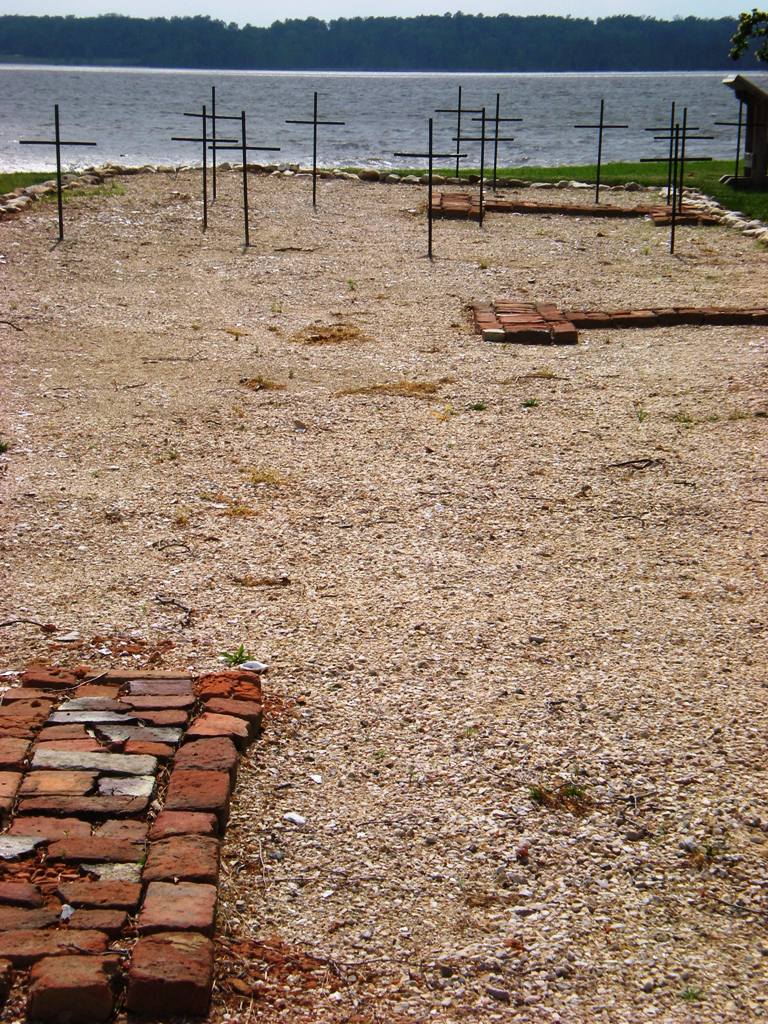
Graveyard at Jamestowne Historic National Park, photo by Sarah Stierch.

Mass grave at Jamestown discovered by archaeologists, beneath the foundations of one of the later capitol buildings. Photo by Sarah Stierch.

Graveyard_at_Jamestowne_Historic_National_Park

Photo credit: By Sarah Stierch [CC BY-SA 2.0 (http://creativecommons.org/licenses/by-sa/2.0)%5D, via Wikimedia Commons.