Today’s agenda — help my fellow Greeks breach Troy’s defenses by constructing a vast, hollow wooden replica of my head and having them hide within it.
CALL IT THE TROJAN DORK.


Today’s agenda — help my fellow Greeks breach Troy’s defenses by constructing a vast, hollow wooden replica of my head and having them hide within it.
CALL IT THE TROJAN DORK.
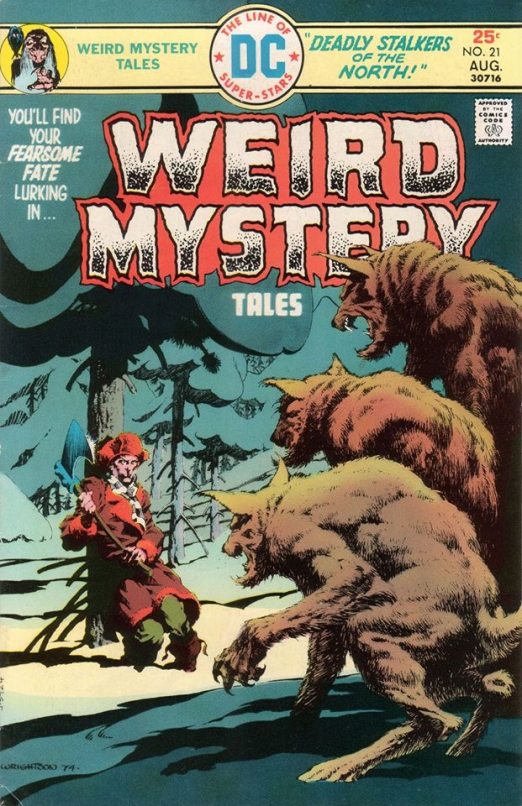
DC Comics.

Oil on canvas.

If dystopian or post-apocalyptic poetry is what your holiday season needs, then do stop by The Bees Are Dead. There you can find “Survival of the Fittest,” by Howard Debs; “ID,” by Duane Voorhees; and even a poem by that Eric Nolan guy (though, if you ask me, his stuff is strictly derivative).
Happy Holidays!
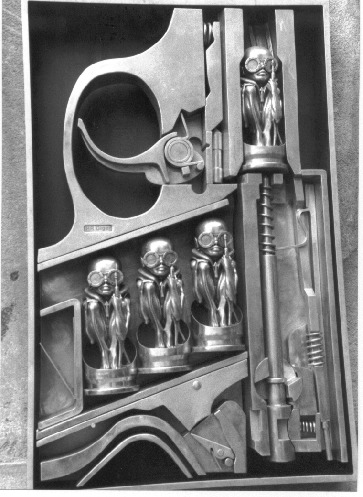
Photo credit: “Birth Machine,” by H.R. Giger. Ojw [Public domain], via Wikimedia Commons.
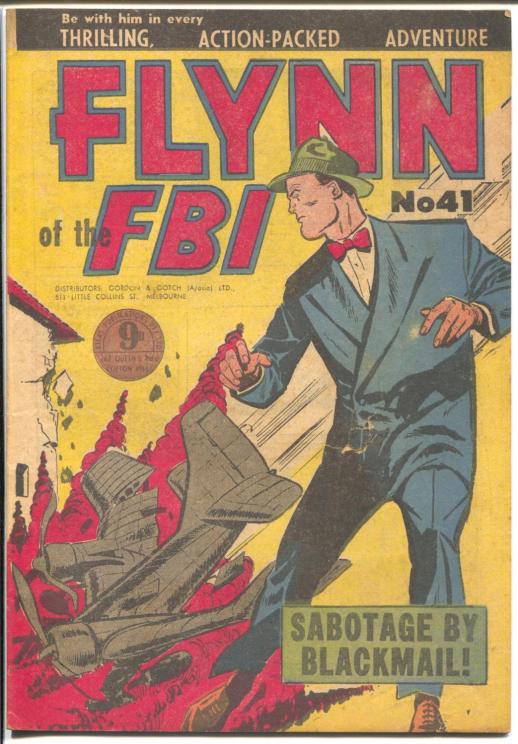
I am unable to determine the artist for this cover, the publisher, or even the issue’s date. My best guess is that artist Arthur Mather designed the cover for Atlas Publications in Australia in the 1950’s.
Why not “The Greek Horse?” The Greeks constructed it. Suppose you have an artist friend in Greece, and he or she mails a traditional Hellenic sculpture to you here in America (and hopefully with nothing all cunning and stabby and murdery inside of it). You wouldn’t call it an American sculpture. It would be a Greek sculpture, right?
“Troy” is a masculine name. But does it ever occur to guys named “Troy” that they were named for an archetypal conquered city?
Why is “Trojan” a desirable brand name for a condom? A small group of Greeks penetrated their city’s defenses with regrettable surprise consequences.
This is the $#/+ I think about when I wake up at 2:35 am and can’t get back to sleep. I swear I can’t turn it off.
Then Credence Clearwater Revival starts playing in my head and things get worse from there.
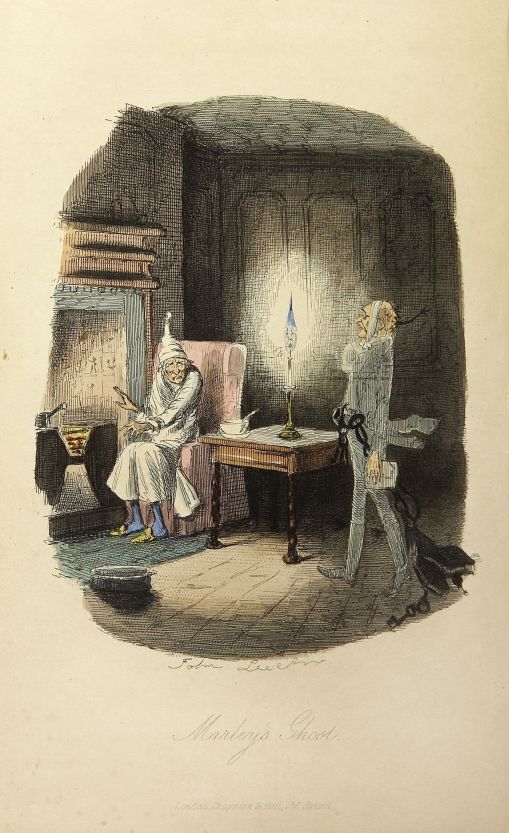
Marley’s ghost, from Charles Dickens’ “A Christmas Carol.” London: Chapman & Hall, 1843. First edition.
Rest in Peace, Penny Marshall.
This is one of only a handful of TV shows that I can remember watching as a tot in the late 1970’s. “Laverne and Shirley” (1976-1983) was the kind of of thing I’d see in my older sisters’ room. My Dad and older brother watched war movies, westerns and monster movies, but my two sisters preferred considerably lighter fare. Two that they watched a lot at the time, if I recall, were this show and “Donnie & Marie” (1976-1979) — about the scariest thing you could find playing on their black-and-white TV was “The Hardy Boys/Nancy Drew Mysteries” (1977-1979). (One of my sisters had a crush on actor Shaun Cassidy; I think there was a poster of him in their room.)
I loved “Laverne and Shirley” when I was that young. Lenny and Squiggy were my favorite highlight of any episode, even if I was sometimes confused about whether they were meant to be “good guys” or “bad guys.” I was in kindergarten, and not altogether bright, and I thought that men who wore black leather jackets (Fonzie notwithstanding) were usually “bad guys.” I also remember thinking that hippies and motorcyclists were the same group of “bad guys” because they disobeyed God or something … my confusion at the time resulted from some vaguely moraled born-again Christian comic books I’d happened across somewhere.
I also remember recognizing “Laverne and Shirley” as being related to another show that a lot of kids back then loved — “Happy Days” (1974-1984), of which it was a spin-off. This might have been the first time in my life that I was aware of two live-action television properties occupying the same fictional universe; I’d already seen it happen in the movies with the various incarnations of “King Kong” and “Godzilla.”
Here’s what makes me feel old — for both “Laverne and Shirley” and “Happy Days,” I probably watched a lot of the episodes when they were first broadcast, and not just in re-runs (although “Happy Days” was also played in syndication endlessly throughout the 1980’s — it remained a fixture of daytime television).
And I only just realized writing this that Lenny was played by the priceless Michael McKean. As an adult, I know him primarily from his brilliant turns in “This Is Spinal Tap” (1984) and “The X-Files” (1998-2018). He’s 71 now. Wow.
Featuring “Golden Rule” by Norman Rockwell.


