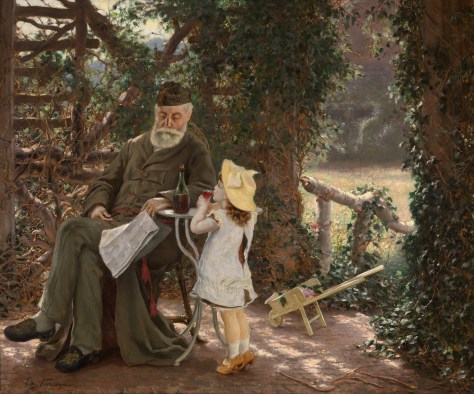
A … more innocent time? Or something?

Anyone here in their 40’s? Anyone remember the material excesses of the 1980’s, and how people thought THAT was proof of America’s declining moral fiber?

Bring back cocaine and parachute pants, and we’ll cheerfully surrender our neo-nazis and child detention centers.


“Frederick II of Prussia and Voltaire,” by Pierre Charles Baquoy after Nicolas André Monsiau, circa 1800

Friedrich_II._von_Preußen_und_Voltaire

“The Boarded Window,” by Ambrose Bierce

In 1830, only a few miles away from what is now the great city of Cincinnati, Ohio, lay a huge and almost endless forest.

The area had a few settlements established by people of the frontier. Many of them had already left the area for settlements further to the west. But among those remaining was a man who had been one of the first people to arrive there.

He lived alone in a house of logs surrounded on all sides by the great forest. He seemed a part of the darkness and silence of the forest, for no one had ever known him to smile or speak an unnecessary word. His simple needs were supplied by selling or trading the skins of wild animals in the town.

His little log house had a single door. Directly opposite was a window. The window was boarded up. No one could remember a time when it was not. And no one knew why it had been closed. I imagine there are few people living today who ever knew the secret of that window. But I am one, as you shall see.

The man’s name was said to be Murlock. He appeared to be seventy years old, but he was really fifty. Something other than years had been the cause of his aging.

His hair and long, full beard were white. His gray, lifeless eyes were sunken. His face was wrinkled. He was tall and thin with drooping shoulders—like someone with many problems.

I never saw him. These details I learned from my grandfather. He told me the man’s story when I was a boy. He had known him when living nearby in that early day.

One day Murlock was found in his cabin, dead. It was not a time and place for medical examiners and newspapers. I suppose it was agreed that he had died from natural causes or I should have been told, and should remember.

I know only that the body was buried near the cabin, next to the burial place of his wife. She had died so many years before him that local tradition noted very little of her existence.

That closes the final part of this true story, except for the incident that followed many years later. With a fearless spirit I went to the place and got close enough to the ruined cabin to throw a stone against it. I ran away to avoid the ghost which every well-informed boy in the area knew haunted the spot.

But there is an earlier part to this story supplied by my grandfather.

When Murlock built his cabin he was young, strong and full of hope. He began the hard work of creating a farm. He kept a gun–a rifle—for hunting to support himself.

He had married a young woman, in all ways worthy of his honest love and loyalty. She shared the dangers of life with a willing spirit and a light heart. There is no known record of her name or details about her. They loved each other and were happy.

One day Murlock returned from hunting in a deep part of the forest. He found his wife sick with fever and confusion. There was no doctor or neighbor within miles. She was in no condition to be left alone while he went to find help. So Murlock tried to take care of his wife and return her to good health. But at the end of the third day she fell into unconsciousness and died.

From what we know about a man like Murlock, we may try to imagine some of the details of the story told by my grandfather.

When he was sure she was dead, Murlock had sense enough to remember that the dead must be prepared for burial. He made a mistake now and again while performing this special duty. He did certain things wrong. And others which he did correctly were done over and over again.

He was surprised that he did not cry — surprised and a little ashamed. Surely it is unkind not to cry for the dead.

“Tomorrow,” he said out loud, “I shall have to make the coffin and dig the grave; and then I shall miss her, when she is no longer in sight. But now — she is dead, of course, but it is all right — it must be all right, somehow. Things cannot be as bad as they seem.”

He stood over the body of his wife in the disappearing light. He fixed the hair and made finishing touches to the rest. He did all of this without thinking but with care. And still through his mind ran a feeling that all was right — that he should have her again as before, and everything would be explained.

Murlock had no experience in deep sadness. His heart could not contain it all. His imagination could not understand it. He did not know he was so hard struck. That knowledge would come later and never leave.

Deep sadness is an artist of powers that affects people in different ways. To one it comes like the stroke of an arrow, shocking all the emotions to a sharper life. To another, it comes as the blow of a crushing strike. We may believe Murlock to have been affected that way.

Soon after he had finished his work he sank into a chair by the side of the table upon which the body lay. He noted how white his wife’s face looked in the deepening darkness. He laid his arms upon the table’s edge and dropped his face into them, tearless and very sleepy.

At that moment a long, screaming sound came in through the open window. It was like the cry of a lost child in the far deep of the darkening forest! But the man did not move. He heard that unearthly cry upon his failing sense, again and nearer than before. Maybe it was a wild animal or maybe it was a dream. For Murlock was asleep.

Some hours later, he awoke, lifted his head from his arms and listened closely. He knew not why. There in the black darkness by the side of the body, he remembered everything without a shock. He strained his eyes to see — he knew not what.

His senses were all alert. His breath was suspended. His blood was still as if to assist the silence. Who — what had awakened him and where was it!

Suddenly the table shook under his arms. At the same time he heard, or imagined he heard, a light, soft step and then another. The sounds were as bare feet walking upon the floor!

He was afraid beyond the power to cry out or move. He waited—waited there in the darkness through what seemed like centuries of such fear. Fear as one may know, but yet live to tell. He tried but failed to speak the dead woman’s name. He tried but failed to stretch his hand across the table to learn if she was there. His throat was powerless. His arms and hands were like lead.

Then something most frightful happened. It seemed as if a heavy body was thrown against the table with a force that pushed against his chest. At the same time he heard and felt the fall of something upon the floor. It was so violent a crash that the whole house shook. A fight followed and a confusion of sounds impossible to describe.

Murlock had risen to his feet. Extreme fear had caused him to lose control of his senses. He threw his hands upon the table. Nothing was there!

There is a point at which fear may turn to insanity; and insanity incites to action. With no definite plan and acting like a madman, Murlock ran quickly to the wall. He seized his loaded rifle and without aim fired it.

The flash from the rifle lit the room with a clear brightness. He saw a huge fierce panther dragging the dead woman toward the window. The wild animal’s teeth were fixed on her throat! Then there was darkness blacker than before, and silence.

When he returned to consciousness the sun was high and the forest was filled with the sounds of singing birds. The body lay near the window, where the animal had left it when frightened away by the light and sound of the rifle.

The clothing was ruined. The long hair was in disorder. The arms and legs lay in a careless way. And a pool of blood flowed from the horribly torn throat. The ribbon he had used to tie the wrists was broken. The hands were tightly closed.

And between the teeth was a piece of the animal’s ear.


001

“How To Defeat Authoritarianism” (act.tv)

Depiction of a Gagoze demon from the Bakemono-Zukushi, Edo Period

From Bakemono-Zukushi (“The Monster Scroll,”) Edo Period (17th to 19th centuries).

Bakemono_Gagoze

“What is right … has nothing to do with politics or nationality.”

“I may not understand much about politics and I have no ambition to do so, but I do have some feeling for what is right and what is wrong. That has nothing to do with politics or nationality.”

—  Sophie Scholl, member of the White Rose resistance movement in Germany, in a letter to Fritz Hartnagel, May 1940


Hans-left-and-Sophie-Scholl-with-member-of-the-White-Rose-movement-660x350-1520311536

“But I don’t want to go among mad people …”

“But I don’t want to go among mad people,” Alice remarked.

“Oh, you can’t help that,” said the Cat: “we’re all mad here. I’m mad. You’re mad.”

“How do you know I’m mad?” said Alice.

“You must be,” said the Cat, “or you wouldn’t have come here.”


—  from Lewis Carroll’s “Alice’s Adventures in Wonderland”


Depiction of a Hajikkaki from the Bakemono-Zukushi, Edo Period

From Bakemono-Zukushi (“The Monster Scroll,”) Edo Period (17th to 19th centuries).

bakemono_zukushi_8

Robert and Kathleen Nolan, circa mid-1970’s

20180617_215015 (2)

“Who knows what evil lurks in the hearts of men? THE SHADOW KNOWS!”

The weed of crime bears bitter fruit.  Crime does not pay.

Dabbling in old time radio inevitably brought me to “The Shadow” — a character I’d heard about periodically when I was growing up.  My Dad had been a fan of the radio program and film serials when he was a kid, and he was fond of rattling off that tagline you see in this blog post’s headline.  (The radio shows were broadcast in to the mid-1950’s, long after they started in 1937.)  I also remember the character from the truly unfortunate 1994 feature film with Alec Baldwin, which I actually saw in the theater with my college girlfriend.  (The less said, the better.  About the movie, I mean.)  The Shadow is also cited periodically as an influence in the creation of my own favorite iconic dark detective, Batman.

The Shadow has a loooooooong, varied and occasionally confusing history – spanning radio, pulp magazines, comic books, television and film.  He’s still being portrayed in comics.  DC Comics released a crossover with Batman last year that looks interesting, and the incomparable Matt Wagner produced a couple of books in 2015 and 2016 that I’d love to get my hands on.  (He fights Grendel!!!)

The radio shows are a lot if fun, just like the antique horror and mystery programs that I’ve linked to here at the blog.  And, just like those, they’re easily found on Internet.  (How my Dad might have marveled at that!)  They’re definitely more campy.  And I suppose that makes sense, as they seem aimed at children, whereas the horror shows seem intended for general audiences or just adults.  The period commercials for Blue Coal are a weird glimpse into the past, too.  If I had to name one thing that I found annoying about all of the old time radio shows I’ve found, it’s the omnipresence of that damned organ music.  (Was it just a cultural staple of the time?)

If “The Shadow’s” stories are a bit hokey, the show’s voice acting and production are just terrific.  I particularly like the actor performing The Shadow for the episode in the first link below — “Death is a Colored Dream” (1948).  I believe it is Bret Morrison.  (And I was surprised to learn that the famous Orson Welles only voiced the character for a year or so a decade earlier.)

But what’s most interesting is the character’s inception.  He didn’t start out as a character in a story at all … “The Shadow” was simply the name of the generic host for a series of unrelated mystery stories comprising “The Detective Story Hour” in 1930.  After a surprising fanbase developed around the creepy-sounding host (voiced at the time by Frank Readick, Jr.), people started asking for stories featuring “The Shadow” at the news stand.  Street & Smith commissioned writer Walter B. Gibson to write up some tales featuring a supernatural detective; the first came out in 1931.  The iconic character was just sort of made-to-order for confused customers who might have thought he already existed.  That “Shadow” later arrived at the airwaves in 1937, with Welles voicing him.

Seriously, though, I totally need to get my hands on “Grendel vs. The Shadow.”


65abeb7e5ce5ea7298ae9cf177524b71

CareysSaltRingAd-47-03-28

56ef5b24ef0bfc25d46cca42c5574a28

Nurse Your Favorite Heresies in Whispers