Tag Archives: 1981

A very short review of “Halloween” (2018)

I just cannot be partial to slasher films.  It’s never been my preferred horror sub-genre to start with, and, at this point in my life, these movies have become so predictable and devoid of story that I often find them boring.  There are exceptions — some of the the original “A Nightmare on Elm Street” films (1984- 2003) and “Child’s Play” (1988) were grotesquely creative and had terrific supernatural setups that were well executed.  But even the attraction of  John Carpenter’s original “Halloween” films (1978, 1981) is still mostly lost on me.

With all of that said, I’ll still say that my horror fan friends were right when they told me that 2018’s “Halloween” was a superior sequel.  It looks a lot better than the segments I’ve seen of of the campier followups in the 1980’s and 1990’s.

It’s far better filmed and directed, it’s occasionally scary and it benefits from a very good cast. (Jamie Lee Curtis is of course quite good as the film’s heroine and perennial “final girl.”  I’m also always happy to see Will Patton on screen, and I like Judy Greer a lot.)  The script occasionally shines unexpectedly, too — the screenwriters have a truly impressive talent for making minor characters vivid with funny throwaway dialogue.  (One of the three screenwriters is actor-writer-comedian Danny McBride, who I liked quite a bit in 2017’s “Alien: Covenant.”)

I’d be lying, however, if I told you that I wasn’t occasionally bored by this latest “Halloween” — simply because its basic, boilerplate plot and conclusion seem endlessly redundant with those of other slasher films.  There are few surprises toward the end — one “gotcha” moment was especially nice — but the overall story is just too tired.  I’d rate this film a 7 out of 10 for its merits, but I can’t actually get excited enough about it to recommend it.


6161DOBUS-L._SL1188_

A few thoughts on “The Wolf Man” (1941)

So I finally watched “The Wolf Man” (1941) for the first time a few nights ago, and I indeed had a lot of fun with it.  Sure, it’s tame by today’s standards, and bit corny too, but it was interesting watching Lon Chaney, Jr. for the first time and seeing the granddaddy of all werewolf films.

Here are a few things that jumped out at me while watching the film and reading a bit about it afterward (and, yes, I do realize that most people already knew these things):

  1.  I knew I recognized the senior Talbot — it’s actor Claude Rains, who was none other than Louis in the following year’s “Casablanca.”
  2. Chaney was a big man.  He is almost always both the tallest and broadest character on screen, and for some reason that surprised me.  Maybe it’s because that in the posters and other media I’ve seen, the Wolf Man always seems smaller in comparison to Dracula, Frankenstein or the Phantom of the Opera.  I half expected the diminutive Rains to become the Wolf Man, while Chaney’s character would become the hero who has to protect the girl, etc.
  3. This is weird … but Chaney bears has a strong resemblance to my best friend from early childhood, Shawn — who also grew up to be a big guy like the actor.  It’s uncanny.  It’d be nuts if Shawn were his great grandson, and we just never knew it.
  4. It was a little odd seeing Rains cast as Chaney’s character’s father, as he didn’t seem much older.  Rains was only 17 years older than Chaney.
  5. The old gypsy man is played by Bela Lugosi.
  6. Rains is easily the best actor here, followed by Maria Ouspenskaya as the old gypsy woman.
  7. This seminal film was not the first Universal Pictures werewolf movie.  That would be “Werewolf of London,” which preceded it by six years.  That movie is the one that inspired the 1978 “Werewolves of London” song by Warren Zevon, as well as John Landis’ 1981 masterpiece, “An American Werewolf in London.”
  8. The Wolf Man monster was made famous for a certain onscreen transformation that represented groundbreaking special effects for its time — the gradual transformation of the monster’s face on camera.  But that key effects sequence didn’t appear here in the 1941 original — only in its several sequels.
  9. The movie was released on December 9, 1941, just two days after the attack on Pearl Harbor.


vG8fu5syTtQLzK1hQXyi3ugOPNF (1)

Throwback Thursday: “The Monster Club” (1981)

I only saw one third of Roy Ward Baker’s “The Monster Club” (1981), when I was maybe in the third or fourth grade.  It was a typical 80’s horror anthology movie, and I walked in when my older brother was watching the third and final segment on television.  I’ll be damned if that segment alone didn’t creep me out, though.  (And the reviews of the film that I’ve read indeed name “The Ghouls” as the scariest entry in the trio.)

It’s pretty tame by today’s standards, or at least to my adult sensibilities.  It was definitely a lower-budget scary story, and probably pretty safe for television even back then.  But I watched it again the other night, and it still retains its creepiness after … about 35 years, I guess.  The titular monsters are indeed “ghouls” in the classical sense — they are human-looking fiends that are very much alive, but that feed on carrion (which actually makes them the reverse of zombies, I suppose.)

I can’t vouch for the rest of the movie, as I’ve only seen snippets, which seem pretty cheesy.  The wraparound segments star none other than Vincent Price and John Carradine, which will of course appeal to fans of classic horror.  (Carradine actually portrays a fictionalized version of R. Chetwynd – Hayes, the prominent British author who penned the stories on which the movie is based.)

If you saw this back in the day and “The Ghouls” got under your skin, then let me know.  I’d get a kick out of knowing that I wasn’t the only one.


MClub2-e1482865864209


Throwback Thursday: Mary Washington College’s “Campus … Drive?” (1981)

The photo below ought to give pause to anyone who went to Mary Washington College when I did in the early 1990’s.  That is indeed Campus Walk back when it was Campus Drive, a legitimate roadway for the Town of Fredericksburg.

I have no idea when it was closed to automobile traffic and the walkway was created.  The photo dates from 1981.  (I am using it here with permission from UMW Special Collections; it comes from the Simpson Library’s Centennial photo database.)

It’s weird though.  Campus Walk was a focal point of college life, especially its social aspects.  It was where you said hello to a lot of your friends and exchanged news and plans, in the days before the internet and cell phones.  And it gave the small campus an isolated feel that was kind of cool.

I’d heard about it being a road when I was a student, though.  I worked at The Rising Sun Tavern museum downtown, and a couple of the other tour guides were women who had graduated from Mary Wash in the 1980’s.  They had some vivid memories of young men from town (and Marines from Quantico) hollering at them as they drove through.  I can see how that might have occasionally gotten awkward.


37051360_10160777353420434_4171339857840308224_n

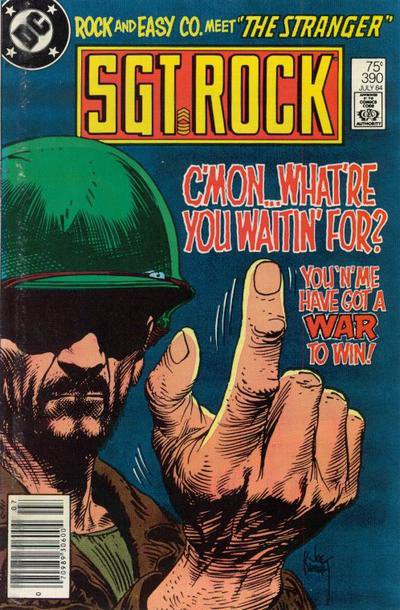
Throwback Thursday: 1980’s “Sgt. Rock!”

DC Comics’ “Sgt. Rock” was far harder stuff than the “G.I Joe” comics and toys that are more often associated with the 1980’s.  They were the darkest and most violent comic books I read when I was a young kid, except maybe for the various “Conan” books.  Hasbro relaunched “G.I. Joe” in 1982 concurrently with its toy line, and it was a famously kid-safe (and lucrative) franchise.  “Sgt. Rock,” in contrast, consisted of brutal stories that focused on the horrors of war — it was really more of a cultural holdover from the comics of the prior two decades.  (The title began as “Our Army at War” in 1959.)

I loved these comics — especially the larger “annuals” with lengthier stories.  Nothing was better than “Sgt. Rock” and Reese’s Peanut Butter Cups.  What occasionally puzzled me as a second-grader was that none of the other boys I knew seemed to be reading them — although a lot of other kids certainly hopped on the “G. I. Joe” bandwagon.

The last one pictured below, from 1981, was my favorite.  If memory serves, it was the first one I ever owned.


Sgt._Rock_Vol_1_377

SgtRock390

Sgt._Rock_Vol_1_374

Sgt._Rock_Annual_Vol_1_2

Sgt._Rock_Annual_Vol_1_3

Sgt._Rock_Vol_1_356

Throwback Thursday: this theater poster for “Raiders of the Lost Ark” (1981)!

I had this poster for “Raiders of the Lost Ark” (1981) when I was 11 or so.  It was goddam gigantic.  It took up nearly an entire wall in my room.

It wasn’t store bought; it came from a theater.  My father used to do something that was pretty damned cool for any parent to do — he’d occasionally ask the manager of a movie theater to save their in-house advertising for my favorite movies.  (I don’t know how things are done nowadays, but back then they’d just throw them out after using them.)  Then my Dad would hand the guy $10 or $20 for one of these, or maybe the manager would just give it to him.

Sometimes that meant a truly industrial-size poster, like this one.  Sometimes it meant one of those huge cardboard stand-up advertisments.  (I could only have a couple of these at a time … I had a small room.)

I also had a cardboard stand-up for “Colors,” the 1988 film depicting Los Angeles gangs — but my older brother brought me that one.  It had nearly life-size cutouts of Sean Penn and Robert Duvall, the movie’s police protagonists.  I don’t know why the nerdiest kid in East Coast suburbia was so taken with a movie about inner-city West Coast gangs, but that movie meant a lot to me.

Come to think of it, a lot of people were talking about “Colors” back in the day.  It was a big deal.  It was considered pretty edgy at the time, the critics loved it, and I’m surprised I never heard about it again after the close of the decade.  Its soundtrack had a damned good title track by Ice-T, too.

The poster below was my favorite, though.  To this day, “Raiders of the Lost Ark” is probably my favorite film of all time.


images

“Do you come from the land down under?”

When I reviewed the second season of the outstanding “Wolf Creek” television series (2016) not too long ago, I neglected to mention something — the trippy rendition of Men at Work’s “Land Down Under” in its opening credits.

It’s a beautiful cover by Australia’s Sabrina Schultz, and it’s perfect for the show — it should please both horror fans and anyone who remembers the original song from 1981.  It has a dreamy, melancholy quality that hints at the show’s weird juxtaposition of brutal violence with its gorgeous outback setting.

Check it out below.


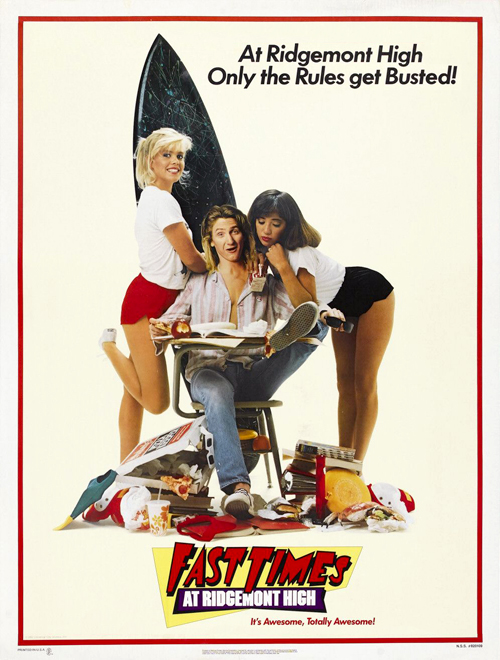
“Fast Times at Ridgemont High” (1982) is actually slow and will leave you feeling low.

“Fast Times at Ridgemont High” (1982) is a pop-culture sacred cow that needs to be skewered.  I’d rate it a 2 out of 10 for being a surprisingly inept and poorly scripted 1980’s “classic.”

I just don’t understand the fervent popular reverence for this movie among people in my age bracket.  It was a minor legend when I was growing up.  I was a fourth grader in 1982, and gradeschool boys could be divided into two groups: 1) those who had seen the “Phoebe Cates pool scene” and 2) those who had not, but wished they had.  When I mentioned on social media a couple of months ago this year that I’d never actually gotten around to seeing this movie, my friends were roundly astonished.

Why do they think this film is indispensable viewing?  Maybe there’s something I’m missing.  I’m tempted to group “Fast Times at Ridgemont High” together with other beloved 80’s films that just don’t resonate with me — like the understandably campy “Tron” (1982) or the unexpectedly sleep-inducing “The Big Chill” (1983).  (I couldn’t even finish the latter.)  But I can’t compare, because I know those movies are objectively good in a lot of ways, even if they weren’t to my taste.

Nor am I squeamish about raunchy sex comedies.  (C’mon.)  I pretty fondly remember “Porky’s” (1981), “Porky’s II: The Next Day” (1983), and “Revenge of the Nerds” (1984).  I mentioned “Porky’s” to the friend with whom I watched “Fast Times” — I told her that it wasn’t highbrow entertainment, but I still remember it being crudely, blasphemously funny.

This movie was just a thinly scripted small collection of vignettes, with no overall plot outside of teenagers having sexual encounters that are … awkward and bluntly sad, for the most part.  (Sean Penn’s character does drugs.)  The dialogue is terrible.  None of the characters are likable — even the story’s nerdy, well-meaning protagonist is grating.

I didn’t really laugh once at anything the director intended — I only laughed at the haircuts and the clothes.  I just can’t believe that the screenwriter here was Cameron Crowe, who also wrote what is possibly my favorite movie of all time — the widely but unfairly maligned “Vanilla Sky” (2001).  (Crowe apparently adapted the screenplay from a novel he wrote.)

There is some enjoyment to be had in watching Penn’s stoner character.  It was fun seeing a well known serious actor in an early comedic role.  Penn is a decent character actor, and it looks like he was having fun.  I do get why kids in the 80’s found him funny.

It’s also fun seeing the handful of other young actors who would go on to great careers (Judge Reinhold is always funny) but, again, this is something that the filmmakers can’t take credit for.

Hey, if you want a slice-of-life dramatic comedy about teenagers in the 1980’s, then go rent “The Breakfast Club” (1985).  It wasn’t perfect, but it was damn good movie that tackled many of the same issues as this movie, but with intelligence and effective humor.  Or, try the oddball “Ferris Bueller’s Day Off” (1986).  Both movies portray teenagers in the 80’s who are smart, likable and emphathetic, in varying degrees.  I myself went to high school in the 1980’s, and I assure you they were around.


fast-times-at-ridgemont-high-poster

Throwback Thursday: “Buck Rogers in the 25th Century” (1979 – 1981)

When I was in the first grade, I absolutely loved “Buck Rogers in the 25th Century.”  It was, technically I guess, a dystopian science fiction story in which a contemporary astronaut is frozen for 500 years, then returns to a post-nuclear earth.  Its feature-length pilot was created by Glen Larson, who also wrote the pilot for “Battlestar Galactica” the preceding year.  (Weird trivia — Wikipedia informs me that this was released theatrically, along with “Battlestar Galactica” in limited theaters.)

Of course I didn’t realize this at the time, but “Buck Rogers” was pretty bad.  It was horribly bad.  Indescribably bad.  It was even bad by cheesy 1970’s TV sci-fi standards.  You can actually find full episodes on Youtube, and I started one, just on a lark.  I could only watch about one minute, maybe less — plus that soul-deadening clip of “Twiki” in the second video below.   Seriously, it’s as though Larson was intentionally giving the worst script he could come up with to NBC as some sort of prank.  (After being told to resuscitate the heroic Buck, one advanced futureperson advises another, “He’s liable to be not too coherent.”)

About Twiki — that little guy fascinated a lot of very young kids in 1979.  For a while, it was all the rage for us to do our “deeby-deeby-deeby” Twiki impressions.


Throwback Thursday: “The Further Adventures of Indiana Jones” comic books

No, I’m not talking about the Marvel Comics adaptation of “Raiders of the Lost Ark” (1981); I’ve written about that separately here at the blog.  This was a regular ongoing comic book title between January 1983 and March 1986.

And every issue of it was a mind-boggling pleasure for a fourth grader whose favorite hero was Indiana Jones.  I remember issues one and two waiting for me after school one day, displayed upright on the kitchen table.  My Dad had picked them up for me.  (He was constantly trying to help me with a problem that had plagued my childhood — I simply never owned enough comic books.)  These were a departure from the “Sgt. Rock” comics that my father usually bought for me, but damn if they weren’t a thousand times better.  I was stunned by the very concept of them.  “Raiders” was a … COMIC BOOK now!?

Of course the plots were derivative of the film.  Ninety percent of the places Indy went, an ancient artifact or temple held a terrifying secret, often unleashing a power that could control or destroy the world.  And only Indy’s superior knowledge of archeology — or just his sheer pluck — would allow him to employ it to vanquish the bad guys.  [Spoiler warning for “Raiders,” by the way.]  The writing was damn good, as far as I can remember.  And we got to see Marion, Sallah, Marcus Brody and even Captain Katanga again.

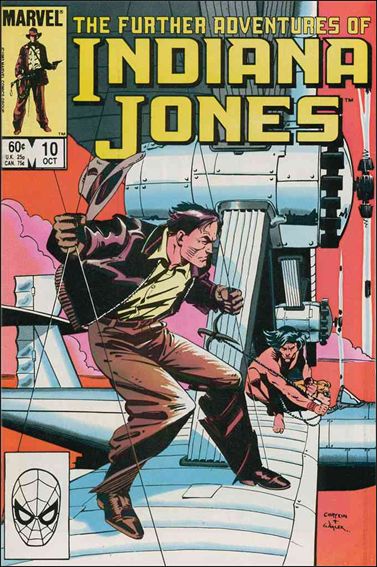
You see that cover where Indy is on the wing of a plane?  That bad guy just might be one of the Hovitos … I can’t remember well enough to be sure.  At one point this adversary steals Indy’s whip and tries to use it against him.  (It doesn’t turn out well for him.)  In fact …I think it was the scene you see on the cover.  I’m not sure why the artist depicted a grappling hook instead.  I remember the villain’s line being, “It would be fitting for such a man to die by the sting of his own weapon.”  I have no idea why I remember that dialogue after 35 years (and little else about the issue).  The mind is a funny thing.

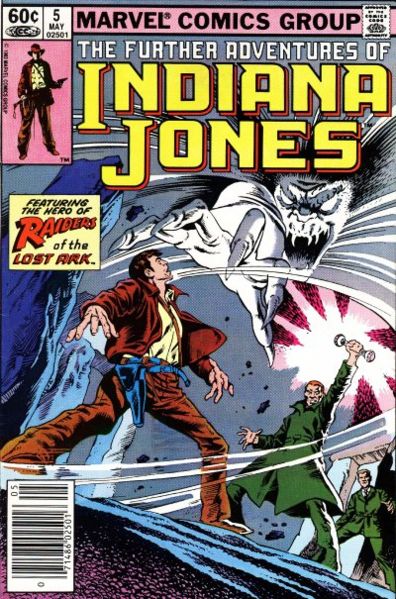
All of the covers were damn cool.  I happen to love that final one  you see at the bottom.  That was Indy’s adventure at Stonehenge.  But the first two covers you see are the ones that I would eventually like to get framed, someday after fame brings me opulence — those were the ones waiting for me on the kitchen table that day in 1981.


Indiania_Further


further-Indiana-Jones-02-00


8-1


22761-3224-25390-1-further-adventures-o

d60be218-6431-4f36-8b49-f0c1343b7a6b

indy_marvel_cover

The_Further_Adventures_of_Indiana_Jones_Vol_1_6

The_Further_Adventures_of_Indiana_Jones_Vol_1_5