Tag Archives: 1982

And here is the latest thing that makes me feel old.

What’s with all the people in music videos looking so damn young these days?  Did they change the child labor laws?

There was a time when I was daily viewer of MTV (the sedate stuff on VH-1 was for old people), and I rocked hard, people.  It seemed to me that whenever I watched a video, I saw people who were my own age.

Now these videos are inhabited only by people who look young enough to be my kids. And that makes sense, because … they kinda are young enough.  (Yes, I realize the video below for The Calling’s “Wherever You Will Go” was made 18 years ago, but that’s beside the point.)  If the performers in a video today were in their very early 20’s, then they’d be about the right age, if I’d fathered kids when I was 26.

Furthermore, some astute commentators pointed out online Monday night that 2019 is the year in which the original “Blade Runner” (1982) was set.  The opening title card names “November, 2019” as the time when all things Fordesque turn angsty and existential and killer-androidy.  Am I … older than Harrison Ford’s character? I am six years older than Ford was when he made the film.

Now I just feel weird.  Why do I write these blog posts, anyway?

[Update: Today I am learning that “Akira” (1988) and “The Running Man” (1987) also set their stories in 2019?! That’s ironic, given that the future we’ve come closest to is that of 2006’s “Idiocracy.”

I wonder how people in our parents’ generation felt when 2001 arrived, if they’d happened to see “2001: A Space Odyssey” in theaters in 1968.]


“Nobody trusts anybody now, and we’re all very tired.”

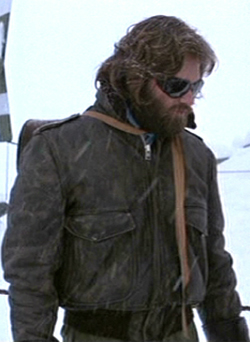
I’m going to hide this tape when I’m finished. If none of us make it, at least there will be some kind of record. The storm’s been hitting us hard now for 48 hours. We still have nothing to go on.

One other thing: I think it rips through your clothes when it takes you over. Windows found some shredded and bloody long-johns in the trash but the name tag was missing. They could be anybody’s.

Nobody trusts anybody now, and we’re all very tired. There’s nothing more I can do, just wait.

This is R.J. MacReady, helicopter pilot, US outpost #31.

— From John Carpenter’s “The Thing” (1982)


Feature_the_thing-med

Lee Hardcastle’s “Thingu” (a parody of John Carpenter’s “The Thing”)

I’ve been meaning to run this on the blog since forever — artist Lee Hardcastle’s brief, brilliant 2012 send-up of John Carpenter’s 1982 masterpiece, “The Thing.”  (It is also a claymation parody of the European children’s program, “Pingu.”  Please note, however, that the video below is NOT for children.)

Even if the animation method is crude, this is damned creative stuff — in addition to being blackly funny, according to your tastes in humor.  This went viral when it was released, and I believe it fully deserves its online fame.

Is it weird if I’d never heard of “Pingu” before this video?  I have friends who certainly recall it.  Maybe it was just a European thing.  Or maybe it’s an example of “The Mandela Effect.”  I am very much an 80’s kid, and I swear I cannot remember that “Oregon Trail” computer game either.


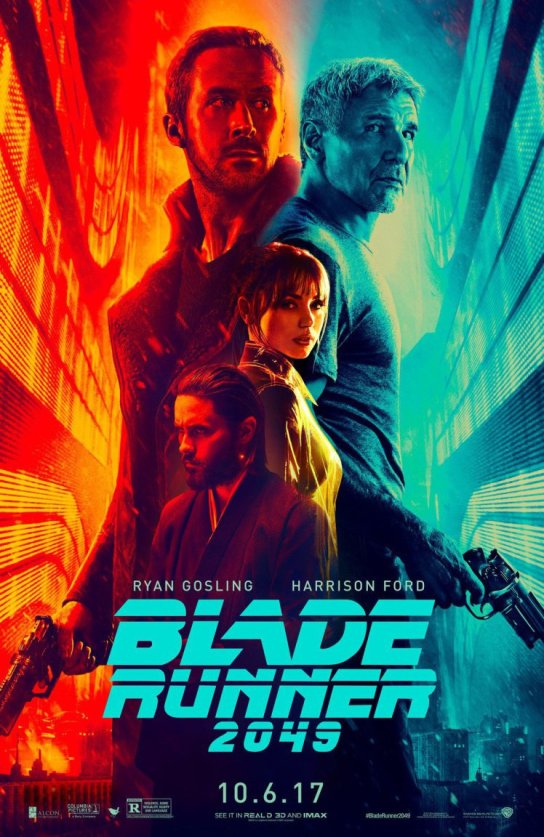
A review of “Blade Runner 2049” (2017)

Denis Villeneuve’s “Blade Runner 2049” (2017) is indeed a worthy sequel, even if it cannot equal Ridley Scott’s seminal 1982 original film.  (And this is absolutely understandable — I opine that Scott’s dour, challenging “Blade Runner” is arguably the greatest movie of all time.)  Some of it worked, and some of it didn’t — but I sufficiently enjoyed this movie to rate it a 9 out of 10.

There is a lot going on here in terms of plot.  I won’t be specific about what I liked and what I didn’t like, because I want to avoid spoilers.  (There are definitely some surprise plot developments, and this is a relatively recent film that fans have waited no fewer than 35 years to see.)  But I’m happy to report that “Blade Runner 2049” satisfies by being a direct and logical follow-up in terms of character, plot and setting.

I do think that this would be a stronger standalone story if it had included the material that was relegated to the online short films that serve as its companions.  (You can find all three of them at Open Culture right here.)  The first one, “Black Out 2022,” is probably necessary to understanding the feature film’s story and ought to be required viewing.

The visuals were vivid and arresting, the action sequences were generally satisfying, and the acting across the board was quite good.  Harrison Ford was predictably perfect.  Jared Leto and Sylvia Hoeks are suitably intense and make terrific bad guys.  (I’ve always loved Leto’s work — even his criminally underappreciated, spot-on interpretation of DC Comics’ “The Joker.”)  And Carla Juri nearly steals the entire movie with her mesmerizing performance in a supporting role.

What I liked best about “Blade Runner 2049” was how surprisingly well it captured the … vibe, I guess, of the first film — its existential angst and the surprising tragic nobility of its characters.  Simply put, this film got the feeling right.  For me, this was best evidenced by a poetic subplot between the characters played by Ryan Gosling and Ana de Armas.  It’s great dystopian science fiction — a fusion of troubling futurism and genuine human emotion.  And the mood was greatly enhanced by an evocative score by Hans Zimmer and Benjamin Wallfisch.

There are were a couple of things that I didn’t like — they were plot points that I won’t detail here.  The pacing also felt too slow, at times.  (This is a long movie, at two hours and 44 minutes.)  And the the climactic fight scene felt just a bit claustrophobic and awkwardly executed.  (It’s a far cry from the epic feel of the original’s rainswept rooftop confrontation.)

I’d still cheerfully recommend “Blade Runner 2049” to fans of Scott’s film.  I’d caution them to sit down with it with as few expectations as possible, though, and to just enjoy this second chapter on its own merits.  It’s mostly great stuff.


pri_50481883

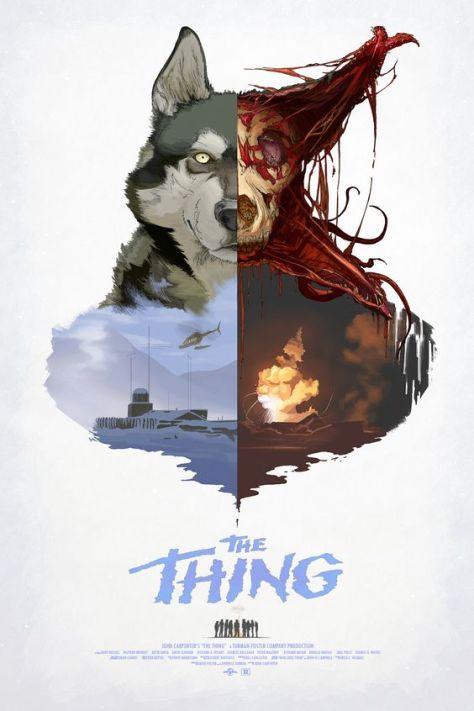
If you’re cold, they’re cold. Bring them inside.

That’s some Thing you always need to remember on a cold night, right?

Anyway, this fan-made movie poster for John Carpenter’s “The Thing” (1982) is absolutely incredible.  I am unaware of its creator, but it’s all over the Pinterest boards for similar fan-made posters.


c4904596122a8a0ea6e84ccdfb6224bb

Throwback Thursday: NBC’s “Knight Rider” (1982 – 1986)

NBC’s “Knight Rider” might be the granddaddy of all 1980’s high-tech super-vehicle shows — if I had to guess which one was the most popular or most fondly remembered, this would be it.  (I suppose the other leading contender would be “Airwolf,” which we talked about a couple of months ago — but that was aimed at an older audience.)

“Knight Rider” was cheesy.  But most 80’s action shows were cheesy, and I still remember it as being decent enough.  Lord knows I and Mikey Wagner, the kid on the next block, were fascinated by it.

As anyone who remembers this show can attest, there is a key character that isn’t even hinted at in the intro below.  The car was sentient.  His name was K.I.T.T. (Knight Industries Two Thousand), and he was an artificial intelligence who actually who had a hell of a lot of personality.  K.I.T.T. was a super-intelligent, talking, futuristic, sleek, black sportscar, and he was an incongruous damned hero to us kids.

The other star was Davis Hasselhoff as Michael Knight.  We looked up to him too.  Hasselhoff, of course, is now better known for his subsequent starring role as a moronic lifeguard on the categorically awful “Baywatch” (1989 – 2001).  I remember seeing snippets of “Baywatch” in the 1990’s — it was constantly playing in the newsroom at my first job as a cub reporter.  (The guys there loved it.)  I remember being disappointed that one of my childhood heroes had somehow morphed into a male bimbo on the most saccharine and brainless TV show I had ever seen.  Hey, “Knight Rider” was a show for kids … but it was goddam “Masterpiece Theater” when compared with “Baywatch.”

Weird trivia — the voice actor for K.I.T.T. was none other than William Daniels, who also gave a stellar performance as John Adams in 1972’s film adaptation of Broadway’s “1776.”  It’s so weird seeing that movie and hearing the voice of K.I.T.T. come out of Adams’ mouth.


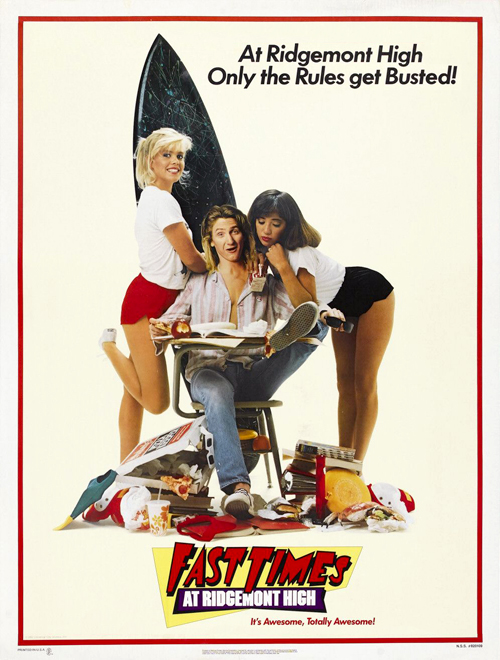
“Fast Times at Ridgemont High” (1982) is actually slow and will leave you feeling low.

“Fast Times at Ridgemont High” (1982) is a pop-culture sacred cow that needs to be skewered.  I’d rate it a 2 out of 10 for being a surprisingly inept and poorly scripted 1980’s “classic.”

I just don’t understand the fervent popular reverence for this movie among people in my age bracket.  It was a minor legend when I was growing up.  I was a fourth grader in 1982, and gradeschool boys could be divided into two groups: 1) those who had seen the “Phoebe Cates pool scene” and 2) those who had not, but wished they had.  When I mentioned on social media a couple of months ago this year that I’d never actually gotten around to seeing this movie, my friends were roundly astonished.

Why do they think this film is indispensable viewing?  Maybe there’s something I’m missing.  I’m tempted to group “Fast Times at Ridgemont High” together with other beloved 80’s films that just don’t resonate with me — like the understandably campy “Tron” (1982) or the unexpectedly sleep-inducing “The Big Chill” (1983).  (I couldn’t even finish the latter.)  But I can’t compare, because I know those movies are objectively good in a lot of ways, even if they weren’t to my taste.

Nor am I squeamish about raunchy sex comedies.  (C’mon.)  I pretty fondly remember “Porky’s” (1981), “Porky’s II: The Next Day” (1983), and “Revenge of the Nerds” (1984).  I mentioned “Porky’s” to the friend with whom I watched “Fast Times” — I told her that it wasn’t highbrow entertainment, but I still remember it being crudely, blasphemously funny.

This movie was just a thinly scripted small collection of vignettes, with no overall plot outside of teenagers having sexual encounters that are … awkward and bluntly sad, for the most part.  (Sean Penn’s character does drugs.)  The dialogue is terrible.  None of the characters are likable — even the story’s nerdy, well-meaning protagonist is grating.

I didn’t really laugh once at anything the director intended — I only laughed at the haircuts and the clothes.  I just can’t believe that the screenwriter here was Cameron Crowe, who also wrote what is possibly my favorite movie of all time — the widely but unfairly maligned “Vanilla Sky” (2001).  (Crowe apparently adapted the screenplay from a novel he wrote.)

There is some enjoyment to be had in watching Penn’s stoner character.  It was fun seeing a well known serious actor in an early comedic role.  Penn is a decent character actor, and it looks like he was having fun.  I do get why kids in the 80’s found him funny.

It’s also fun seeing the handful of other young actors who would go on to great careers (Judge Reinhold is always funny) but, again, this is something that the filmmakers can’t take credit for.

Hey, if you want a slice-of-life dramatic comedy about teenagers in the 1980’s, then go rent “The Breakfast Club” (1985).  It wasn’t perfect, but it was damn good movie that tackled many of the same issues as this movie, but with intelligence and effective humor.  Or, try the oddball “Ferris Bueller’s Day Off” (1986).  Both movies portray teenagers in the 80’s who are smart, likable and emphathetic, in varying degrees.  I myself went to high school in the 1980’s, and I assure you they were around.
 

fast-times-at-ridgemont-high-poster

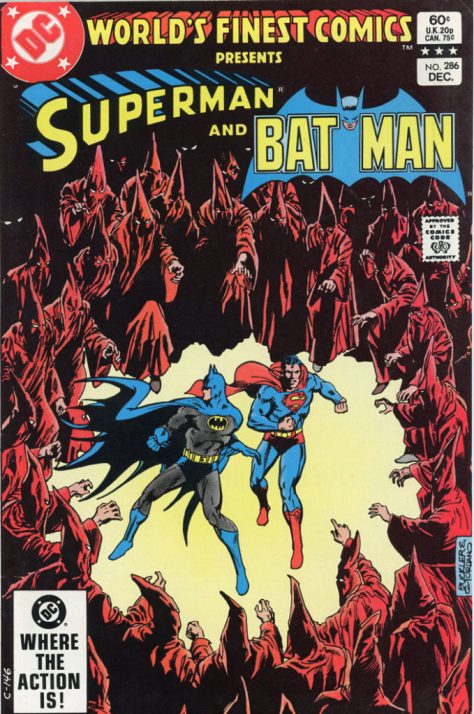
Cover to “World’s Finest Comics” #286, Rich Butler and Dick Giordano, 1982.

DC Comics.


7-Nazi-Comics-679x1024

Throwback Thursday: the “WKRP in Cincinnati” theme song!

I didn’t watch “WKRP in Cincinnati” (1978 – 1982) when I was a kid; it was a show for adults.  I loved the theme song just as much as anyone else, though.

This was just meant as a catchy tune for the show’s opener — but it was such a cool and popular soft-rock number (performed by Steve Carlisle), that a full-length version was released as a singe in 1979.  It reached number 65 on the Billboard Hot 100 Chart in 1982.


“An Ode for Fellow Replicants,” by Eric Robert Nolan

(Dedicated to Philip K. Dick)

What if the Internet is an android’s dream,
and we are the electric sheep?

Dick would know at once
our artificial people:
every boy a Roy,
every girl a pleasure model,
trying to pass as real,
inwardly concerned with their design —
“Morphology. Longevity. Incept dates.”

On Facebook,
“More Nolan than Nolan”
is my motto.

If I, in my genuine moments,
could greet my jpeg face
hiding in his electronic words,

he’d go offworld or die.
After all,
“It’s not an easy thing to meet your maker.”

[Author’s note — the film quoted and paraphrased above is Ridley Scott’s “Blade Runner” (1982), to which this poem is an homage.  “Blade Runner” is itself an adaptation of Dick’s 1968 novel, “Do Androids Dream of Electric Sheep?”]

(c) Eric Robert Nolan 2016

Facebook engancha.jpg

Photo credit: By olga.palma – facebook enganchaUploaded by JohnnyMrNinja, CC BY 2.0, https://commons.wikimedia.org/w/index.php?curid=16525385