Tag Archives: 1984

“Perhaps one did not want to be loved so much as to be understood.”

“Perhaps one did not want to be loved so much as to be understood.”

— George Orwell, 1984


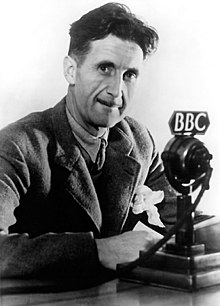
220px-George-orwell-BBC

DVD Cover for “1984” (Criterion Collection), 1984

20th Century Fox.

BonyZ4taymxrfBiRqY6K42NBh0jsop_large

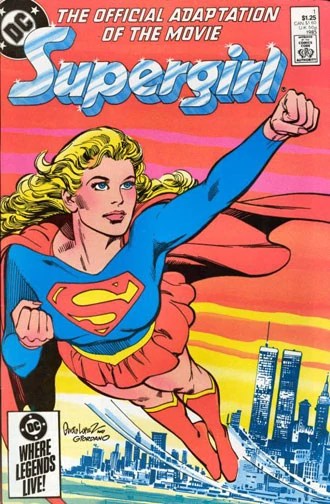
Cover to “Supergirl Movie Special,” José Luis García-López and Dick Giordano, 1984

DC Comics.

Supergirl_Movie_Special_Vol_1_1

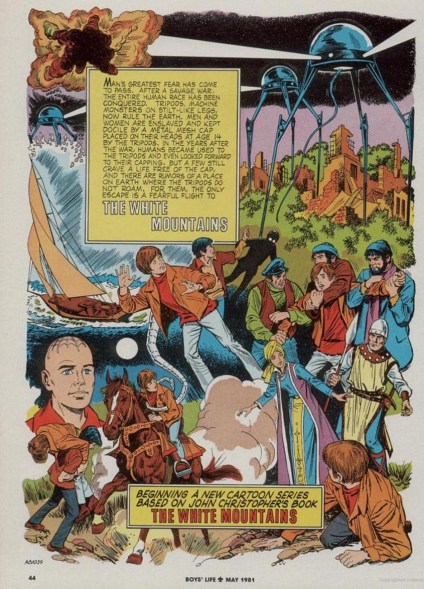
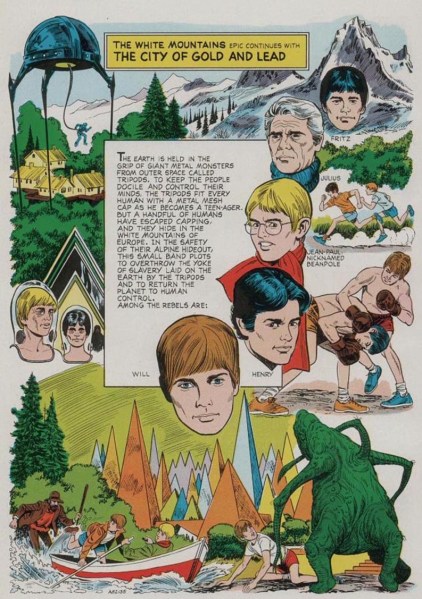
Throwback Thursday: “The Tripods” comic strip in “Boys’ Life” magazine!

I had a subscription to Boys’ Life magazine for a couple of years when I was a Cub Scout in the early 1980’s.  My parents canceled it after a year or two, and I can’t blame them — I just wasn’t reading it.  Boys’ Life was the official magazine of the Boy Scouts of America, and it was pretty wholesome stuff … it just didn’t offer the excitement of my comic books or the occasional copy of Fangoria that I manged to get my hands on.

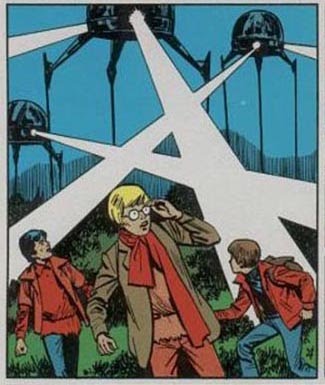
But there was one feature of Boys’ Life that I followed religiously — the serialized comic strip adaptation of John Christopher’s The Tripods book trilogy.  (Christopher published the first three of his books in the late 1960’s; he added a prequel novel in 1988, but that was long after the Boy Scouts and Boys’ Life was behind me.)

The Tripods was cool, dark dystopian stuff.  The story opened with the first book, The White Mountains, to find humanity settled into an agrarian, pre-industrial age in which their overlords were the titular “tripods” — massive three-legged vehicles piloted by unknown beings.  Humans were ritualistically “capped” with a brain-altering device when they reached age 14 — thereafter becoming docile and conformist and easier for the mysterious machines to subjugate.

The White Mountains followed a trio of 13-year-old boys who escaped the “capping” to seek out a human resistance movement; the second book, The City of Gold and Lead, shows two of these protagonists infiltrate the city of the tripods’ operators.  (Spoiler — they’re grotesque aliens.)  The third book, The Pool of Fire, presumably picks up from there, but my Boys’ Life subscription ran out before the magazine got to that.

I recently, however, used this Interwebs thingamajig to discover what looks like a real gem of a find — a 1984 BBC mini-series adaptation of the books.  I started the first episode and it looks quite good.  If I get around to watching the whole thing, I’ll review it here.


40da7d9da25e489860f6e1bc7bccf65a7112394a

3

4

5

2

“When I said Mexico would pay for the wall … obviously I never meant Mexico would write a check.”

“The past was alterable. The past never had been altered.

“Oceania was at war with Eastasia. Oceania had always been at war with Eastasia.  A large part of the political literature of five years was now completely obsolete. Reports and records of all kinds, newspapers, books, pamphlets, films, sound-tracks, photographs — all had to be rectified at lightning speed. Although no directive was ever issued, it was known that the chiefs of the Department intended that within one week no reference to the war with Eurasia, or the alliance with Eastasia, should remain in existence anywhere. ”

— from George Orwell’s “Nineteen Eighty-Four”


cvbs1taisll01

Throwback Thursday: “Laverne and Shirley” (1976-1983)

Rest in Peace, Penny Marshall.

This is one of only a handful of TV shows that I can remember watching as a tot in the late 1970’s.  “Laverne and Shirley” (1976-1983) was the kind of of thing I’d see in my older sisters’ room.  My Dad and older brother watched war movies, westerns and monster movies, but my two sisters preferred considerably lighter fare.  Two that they watched a lot at the time, if I recall, were this show and “Donnie & Marie” (1976-1979) — about the scariest thing you could find playing on their black-and-white TV was “The Hardy Boys/Nancy Drew Mysteries” (1977-1979). (One of my sisters had a crush on actor Shaun Cassidy; I think there was a poster of him in their room.)

I loved “Laverne and Shirley” when I was that young.  Lenny and Squiggy were my favorite highlight of any episode, even if I was sometimes confused about whether they were meant to be “good guys” or “bad guys.”  I was in kindergarten, and not altogether bright, and I thought that men who wore black leather jackets (Fonzie notwithstanding) were usually “bad guys.”  I also remember thinking that hippies and motorcyclists were the same group of “bad guys” because they disobeyed God or something … my confusion at the time resulted from some vaguely moraled born-again Christian comic books I’d happened across somewhere.

I also remember recognizing “Laverne and Shirley” as being related to another show that a lot of kids back then loved — “Happy Days” (1974-1984), of which it was a spin-off.  This might have been the first time in my life that I was aware of two live-action television properties occupying the same fictional universe; I’d already seen it happen in the movies with the various incarnations of “King Kong” and “Godzilla.”

Here’s what makes me feel old — for both “Laverne and Shirley” and “Happy Days,” I probably watched a lot of the episodes when they were first broadcast, and not just in re-runs (although “Happy Days” was also played in syndication endlessly throughout the 1980’s — it remained a fixture of daytime television).

And I only just realized writing this that Lenny was played by the priceless Michael McKean.  As an adult, I know him primarily from his brilliant turns in “This Is Spinal Tap” (1984) and “The X-Files” (1998-2018).  He’s 71 now.  Wow.


Barnhill, in the Scottish Hebrides.

House on the island of Jura occupied by George Orwell when writing the novel “Nineteen Eighty-Four.”


Barnhill


“Attack of the 1st Minnesota at Gettysburg,” Don Troiani, 1984

The First Minnesota

Throwback Thursday: “THANKS, EASTER BUNNY!”

Can anyone who lived in 1984 forget this M&M’s commercial?  Every kid on the school bus did an impression of the two kids at the end.

POCK! POCK!


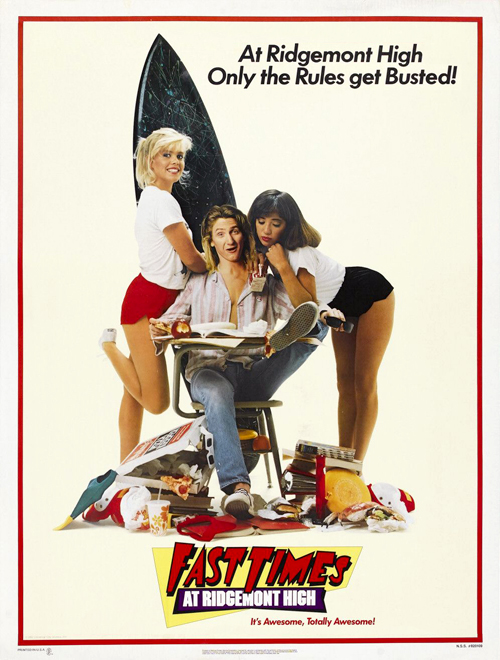
“Fast Times at Ridgemont High” (1982) is actually slow and will leave you feeling low.

“Fast Times at Ridgemont High” (1982) is a pop-culture sacred cow that needs to be skewered.  I’d rate it a 2 out of 10 for being a surprisingly inept and poorly scripted 1980’s “classic.”

I just don’t understand the fervent popular reverence for this movie among people in my age bracket.  It was a minor legend when I was growing up.  I was a fourth grader in 1982, and gradeschool boys could be divided into two groups: 1) those who had seen the “Phoebe Cates pool scene” and 2) those who had not, but wished they had.  When I mentioned on social media a couple of months ago this year that I’d never actually gotten around to seeing this movie, my friends were roundly astonished.

Why do they think this film is indispensable viewing?  Maybe there’s something I’m missing.  I’m tempted to group “Fast Times at Ridgemont High” together with other beloved 80’s films that just don’t resonate with me — like the understandably campy “Tron” (1982) or the unexpectedly sleep-inducing “The Big Chill” (1983).  (I couldn’t even finish the latter.)  But I can’t compare, because I know those movies are objectively good in a lot of ways, even if they weren’t to my taste.

Nor am I squeamish about raunchy sex comedies.  (C’mon.)  I pretty fondly remember “Porky’s” (1981), “Porky’s II: The Next Day” (1983), and “Revenge of the Nerds” (1984).  I mentioned “Porky’s” to the friend with whom I watched “Fast Times” — I told her that it wasn’t highbrow entertainment, but I still remember it being crudely, blasphemously funny.

This movie was just a thinly scripted small collection of vignettes, with no overall plot outside of teenagers having sexual encounters that are … awkward and bluntly sad, for the most part.  (Sean Penn’s character does drugs.)  The dialogue is terrible.  None of the characters are likable — even the story’s nerdy, well-meaning protagonist is grating.

I didn’t really laugh once at anything the director intended — I only laughed at the haircuts and the clothes.  I just can’t believe that the screenwriter here was Cameron Crowe, who also wrote what is possibly my favorite movie of all time — the widely but unfairly maligned “Vanilla Sky” (2001).  (Crowe apparently adapted the screenplay from a novel he wrote.)

There is some enjoyment to be had in watching Penn’s stoner character.  It was fun seeing a well known serious actor in an early comedic role.  Penn is a decent character actor, and it looks like he was having fun.  I do get why kids in the 80’s found him funny.

It’s also fun seeing the handful of other young actors who would go on to great careers (Judge Reinhold is always funny) but, again, this is something that the filmmakers can’t take credit for.

Hey, if you want a slice-of-life dramatic comedy about teenagers in the 1980’s, then go rent “The Breakfast Club” (1985).  It wasn’t perfect, but it was damn good movie that tackled many of the same issues as this movie, but with intelligence and effective humor.  Or, try the oddball “Ferris Bueller’s Day Off” (1986).  Both movies portray teenagers in the 80’s who are smart, likable and emphathetic, in varying degrees.  I myself went to high school in the 1980’s, and I assure you they were around.
 

fast-times-at-ridgemont-high-poster