Tag Archives: 1988

I introduced a pal last night to John Carpenter’s “The Thing” (1982).

And she was predictably impressed.  Here are a few observations that came up for me, about the categorically rewatchable sci-fi/horror movie that keeps on giving.  (Yeah, I know I sound overly preoccupied with this movie, and that’s weird, but I’m just really into movies.  And John Carpenter’s “The Thing” is the same kind of classic for monster movie fans as “It’s a Wonderful Life” or “A Christmas Story” is for people who like Christmas movies.)  [THIS BLOG POST CONTAINS MAJOR SPOILERS.]

1) It was fun watching “The Thing” with someone who was seeing it for the first time.  Not only did I have to stifle a chuckle at her cry of “That poor dog!” during the opening credits, but I also watched while she guessed (incorrectly, as most of us did) at which characters had been assimilated by the shape-shifting monster as the story progressed.  (I noticed something ironic last night that I couldn’t mention.  When MacReady delivers his short “I know I’m human. And if you were all these things, then you’d just attack me” speech, all of the men he’s addressing are also still human … Unless I’m mistaken, Norris and Palmer are elsewhere.

Which brings me to what at first occurred to me as a … remotely possible plot hole in this otherwise perfect masterpiece.  If The Thing truly wants to escape Antarctica and prey upon the rest of the world, it doesn’t need to assimilate (or “Thingify,” as I like to think) everyone in the camp.  It only needs to overtake a single human.  (This would be the silhouetted figure that the dog first approaches; my money’s on Norris.)  Think about it … nobody stationed at Outpost 31 remains at the research station indefinitely.  They’d cycle out at the end of a shift of … six months?  Eight months?  Longer?  (And what about vacations and holidays?)  Sooner or later, they’d fly home.  And, having perfectly replicated a human’s anatomy, The Thing need only sustain itself until that departure by eating the same food the other humans were eating.  Then, as soon as it arrived at any other, warmer location on earth, it could attack life in its abundance.

But this morning I realized that my analysis here is faulty.  First, the humans were already getting wise to The Thing and its means of procreation — thanks to a pre-diabeetus Wilford Brimley wisely intoning, “That ain’t dog.”  Maybe The Thing was smart enough to realize the humans could effectively quarantine it.  Second, I am assuming in my criticism that “The Thing” is acting as a single entity.  Yet it shouldn’t act that way at all; this is the entire point of MacReady’s “blood test.”  While one incarnation of The Thing is safely munching on canned goods disguised as a human, a separate incarnation was sitting in storage, exposed — presumably only until the humans finally realized it needed to be destroyed somehow.  That iteration of The Thing needed to attack and duplicate Redding if it wanted to save itself.

2)  The Thing actually shouldn’t need to reach civilization in order to begin attacking all life on earth; it only needs to reach the Antarctic coast. If it enters the water and begins assimilating sea life (and why shouldn’t it be able to?), then it’s game over.  I said last night that “a fish can travel wherever it wants,” which my friend found pretty funny, but it’s true.  A Thingified fish (or its fish-Thing progeny) could arrive at any continental coastline.

3)  If The Thing replicates a human perfectly on a cellular level, then … might it be reluctant to kill anyone else, because it would basically be a human?  (Obviously, the film’s plot-driving antagonist has no such reluctance, but … still, think about it.)  If it perfectly replicates a human brain, right down to its cellular structures and chemistry, then wouldn’t it have a conscience and experience empathy?  My friend pointed out the reductionist nature of my question, though — it assumes that conscience and empathy can have only physical origins.

4)  The movie’s characters (and most viewers) assume that The Thing is “a lifeform” or an organism.  Is it, or is it simply “live” tissue?  Somebody on the Internet Movie Database message board pointed out long ago that it’s “just cells,” and that’s … literally true; the film even shows this via crude 80’s-era computer graphic.  Is it an “organism” if it is simply tissue that replicates?  Or is it no more a “lifeform” than a cancer, or tissue grown in a lab?

5) I honestly opine that the film is perfect, or very nearly so.  It is the paragon of sci-fi/horror movies.  And I’d put it on par with other films that I hold virtually perfect, like “To Have and Have Not” (1944), “Alien” (1979), “Blade Runner” (1982), “Aliens” (1986), “The Accidental Tourist” (1988), “Alien 3” (1992) and “Vanilla Sky” (2001).

6)  My friend reaaaally likes Kurt Russell’s hair in this film.

Okay, enough.  I’m sorry about this.  Hey, at least I’m not obsessing over comics tonight.


421rmr3zl7tab4ovnwtundj3nhk

And here is the latest thing that makes me feel old.

What’s with all the people in music videos looking so damn young these days?  Did they change the child labor laws?

There was a time when I was daily viewer of MTV (the sedate stuff on VH-1 was for old people), and I rocked hard, people.  It seemed to me that whenever I watched a video, I saw people who were my own age.

Now these videos are inhabited only by people who look young enough to be my kids. And that makes sense, because … they kinda are young enough.  (Yes, I realize the video below for The Calling’s “Wherever You Will Go” was made 18 years ago, but that’s beside the point.)  If the performers in a video today were in their very early 20’s, then they’d be about the right age, if I’d fathered kids when I was 26.

Furthermore, some astute commentators pointed out online Monday night that 2019 is the year in which the original “Blade Runner” (1982) was set.  The opening title card names “November, 2019” as the time when all things Fordesque turn angsty and existential and killer-androidy.  Am I … older than Harrison Ford’s character? I am six years older than Ford was when he made the film.

Now I just feel weird.  Why do I write these blog posts, anyway?

[Update: Today I am learning that “Akira” (1988) and “The Running Man” (1987) also set their stories in 2019?! That’s ironic, given that the future we’ve come closest to is that of 2006’s “Idiocracy.”

I wonder how people in our parents’ generation felt when 2001 arrived, if they’d happened to see “2001: A Space Odyssey” in theaters in 1968.]


Cover to “Detective Comics” #587, Norm Breyfogle, 1988

DC Comics.

Detective_Comics_587

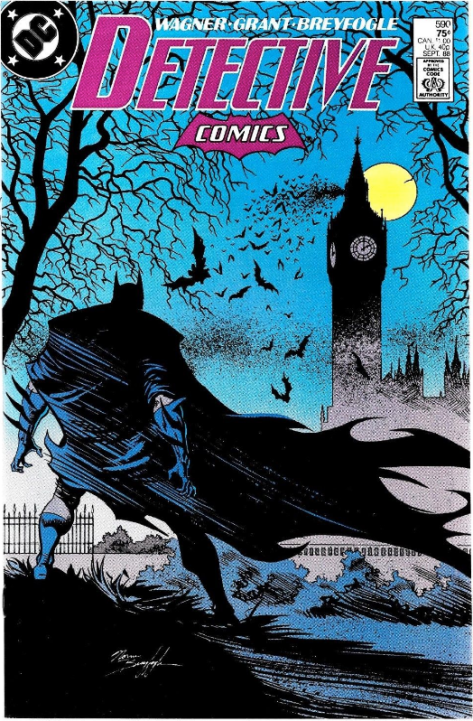
Cover to “Detective Comics” #590, Norm Breyfogle, 1988

DC Comics.

Screen-Shot-2018-09-27-at-4.10.53-PM

Cover to “Grendel” #26, John K. Snyder III, 1988

Comico.

593757-grendel26

Throwback Thursday: this theater poster for “Raiders of the Lost Ark” (1981)!

I had this poster for “Raiders of the Lost Ark” (1981) when I was 11 or so.  It was goddam gigantic.  It took up nearly an entire wall in my room.

It wasn’t store bought; it came from a theater.  My father used to do something that was pretty damned cool for any parent to do — he’d occasionally ask the manager of a movie theater to save their in-house advertising for my favorite movies.  (I don’t know how things are done nowadays, but back then they’d just throw them out after using them.)  Then my Dad would hand the guy $10 or $20 for one of these, or maybe the manager would just give it to him.

Sometimes that meant a truly industrial-size poster, like this one.  Sometimes it meant one of those huge cardboard stand-up advertisments.  (I could only have a couple of these at a time … I had a small room.)

I also had a cardboard stand-up for “Colors,” the 1988 film depicting Los Angeles gangs — but my older brother brought me that one.  It had nearly life-size cutouts of Sean Penn and Robert Duvall, the movie’s police protagonists.  I don’t know why the nerdiest kid in East Coast suburbia was so taken with a movie about inner-city West Coast gangs, but that movie meant a lot to me.

Come to think of it, a lot of people were talking about “Colors” back in the day.  It was a big deal.  It was considered pretty edgy at the time, the critics loved it, and I’m surprised I never heard about it again after the close of the decade.  Its soundtrack had a damned good title track by Ice-T, too.

The poster below was my favorite, though.  To this day, “Raiders of the Lost Ark” is probably my favorite film of all time.


images

Yes, “Die Hard” is a Christmas movie. Now get over it and go watch “A Midnight Clear.”

The perennial half-joking debate about whether “Die Hard” (1988) is a Christmas movie will be with us for a long time, I guess.  Yes, it is a Christmas movie — not only does it take place on Christmas Eve, the holiday helps set up the plot.  (Our protagonists are at the besieged Nakatomi Tower for a Christmas party.)  It just happens to be an ironic Christmas movie, that’s all.

And if we’re on the subject of ironic Christmas movies, I have to recommend “A Midnight Clear” (1992).  It’s one of those films that doesn’t deserve its obscurity.  It’s absolutely exceptional and poetic, which makes it maddening to me that a lot of people haven’t even heard of it.

I won’t describe it at length, because it’s one of those movies where “the less you know, the more you’ll enjoy it.”  (Even its central plot development is meant to be unexpected.)  I’ve never seen the trailer for this, but I can only imagine that it fails to avoid at least some spoilers.

Suffice to say that “A Midnight Clear” is a truly great film — one I would rate a perfect 10.  It’s perfect.  It just might make you look at war differently.

It’s a collection of contradictions, too.  It’s a war movie with an (arguably) pacifist message, and a “Christmas movie” that is absolutely mournful.  (I am not actually suggesting that anyone watch it to feel festive.)  It’s also a World War II movie made in the 90’s, but it feels as though it’s channeling the sadness and existential loss of the post-Vietnam 1970’s.

Again, if you choose to watch it, learn as little as possible about it beforehand.  And be aware that it’s probably sadder than you think.  Let me know what you think about it, too.  I’m curious about how other people feel about it.


1992-a-midnight-clear-poster1

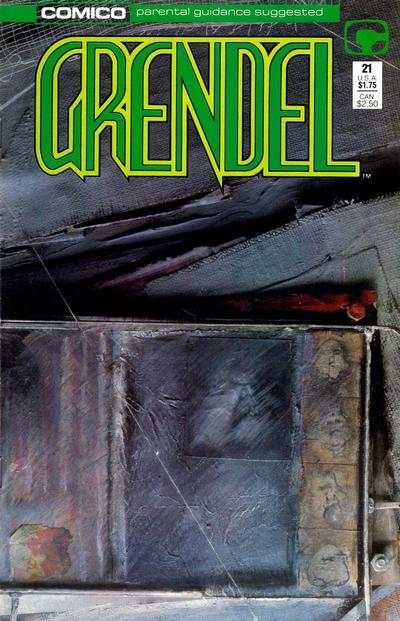
Cover to “Grendel” #21, Ron Turner, 1988

Comico.

grendel1986series21

Cover to “Grendel” #23, Ron Turner, 1988

Comico.

b6eed9c9eb4b685566a46bf548dc


Cover to “The New Yorker,” Charles Addams, October 31, 1988

Af_ny_19881031