

Tag Archives: 2001
“Emilie” (2015) is a superb, gut-wrenching thriller.
I’ll come straight to the point — “Emilie” is an exceptional horror-thriller that belongs on your list of films to see, provided you can stomach some disturbing content. This movie hooked me in under a minute, even before its title appeared on screen. Then it kept me glued to it throughout most of its running length. It could have been an even better film — a classic on par with “Psycho” (1960) or “Fatal Attraction”(1987), were it not for some key creative choices about halfway through.
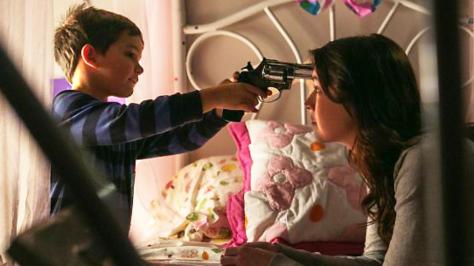
I’d give this movie a 9 out of 10. It succeeds for two reasons — great acting and a script that perfectly employs dialogue that is at first subtle and nuanced, and then increasingly frightening. The title character is a babysitter who is not what the parents expected, in more ways than one. After some deliberately awkward character interaction with the departing parents, she proceeds to subject the children to a series of progressively more demented psychological games. What follows is a thriller brimming with pathos. The movie reminded me a lot of the critically acclaimed and controversial “Funny Games” (2007). That film also showed ostensibly innocent adversaries entering a family’s home after gaining their trust, and then doing awful things.
Emilie is played to perfection by Sarah Bolger, who has a beautiful, kind face, which only makes the character’s incongruous psychopathy even more unsettling for the viewer. It took me a while to place the actress’ face, until I recognized her as the somewhat feckless protagonist of 2011’s “The Moth Diaries.” I was impressed with her talent then as a hapless good guy, and I think her performance here was phenomenal. She plays the innocent-looking, yet icy antagonist here with subtle, unnerving malice. The rest of the cast is also uniformly quite good. This is true even of the young child actors, but most especially of Joshua Rush.
The movie is briskly paced, but its sparing dialogue still manages to rattle and then shock. It’s a sometimes obscene story of imperiled children that really gets under your skin. Most of its directing is clean and clear. Combined with the unusual score, it gives the story a dreamlike quality.
The movie loses its way just a little at about the 40-minute mark, when its perverse, moody dialogue and strictly psychological horror give way to the familiar elements of a boilerplate thriller. An unnecessary backstory is given for our antagonist, delivered by an overly convenient, standard flashback sequence that feels out of place and that disrupts the pacing. (“Her mind was shattered.”) Then, other plot points also feel just a little by-the-numbers, moving “Emilie” away from true cinematic greatness and toward just being a very good horror flick.
Finally, Bolger’s villain is defanged a little when the script calls for her to lose her calm demeanor after the plucky, oldest child (Rush) defies her, in a well executed but entirely predictable David and Goliath story. And her character’s reliance on a nameless, voiceless and superfluous confederate here also makes her a little less enigmatic.
How much greater would this movie have been if Emilie’s motivations remained a mystery? What if, like “Funny Games” or “The Strangers” (2008), all we knew is that she was an highly intelligent sociopath acting for no discernible reason? What if she were acting entirely alone?
And what if the horror remained strictly psychological, with no actual violence to up the ante until the closing minutes? The most disturbing scenario I can think of is this — what if she were able to psychologically manipulate the children to violently turn against one another, or against their parents upon their return? That could be an ambiguous, darker and far more thematic story than the second half of the film we see here.
Still, this was a damned effective scary movie, and that’s good enough. I recommend it.
One more thing — there actually is a famous, heartwarming French romantic comedy entitled “Amelie” (2001), which I have not seen. I think it would be blackly funny if some sentimental filmgoers wanted to rent that and accidentally picked up “Emilie.”

“Ben Affleck was the bomb in ‘Phantoms.'”
I revisited “Phantoms” (1998) the other night, and I thought I’d just speak up briefly here on its behalf. For one thing, I really chatted up Dean Koontz’ 1983 source novel here at the blog not too long ago. And for another, this critically and popularly panned movie is one that I happened to like.
Ben Affleck actually wasn’t “‘the bomb’ in “Phantoms.'” (Referring to something as “the bomb” was, at one time, a high compliment in American slang.) He mostly phoned it in, and even seriously flubbed a scene or two. (Hey, I actually like the guy a lot, and I’m willing to give him a chance as the next Batman.) The headline above is actually some particularly meta humor from another character played by Affleck, in Kevin Smith’s “Jay and Silent Bob Strike Back” (2001). Affleck was poking fun at himself a little here, along with his fellow denizens of Smith’s “View Askewniverse.”
Roger Ebert dismissed “Phantoms” as “another one of those Gotcha! thrillers in which loathsome slimy creatures leap out of drain pipes and sewers and ingest supporting actors, while the stars pump bullets into them.” You can read his entire review right here:
http://www.rogerebert.com/reviews/phantoms-1998
No, “Phantoms” isn’t classic sci-fi-horror. It’s sometimes pretty thin stuff on a number of levels … but primarily the levels of acting and screenwriting.
But, dammit, I still liked this movie a lot. If you’re a fan of the book (I’ve suggested it’s Koontz’ best), you’ll be happy to discover that it indeed conscientiously sticks to its wicked-cool source material. We see a small Colorado mountain town where all the inhabitants have vanished; a clutch of wayward visitors then try to escape the same grisly, mysterious fate as its residents.)
The book’s central plot device is a nicely conceived and executed idea for a monster, with some effectively creepy historical and scientific context. (I can still remember a colonial victim’s warning, which is referenced in the book, but not the movie: “It has no shape; it has every shape.”)
Despite its clunky script, the film brings us a story that is pretty intelligent — thanks to retaining so many elements of the novel. This is a thinking man’s monster movie — like somebody rewrote “Beware the Blob” (1972), but put a hell of a lot of smarts and creativity into it. We’ve got two groups of bright people who fight back against “the Ancient Enemy,” and their actions and strategies generally make sense.
Also … Liev Schreiber does creepy incredibly well, and Peter O’Toole does everything incredibly well. The former’s face and mannerisms do much to unsettle us. And the latter brings the “Lawrence of Arabia” (1962) treatment to the fifties-esque trope of the monster-fighting hero scientist.
Finally, this might be an odd thing to praise a film for, but I loved its sound effects. Because that voice (or voices) on the story’s single working telephone was exactly how I wanted the adversary here to sound.
Slam it all you want. I’ll watch this one again.

 Eric Robert Nolan, Author