Tag Archives: 2012

I’m just slightly underwhelmed by “The X Files” reboot trailer.

It really just seems to show us everything we’ve seen before: ominous dialogue; dire, vague warnings from sources; and flashbacks to urgent looking 50’s-era soldiers and government workers.  All of those things taken together were sufficient to entertain for, oh, say … eight years or so.  But by the time we reached Season 9, the show really suffered from what seemed like endlessly recycled tropes and story arcs.

If the show does take new directions, as it needed to before it was cancelled, then it will need time to develop.  The January “miniseries” will only be six episodes to start with.  And I thought I read elsewhere that Chris Carter intends some of those to go to the popular “monster-of-the-week” eps that had nothing to do with the overarching mythology.

Nor do I think our main characters will be reunited with the Cigarette Smoking Man.  We do not see the face of (priceless) actor William B. Davis.  It’s only a hand, and it looks like a young man’s hand.  I’m betting we see him only in flashback.

See what you think from the trailer below.  (It’s in two parts.)

I know this is probably non sequitur, but if you love Davis’ work the way I do, then please check out his supporting role in the criminally underrated thriller, “The Tall Man” (2012).

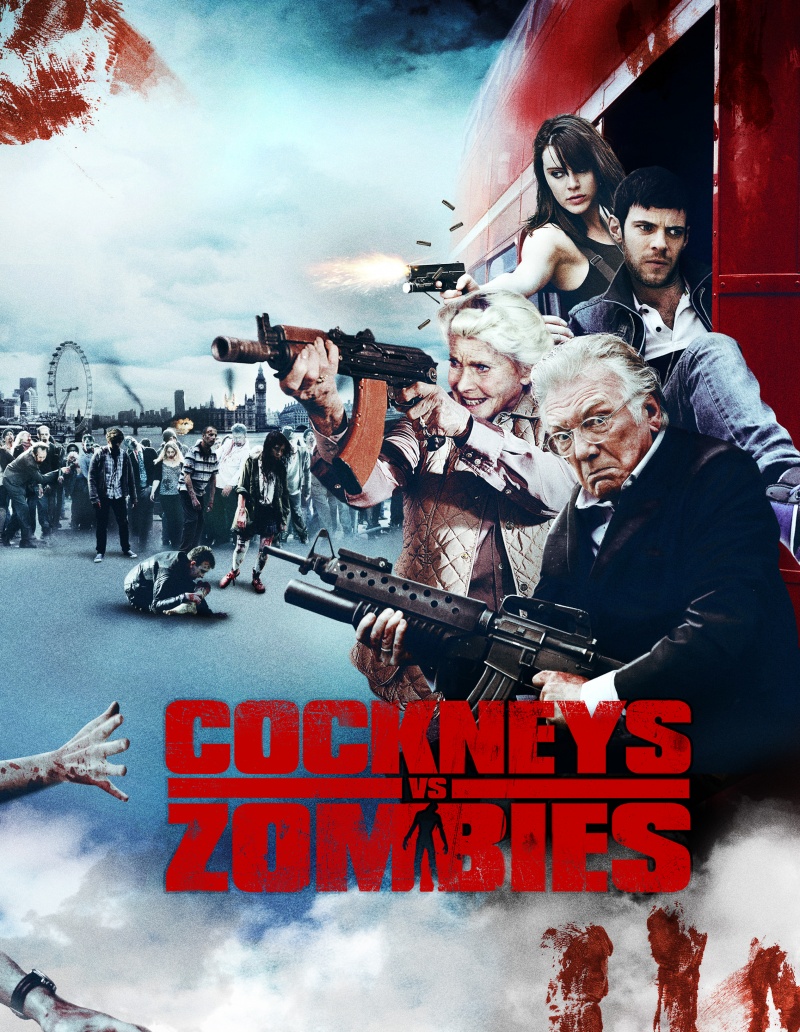
A very short review of “Cockneys vs. Zombies” (2012).

“Cockneys vs. Zombies” (2012) began with such promise — with cool, funny characters; capable comedic actors; an attempt at a decent story; and dry, witty British dialogue.  It looked like it could be a cool unauthorized companion film to “Shaun of the Dead” (2004).

Sadly, then, it didn’t pan out.  The offbeat, character-driven banter gave way to a lot of slapstick that didn’t really work for me.  And problems with pacing and tension prevented this from being an effective horror film.

I’d give this a 4 out of 10.  Oh well.

I have two questions after this film about British slang, with which I try to stay current.  (What can I say?  Some great horror movies come out of Britain.  I love it when Frank tells the crow in “28 Days Later” to “get out of it.”)

  1.  When someone gets mad at another, they call him a … mop-head?  Moppet?  Muppet?  They always say that word so fast.
  2.  If somebody says something stupid, you call them a “plum?”
kinopoisk.ru
kinopoisk.ru

A review of “Sinister” (2012). (With a caveat.)

It’s easy to see why “Sinister” (2012) came so highly recommended; this is a startlingly scary horror movie to which I’d give an 8 out of 10.  I was tempted to give it a 9, but some subjective personal tastes prevent me from giving this unusually disturbing film a higher rating.

It’s frightening.  The design of the supernatural Big Bad is quite good, despite its simplicity.  This film succeeds in giving us an intimidating bogeyman.  Far worse is his choice of victims and his modus operandi.  I won’t say much here … this is a movie where we learn about the story’s antagonist because the protagonist is an investigator — true-crime writer “Ellison Oswalt,” wonderfully played by Ethan Hawke.  I also won’t go into precisely how the baddie operates, because it’s just a little too dark to contemplate here.

It’s shot and scripted quite well … there are a number of nice touches, and the basic story is unsettling even by horror movie standards.  A late twist about how the violence is perpetrated is telegraphed in advance, but it still gets under your skin.  The directing by Scott Derrickson is spot on — the “jump moments” are cheap, but they still work.  Derrickson’s and C. Robert Cargill’s script is smartly unnerving — especially with respect to how these crimes are perpetrated.  (Yeesh.)  And the use of unusual and disturbing music is quite effective.  This film was the result of a lot of thought and effort.

Still, a few things suggested to me that this falls short of being a perfect horror movie:

  1.  Common tropes abound.  The most tired, to me, was the use of a horror writer as an ironic protagonist.  That’s an overused device.  The master himself, Stephen King, for example, has used this in no fewer than four novels and their subsequent film treatments, by my count.  (Yes, Hawke here is a nonfiction writer instead of a novelist, but the principle is the same.)
  2. Hawke’s protagonist, as scripted, is pretty damned unlikable.  “Deputy So-and-So” is his most important source, not to mention someone who shows him compassion when things get really tough.  Yet he sticks with that insulting appellation, and even screens his calls, throughout the entire movie.
  3. The bestselling nonfiction writer here has no idea how to cultivate a source.  (See above.)  I’ve been a writer, in some capacity, for my entire adult life, and I started out as a paper jockey.  You treat every source as important, even the crazy ones.  It’s both good manners and proper professional conduct.  And when you deal with any police officer, you’re especially conscientious if you’re smart — people in law enforcement are often (understandably) very sensitive about how they are portrayed in writing.
  4. Ellison Oswalt feels the need to move into a home where a multiple homicide was committed, in order to write about the crime?  That’s just nuts, even by eccentric writer standards.
  5. He chooses not to tell his wife?  I have never been married, but I know from both my personal and professional life that women get really, really pissed off when you neglect to tell them things that they think are important.
  6. Is Oswalt’s wife a Luddite who never googles anything?  I moved to Virginia a year ago, and I STILL google my address because I keep forgetting my zip code.
  7. Oswalt expects no neighbors to share such information with his wife?  (This is lampshaded a bit, as a child brings home the information from his school.)

Finally, there is one subjective matter that kept me from loving this movie — and it is admittedly a matter of taste.  Even as a devoted lover of dark stories, my enjoyment is sometimes affected by films in which children are victimized.  (I am referring here to the children depicted in the 8 MM (“Super 8”) film strips that are discovered by the main character.)

Yes, these are horror movies, and they are intended for adults, and we ourselves should be adult enough to recognize fiction as such.  (Otherwise we can buy a different ticket or click elsewhere among Netflix’ options.)  And plenty of great horror films feature imperiled children.  “28 Weeks Later” (2007) immediately springs to mind for me, probably because it is a favorite.  I think most other genre devotees would point to the universally recognized “The Exorcist” (1973).  But in those films and most others, things were depicted … differently.  (I’m being vague here for fear of spoilers all around.)

I’m a veteran horror-hound; I’ve routinely enjoyed films in which zombies or vampires wipe out humanity.  But what I saw in “Sinister” was too dark even for my taste.  This sort of reaction is rare on my part, but not unprecedented.  “The Devil’s Rejects” (2005) and “Wolf Creek” (2005) both took violence against the innocent too far for me to really enjoy or recommend them.  (Strangely, 1980’s legendary “Cannibal Holocaust” affected me little.)  Yes, zombie apocalypses tend to be gory affairs, but they are almost always faced by grownups, who are unbound, and armed, and generally able to fight back.

I would really  think twice recommending this to the casual filmgoer without a spoilerish hint about its content.  Your mileage may vary.

Hey … if you really want a scary story, check out The Internet Movie Database’s trivia section for “Sinister” after you see the movie.  Read how the “Pool Party” scene was filmed.  That’s … that’s nuts.  Nobody wants a director that committed.  Somebody should have called OSHA.  Seriously.

And here’s a joke for you.  Given the “Super 8” films we see in this movie, wouldn’t it be blackly funny if this film were  sequel to Steven Spielberg’s heartwarming “Super 8” (2011)?  It’s all about the kids, right?

Sinister

A short review of “The Hobbit: An Unexpected Journey” (2012).

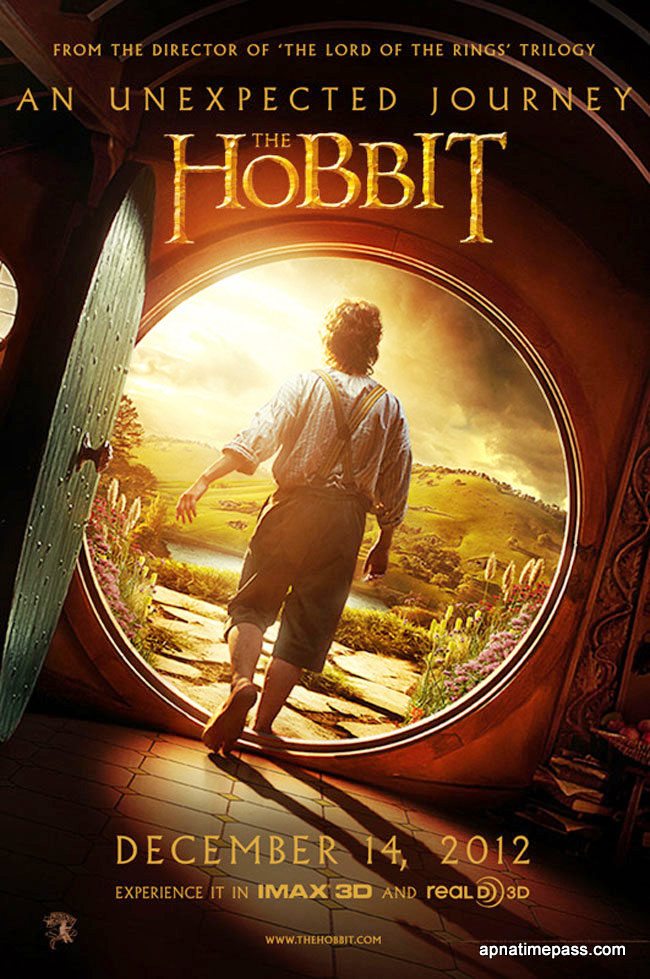
I actually really liked “The Hobbit: An Unexpected Journey” (2012).  I’d give it an 8 out of 10.  And that’s even with my own admitted possible bias, as I am not a huge fan of traditional fantasy.  I certainly can’t claim to be a fan of the original books, because [downcast eyes], I’ve never read them. I tried “The Silmarillion” once, because I thought that was supposed to come first in J.R.R. Tolkien’s chronology … and I just couldn’t stay with it.  So I guess my take on this movie is that of an outsider, as it was with Peter Jackson’s “The Lord of the Rings” trilogy.

But this was enjoyable movie for anyone, I thought.  It’s a total immersion into an incredibly beautifully rendered fantasy world.  I thought the sets and backgrounds were more detailed than the first films, for example.  It’s a gorgeous movie to look at.  The acting is uniformly excellent throughout.  And the continuity is just great; there are well crafted segues into subplots that will eventually lead to the original trilogy.

I think the only thing that hampered my enjoyment was that it felt so much like a children’s story.  (I believe I read once that Tolkien actually began his novel as a bedtime story for his children, while his subsequent “Rings” epic was intended for adult, mainstream readers.)

Peter Jackson had his creative sensibilities planted firmly in childhood fairy tale when constructing this movie.  For an outsider, this seems like a standard (and sometimes predictable) quest movie.  We have a tremendous deus ex machina at the end that a child might not recognize, but this adult did.

The dialogue, monsters and action were often too cartoonish for me.  As a fan of creature features, I found the monsters were often too silly to be credible.  (I had this small quibble, as well, with the original film trilogy.)  With the outstanding exceptions of the Warg and the White Orc, they often seemed like CGI-rendered cartoons.  The three trolls who want to cook the dwarves, for example, were like something out of a silly Hanna-Barbera cartoon.  If this film was supposed to engage adult viewers, this creative approach was a pretty big misfire.

But I recommend this, even to people who don’t typically enjoy sword-and-sorcery fantasies.

Seriously, though … that deus ex machina at the end … if such an option is available to our heroes, why not employ it from the start of the movie?  Hell, why not employ it throughout the entire “Rings” trilogy?

the-hobbit-an-unexpected-journey-movie-poster-1

A quick review of “Total Recall” (2012)

I am blogging some of my past movie reviews from Facebook; this was my take on the “Total Recall” remake.

**********

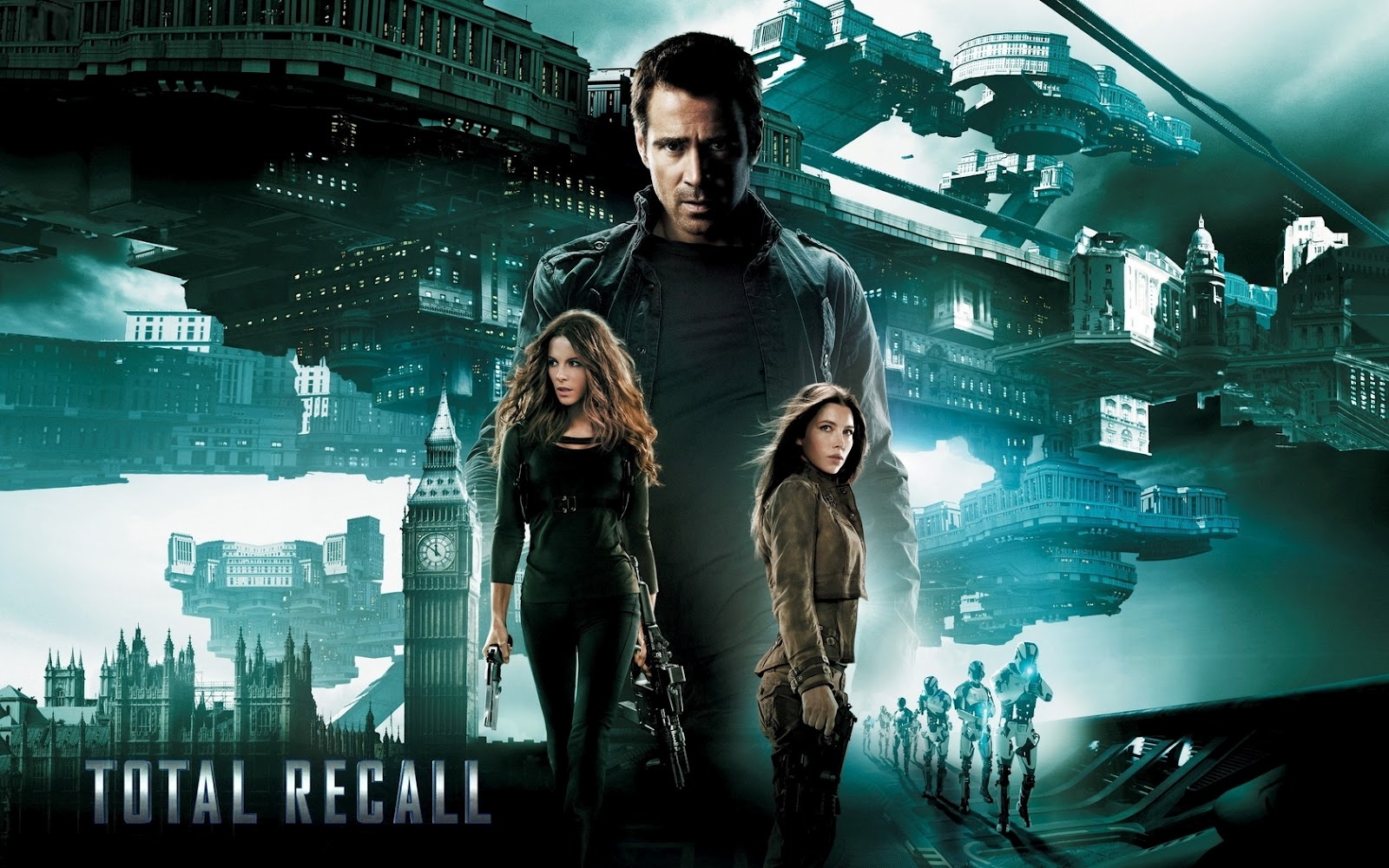
“Total Recall” (2012) was a fun, slick update of the 1990 classic; I’d give it an 8 out of 10. It can’t match the magic of the original (especially with the abandonment of one particular twist near the end), but it was still fun enough. Plus, any fast-paced, CGI-heavy, sci-fi action movie with both Jessica Biel and Kate Beckinsale really is just pure nerd fun.

Beckinsale grows on me. She’s a great actress, especially in roles that require her to be powerful or angry, and she does physical stunt-work superbly. She deserves to carry her own franchise, and I mean something better and more mainstream than the “Underworld” films.

Anyway … I’m pretty sure I have a good answer to this movie’s central mystery (as well as that of its predecessor). This is the question of whether or not everything Quaid witnesses is real. (Is he a secret agent, or is this all a fantasy generated by “Rekall?”)

It is real, and here’s why. In both movies, the viewer witnesses events that are outside of Quaid’s experience. For example, we see the police plotting to capture him and interviewing witnesses. Quaid is nowhere near these events when they occur, and does not see or hear them; therefore they cannot be part of his virtual reality fantasy. Yet you and I see them up on the screen. So they are real, within the story, and not imagined by Quaid. To me, it all seems pretty straightforward.

All in all, this was a fun ride. I recommend it.

Total-Recall-HD-Wallpapers

A review of “The Tall Man” (2012)

I’m again blogging old movie reviews from Facebook.  In retrospect, I maybe should have given this clever, unexpected gem a 9 out of 10.  I am also a little confused about whether there was a sequel to this movie, entitled “The Regret.”  (Or was that an overseas title for this film?)

*****

I really liked “The Tall Man” (2012) though I can tell right away that many other viewers will not. And it’s hard to explain why, because this is a “twist movie” that’s difficult to discuss without spoilers. The film that you sit down to watch absolutely is not the same film that you wind up seeing.

The movie opens with Jessica Biel as an idealistic doctor in a gorgeous but very poor Washington State small town. The town’s children sporadically disappear, according to a creepy and wonderfully effective montage, and townsfolk blame the supernatural “Tall Man.” For a while, it’s a first-rate thriller. I jumped a few times.

Then there’s a twist.

Then, in the movie’s final 10 minutes, there’s another twist that affects the first. And there’s a hell of a lot of moral ambiguity. (Or maybe not – I, for one, disagreed with and would have hated the prevailing character.)

I thought the whole thing was smart, creative and frightening. Jessica Biel did a great job. The sweeping pans of the forest are fantastic – was it partly CGI? Did they use a helicopter?

It actually isn’t a perfect mystery. There are a few implausibilities. One character is far too well adjusted for his or her circumstances, one character conceals something for no reason, and the young mute girl’s decision makes no sense, if you consider what she does and does not know.

Still – good movie. I’d give it an 8 out of 10.

The-Tall-Man-2012-Movie-Title-Banner