Tag Archives: 2014

“Annabel Lee,” by Edgar Allan Poe

Halloween season is almost upon us.  (I’m the kind of purist who thinks it begins on October 1.  My neighbors have shown surprising restraint; I’ve only seen one decorated house.)  And Halloween is the season for Edgar Allan Poe.

I’m running “Annabel Lee” today, however, because I was chatting with a Mary Washington College Alumna the other day who named her daughter “Annabelle.”  The conversation came up after my review of last year’s surprisingly good horror movie of the same name.  (My New Hall friend arrived at “Annabelle” after researching the name, but not after this poem.  That would be weird.)

“Annabel Lee,” by Edgar Allan Poe

It was many and many a year ago,
In a kingdom by the sea,
That a maiden there lived whom you may know
By the name of Annabel Lee;
And this maiden she lived with no other thought
Than to love and be loved by me.

I was a child and she was a child,
In this kingdom by the sea,
But we loved with a love that was more than love—
I and my Annabel Lee—
With a love that the wingèd seraphs of Heaven
Coveted her and me.

And this was the reason that, long ago,
In this kingdom by the sea,
A wind blew out of a cloud, chilling
My beautiful Annabel Lee;
So that her highborn kinsmen came
And bore her away from me,
To shut her up in a sepulchre
In this kingdom by the sea.

The angels, not half so happy in Heaven,
Went envying her and me—
Yes!—that was the reason (as all men know,
In this kingdom by the sea)
That the wind came out of the cloud by night,
Chilling and killing my Annabel Lee.

But our love it was stronger by far than the love
Of those who were older than we—
Of many far wiser than we—
And neither the angels in Heaven above
Nor the demons down under the sea
Can ever dissever my soul from the soul
Of the beautiful Annabel Lee;

For the moon never beams, without bringing me dreams
Of the beautiful Annabel Lee;
And the stars never rise, but I feel the bright eyes
Of the beautiful Annabel Lee;
And so, all the night-tide, I lie down by the side
Of my darling—my darling—my life and my bride,
In her sepulchre there by the sea—
In her tomb by the sounding sea.

Annabel_Lee_fair_copy_Poe_1849

Photo credit: By Edgar Allan Poe, “Annabel Lee”, 1849 fair copy. [Public domain], via Wikimedia Commons

“Annabelle” (2014) scared the $#@& out of me!!

“Annabelle” seems like precisely the sort of horror film that shouldn’t work.  Thinly drawn characters wind their way through a series of overly familiar tropes, including, of course, the titular possessed doll.  These characters make the same baffling decisions that only people in horror movies are stupid enough to make, and cavalierly remain in dangerous situations long after you and I would have gotten the hell out of there.  The film is so reminiscent of “Rosemary’s Baby” (1968) that for a while I actually wondered if it was a remake.  And the script is pretty clunky — especially the coda at the church.

Yet … “Annabelle” still works.  This is a frikkin’ scary movie.  I’d give it a 9 out of 10.

There are a couple of reasons for the movie’s success, I think.  First, it’s beautifully shot and directed throughout an especially creepy apartment building. Our supernatural antagonists are (at first) wisely seen down long corridors and stairwells.  There are some static shots of the doll but none of the silly cut-and-cut-back tricks to explain that it is moving on its own.

Second, there is no ham-handed CGI to make the action cartoonish; there are only sparsely placed practical effects, and they work quite well.  This felt like an effective old-fashioned 1970’s horror movie about the devil.

Third, Annabelle Wallis does well in her role as the wife in the young married couple targeted by Satan. She underplays it quite a bit, but she’s still a good actress.  (The beautiful Wallis is none other than the college student that young Charles Xavier tried to pick up in 2011’s “X-Men: First Class.”  And, yes, she does have the same first name as the demonic doll.  Weird world.)

I was confused at first about the awkward and confusing bookends to the film; they’re distracting and unnecessary.  Wikipedia informs me that these are intended to remind viewers that this movie is a spinoff of “The Conjuring” (2013), which is regarded by horror fans as superior to this film.  I guess I’ll need to watch that soon.


a11da6bd58b95b334f8cd49f00918f16_500x735

A review of “Deliver Us From Evil” (2014)

“Deliver Us From Evil” (2014) pleasantly surprised me by being a pretty decent horror movie; I’d give it an 8 out of 10.

I expected a predictable melodrama between its two primary protagonists — the hardened, intractably “close-minded” cop and the wise young priest.  This, I thought, would upstage a thin, generic, supernatural backstory.

Well … there was some of that expected character interaction, but I admit that it was done pretty well.  And the old fashioned scares served up here make this an above average horror movie.

I say “old fashioned” because this seemed to channel the demonic possession classics that defined this horror movie sub-genre, for me, anyway — “The Exorcist” (1973) and “The Exorcist III” (1990).  It has an expansive story that begins in a nicely surprising battle scene in Iraq, then shifts its focus to several chilling violent crimes in New York City.  Then it effectively blends a horror story with a police thriller.  And the story is detailed, with some thought put into the demon’s modus operandi and choice of victims, as well as the their investigation by streetwise New York City cops.  A straight horror-thriller like this is a nice contrast to recent well made supernatural horror films like last year’s “The Babadook” or “It Follows,” which were ambiguous and heavily thematic, personal stories with virtually no exposition.

Eric Bana and Edgar Ramirez were both terrific; even they might have been upstaged by Joel McHale in a supporting role as Bana’s foul mouthed but loyal anti-hero partner. I was rooting for him more than the thinly drawn hero scripted for Bana. (Can any NYC cops really wield a knife like that?  If so, that’s totally badass.)  McHale is damn good — I’ll be looking for him in his regular role in the upcoming revival of “The X Files.”  If you were an NYC cop, wouldn’t you want a partner like that?  Seriously … that dude is BADASS.

Regrettably, this movie’s thought and creativity do seem to lose steam toward the end.  Certain scares and images were done wonderfully.  The scenes inside the asylum were great, for example, especially one shot that made me think of the Batman mythos’ Arkham Asylum.  Others fell flat.  Our Big Bad, when finally revealed in full, is just a generic ugly dude in drab whiteface.  And a sequence involving a piano is shot with little visual flair.

The most frightening subplot of all involves a troubled girl in her bedroom; it’s cut short and rendered irrelevant in order to move the plot forward.  And the finale features an exorcism that recycles mostly old tropes from the sub-genre.

Hey … this was still a good movie, though.  It certainly was better than I thought it would be.  I’d cheerfully recommend it.

Oh!  One more thing — this is supposedly based on a true story.  Scott Derrickson’s interesting screenplay derives from the 2001 book, “Beware The Night,” by retired NYC police officer Ralph Sarchie (Bana’s character).  I wonder what evidence anyone has gathered to either support or debunk the story here.
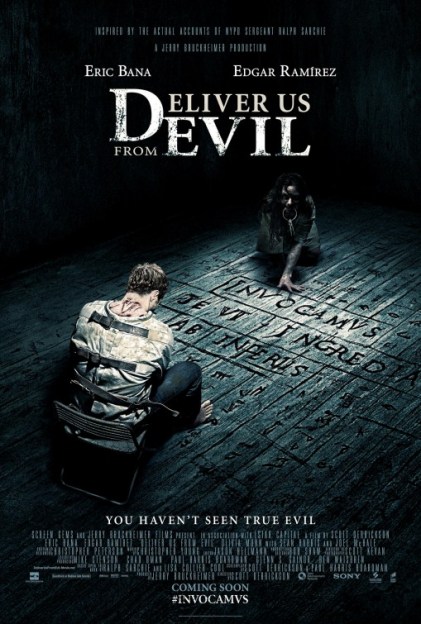
deliver_us_from_evil

A gorgon’s head, from the “Monsters Exhibition,” Palazzo Massimo, Rome, 2014

Antefissa_circolare_a_testa_di_gorgone,_510-500_ac_ca.,_da_taranto_(MAN_taranto)

Photo credit:  “Antefissa circolare a testa di gorgone, 510-500 ac ca., da taranto (MAN taranto)” by Sailko – Own work. Licensed under CC BY 3.0 via Wikimedia Commons.

A review of “Unfriended” (2014)

“Unfriended” (2014) is a low-budget independent horror film that took enormous risks — and boy, did they pay off nicely.  This is an outstanding and truly creative entry into the found-footage horror sub-genre that deserves a 9 out of 10.

This movie is unique, as far as I’m aware — it is seen almost entirely through the computer screen of one of five friends terrorized by a vengeful ghost — a classmate who commit suicide after a humiliating video of her was posted online.  But the term “vengeful ghost” probably doesn’t do justice to Laura Barns; the antagonist here brutally turns the story into a kind of slasher film.  It’s surprisingly well done.  Screenwriter Nelson Greaves attacks the script with darkly ingenius flair, as Laura sadistically and psychologically torments each victim before dispatching them.

The movie was shot in a single long take, and the actors actually performed in different rooms of the same house.  Except for its final shot, it takes place exclusively on Skype, Facebook, and Youtube, I think.  It makes me wonder … did the filmmakers get permission from those websites?  I doubt it.  Or are screenshots of global, publicly accessible forums like those not protected by copyright?

The only real quibbles I had reflect “Unfriended’s” limited budget.  The character deaths vary greatly in realism.  One is terrifying, another is slightly less so. One is scary but also puzzling, given its modus operandi.  One is scary only if you are susceptible to a predictable jump scare.  And one is so obviously staged that it seems like something you or I might better portray with a $4 prop from a novelty store.

I should note also that this is a particularly dark film, even without the horror elements.  Its portrayal of teenage life during the Internet age is ugly, to say the least.  Suppose there were no homicidal ghost in this story — it would still be a disturbing film even if every character besides the suicidal Laura survived.

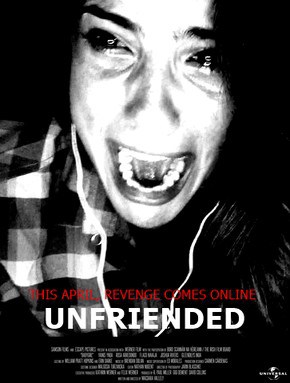
Unfriended-poster

A review of “The Hobbit: The Desolation of Smaug” (2013)

I felt the same way about “The Hobbit: The Desolation of Smaug” (2013) as I did about its predecessor — it’s a beautifully rendered, immersive fantasy that still falls short of being a truly great movie.  I’d give it an 8 out of 10.

The special effects are downright beautiful.  We’ve got a fantastic dragon to behold.  The acting is roundly terrific too.  I can only imagine it must be harder for a professional actor to portray a hobbit, dwarf, elf, or wizard, with their stylized language and fantastical quirks.  Yet every member of the cast was either good or great.  The obvious standouts are Sir Ian McKlellan as Gandalf and Martin Freeman as Bilbo.  Ken Stott as Balin was also quite good.

Yet the monsters and action were sometimes so cartoonish that they really challenged an adult viewer’s willing suspension of disbelief.  The battle sequence involving the barrels, for example, seemed like something out of a Warner Brothers cartoon.

I also noticed a couple of other things.  This is my fifth of Peter Jackson’s “The Lord of the Rings” movies that I’ve watched, and I am beginning to understand the viewer contention that these film’s story structures consist of a lot of “walking and fighting.”

The most interesting story element, for me, was Bilbo’s use of The Ring as his secret weapon — all the while concealing its magic from his comrades and first gaining the psychic attention of Sauron.  We also see hints that he may develop his own slavish devotion to The Ring, spookily suggested when he brutally attacks the giant spider assailants who might jeopardize his possession of it.  The Ring’s subplot (and the way it sets up “The Lord of the Rings” trilogy) engaged me more than anything else.  Throughout all the films, it’s a fantastic story device, and well suited for a fantasy context.  The Ring could be a metaphor for greed, love of power, possessive love, or even drug addiction.  It adds so much depth to the Lord of the Rings universe, and goes far beyond a story of little good guys fighting big bad guys.  To me, The Ring and Bilbo were far more entertaining than traveling dwarves greeting or fighting characters throughout Middle Earth.

There may have been pacing problems; this felt slow.  I got the sense that too much time was spent establishing Lake-town and its (fairly boring) residents, although it was great seeing the immeasurably talented Stephen Fry’s surprise turn as its “Master.”  Too much dialogue is devoted to things like arguing with elves, negotiating boat rides, and penetrating a magic door.  (And I’m still not sure how the “last light of … day” translates into an Autumn moon.)

This was a good movie, even for someone who isn’t a fan of the source material.  Given its length and its slower pacing, however, I may not feel the need to see the third film right away.

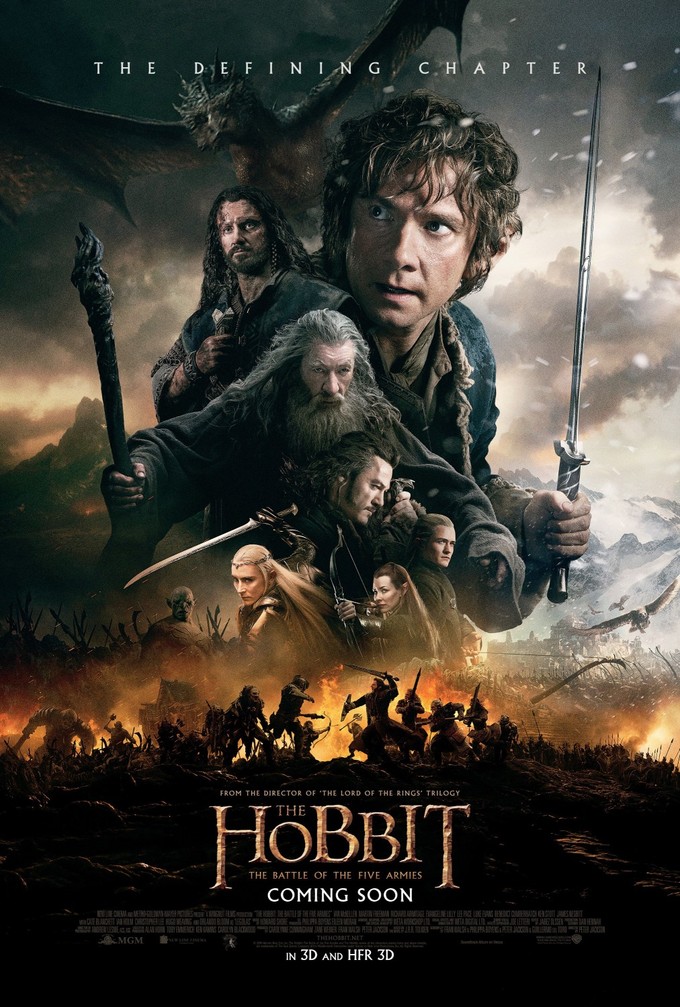
[Edit: I’m not sure why the poster below appears to cite 2014 as its release date.  Was it re-released in theaters?]

hobbit-2-tie-in-book-1