If I write a blog post, check or e-mail and date it 2020, I am not a &^%$ing imbecile who still can’t manage to write the new year correctly.
I have mastered time travel, and I actually am contacting you from the future.

If I write a blog post, check or e-mail and date it 2020, I am not a &^%$ing imbecile who still can’t manage to write the new year correctly.
I have mastered time travel, and I actually am contacting you from the future.
“The First Purge” (2018) isn’t the best horror-thriller I’ve ever seen, but it certainly isn’t the worst, either. I thought that I would be all purged out by now, but this fourth entry in the film series is a solid prequel — I’d rate it an 8 out of 10. (There is also a TV show set in “The Purge” universe, which USA has renewed for a second season, and I’m told that it’s pretty good.) I suppose this is a durable franchise because its premise could be explored through countless different characters.
The movie has some weaknesses. The pacing is off, and you could argue that the political theme of “The Purge” films, though compelling, is getting redundant by now. (There are some specific jabs this time out at Donald Trump and his following; they’re heavy-handed, but they’re fun to spot.)
But “The First Purge” is still a suspenseful and disturbing dystopian horror film. It’s got a terrific bad guy in Rotimi Paul’s “Skeletor” psychopath and some surprisingly damned good action sequences. There is another difference here, too — this “Purge” is far less campy than the second and third films. There are fewer plot twists, fewer over-the-top characters, and far fewer trippy visuals — it feels more like a straight horror film instead of a zany one. Depending on your preferences, you might find it superior.
One more thing — given its obvious love for Staten Island, this film would make a great double-feature with “Bushwick” (2017), another thriller which seems like a love letter to its own setting in Brooklyn. And they are both urban neighborhood thrillers with a similar storytelling style.

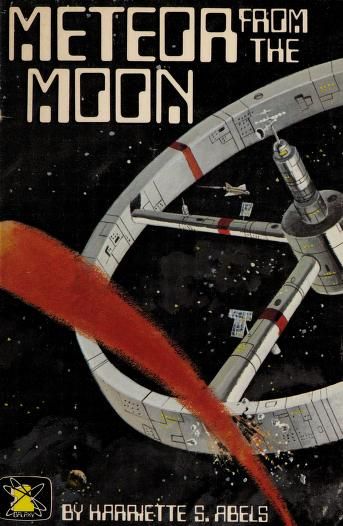
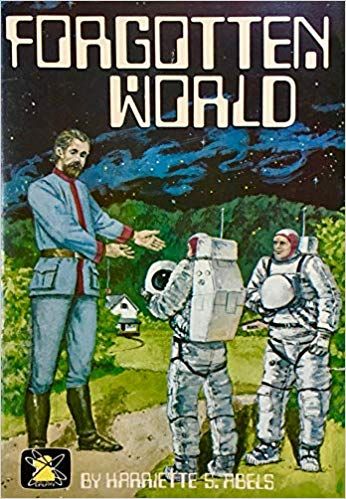
Harriette Sheffer Abels’ “Galaxy 1” books appear to be fully consigned to obscurity — I don’t have a single friend who remembers them. They were published by Crestwood House in 1979; I certainly loved the ones I found in my elementary school library in the 1980’s. And that says a lot, because I was a kid who loved the fantasy genre far more than science fiction. (I had an older brother who played “Dungeons & Dragons,” and Ralph Bakshi’s animated take on “The Lord of the Rings” had captured a lot of kids’ imaginations since 1978.) I remember how pleased I was to discover anthology-style books that featured the same cast of characters on different space-based adventures.
I’m pretty sure that “Mystery on Mars,” “Medical Emergency,” and “Silent Invaders” were among those that I read. My favorite, however, was “Green Invasion,” which featured alien vines that grew uncontrollably and crushed anything they could ensnare and tangle. Lord knows that was a scenario I re-created with my G.I. Joes at home.





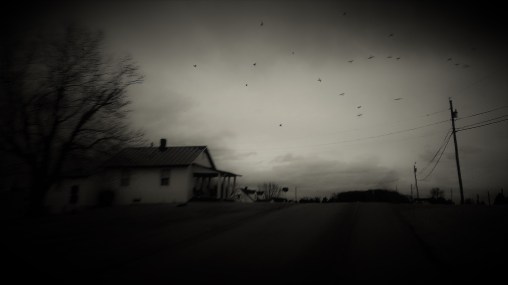
I actually took these photos of Botetourt County early last year, I think. I’m just having some fun with photo filters.




I thought that The Cheese Bukowski was the best burger I ever invented, but The Cheesy Carpetbagger just might be my true piece de resistance.
You just fry melted provolone over the burger itself, and colby jack cheese over a slice of honey ham beside it in the pan. Then serve on toast, maybe with a cheesy one-liner. Teach these Southerners how we do it in New York.

“Bandersnatch” is a difficult episode of Netflix’ “Black Mirror” to review — it isn’t really an “episode” or a “movie;” it’s more of an interactive online game that is reminiscent of the “Choose-Your-Own Adventure” young-adult books of the 1980’s. (I believe they are actually name-checked in “Bandersnatch’s” main narrative, before it branches off into multiple stories.) This main narrative follows a troubled young computer programmer (expertly played by Fionn Whitehead) as he begins to question his own reality while struggling with demons from his past.
From there, “Bandersnatch” unfolds according to the viewer’s choices. (Netflix has configured the episode so that viewers control the protagonist simply by clicking options with their computer’s cursor.) The meta-fictional twist here is that Whitehead’s protagonist is himself developing a groundbreaking multiple-choice style video game for his employer. (The episode is set in 1984, when interactive games had not yet developed alongside arcade-style games.) What follows is a seemingly indeterminate number of stories, with “Black Mirror’s” predictably disturbing surprises.
I’ve read that there are four “main endings” at which the show’s writer, Charlie Brooker, thinks most viewers will arrive. There are supposedly a great number of other endings, as well — and the viewer can reverse the course of a narrative and follow a different path. It’s all interesting stuff, even if it’s a little complicated.
So I’m not sure how to review it. And I’m not sure I’m the best guy to offer such an opinion, as I am not the target audience for an experiment like this. I’ve always been a “movie guy,” and not a “video game guy” — I’m the kind of milquetoast man that would rather be passively entertained by a story than involved, in real-time, in its creation. I want a cohesive story with a clear denoument that was intended by the writer and director — not a mongrelized story that I helped come up with myself. (Yes, I know that makes me sound like the precise opposite of cool and fun and creative, but I’m just being honest.) I trust “Black Mirror” to knock my socks off with it’s storytelling — Brooker is a goddam genius, and this show is nothing less than the 21st Century’s “Twilight Zone.
I certainly liked “Bandersnatch.” A key expository sequence in the first pathway I selected made me smile and laugh (due to the show’s intended black humor, of course). I’d rate this viewing experience an 8 out of 10, for the fun I had with it.
But I do hope this is the only episode of its kind. There are disadvantages that this experimental format probably cannot escape. Pacing, plot structure and story cohesion all typically go right out the window after “rewinding” and story options are introduced. I also had the compulsion, upon completing my first story arc, to return to the action and find an ending that was “correct” or possibly better. And when my next narrative meandered, I wondered whether I was “doing it right.” This lacked the cinematic quality that is characteristic of “Black Mirror” episodes, and ultimately felt like a video game.
I had another quibble too, and it’s admittedly a strange one. Many elements of “Bandersnatch’s” 1980’s setting here are garish, bizarre or unpleasant. (Some of the characters — particularly the father — were so off-putting that they made revisiting a story sequence almost irritating.) I suppose that this was probably a deliberate choice by Brooker and by episode director David Slade — possibly to capture the vibe of the Philip K. Dick stories that are this episode’s obvious inspiration. But I don’t think it was necessary to the plot. Consider how different a story like this might be if it were filmed with the starkly beautiful visuals of the 2017 “Crocodile” episode directed by John Hillcoat.
Postscript — there was one metafictional twist that only I could enjoy. And that’s a shame, because it was pretty neat. When Will Poulter’s character here tells Whitehead’s that they’ve “met before,” that struck a chord with me personally — because Poulter, who has blond hair here, looks a lot like an old pal of mine from college. That was weird.
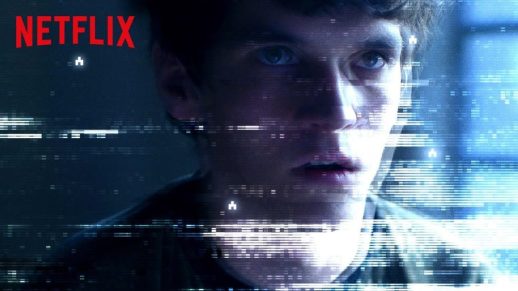
I told Brent Spiner on Twitter that I hope he endorses a presidential candidate, because I want to vote for someone whose positions are supported by Data.
And NOBODY laughed. WHY can’t people understand how BRILLIANT I am?
Eilis Dillon’s “The Singing Cave” was another favorite childhood book of mine for the obvious reasons — a young boy explores a seaside cave and discovers a Viking skeleton, complete with a sword and armor. That pretty much hit all the right notes for me when I was in early gradeschool in the 1980’s. (Some sort of age-appropriate young-adult mystery unfolded after the skeleton disappeared, possibly involving the townspeople, but I don’t even remember that very well. What thrilled me and stayed with me was the kid finding a armored Viking skeleton in a cave.)
The book was published first in 1959 in the United Kingdom by Faber & Faber; Dillon was Irish and the story was set in Ireland. It was released here in America the following year by the now defunct Funk & Wagnalls — the same company that produced those huge reference books that Gen X’ers remember lugging around before the arrival of CD-Roms. (Funk & Wagnalls is a name I haven’t heard in a very long time. It turns out they quite bein’ a thing in 1997.)
I went through one hell of a Viking Phase when I was a kid. (I suppose it wasn’t too different from other kids wanting to be pirates.) I was thrilled with stories about Leif Erikson, and I was pretty happy that his last name sounded like my first. It would be years later when my parents told me that I was actually named after another Viking, Erik the Red, albeit very indirectly. (My parents like the name featured in the “Erik” cigars television commercial.)
I might have talked about this at the blog before, but I even constructed my own “Viking ship” with the kid next door when I was very young. It probably wasn’t seaworthy; it was really just a wooden pallet with some two-by-fours nailed together as a mast, and a white sheet for a sail. (Where had we gotten that sheet? It seems to me that if I’d stolen it from the laundry, I’d have gotten into some trouble for that with my Mom.) Bizarrely, my friend and I etched a bright red Spanish Cross on the sail — even though that emblem had nothing to do with the Vikings. You kinda can’t excuse our stupidity because we were kids … we’d seen plenty of pictures of the Nina, the Pinta, and the Santa Maria in school.
My Dad also cautioned me and my buddy that our Viking ship might not float. (The hindsight of adulthood assures me that it definitely wouldn’t have floated, but my Dad didn’t want to dash our hopes too abruptly.) He explained to us patiently in the backyard that in order for something to float, it had to “displace its own weight in water.” And … I actually understood that, surprisingly enough. It’s probably the only physics lesson I’ve understood in my life.
In fact … I don’t think we even had a plan in place for moving that boat from the backyard to the water. We were so enamored with the concept of shipbuilding that we kinda didn’t think things through very far at all.

(I was talking about ABC’s “Donny & Marie” show from the late 70’s, which I really enjoyed as a tot.) At the time I suggested they the Osmond siblings were immortal vampires because they are still performing in Las Vegas.
I take it all back. I was just reminded that Osmond is the unnamed dancing man in the 2008 “first take” video for “Weird Al” Yankovic’s “White & Nerdy.” Have you seen the way this guy mugs and dances for three minutes straight? He’s hilarious. And he’s a goddam force of nature. He’s like Spider-Man 2099. He’s cooler in that three minutes of video than I will ever be.
Besides, I’m old too. I feel certain I was told at some point years ago that the guy was Osmond, yet I completely forgot about that when I discussed the show. I also don’t know if “throwing shade” has fully replaced “smack-talking” in the vernacular, or even if the term should be hyphenated.

