Tag Archives: Martin Freeman

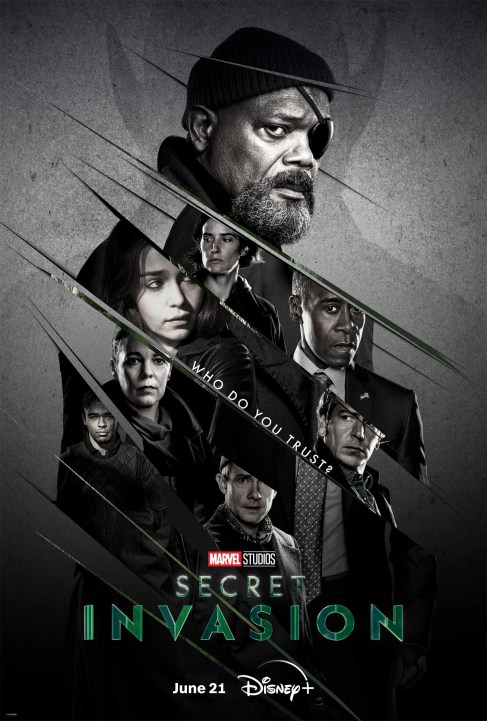
A few quick words on the series premiere of “Secret Invasion” (2023).

I’ve never actually read a comic book featuring the shapeshifting alien Skrulls.  The story concept always seemed too campy for me.  (And it still does.)  But I still had loads of fun with the first episode of Marvel’s “Secret Invasion” (2023).  I’d cheerfully rate this new limited series an 8 out of 10.

There are two clear reasons here.  The first is that I love comic book stories in which ordinary, non-powered characters are working with (or against) superpowered characters — it makes the story and action feel more grounded in reality, and the juxtaposition is always fun to explore.

The second is that the Marvel Cinematic Universe just happens to be good at the cloak-and-dagger stuff.  It’s a little surprising, if you think about it.  Here we have a fictional universe known for linchpinned by story conceits derived from science fiction or magic.  Yet the MCU’s stories about spies, governments and politics remain fan favorites.  (Look at the broad-based appeal of 2014’s excellent “Captain America: Winter Soldier,” for example.)  As I’d hoped, I really enjoyed the twists and surprises of the first episode.

Samuel L. Jackson, Martin Freeman, Emilia Clarke are always a pleasure to watch.  And I’m starting to understand that Ben Mendelsohn is really terrific too.

This looks to be one of the better MCU outings.  I recommend it.


si

A spoiler-free review of “Sherlock” Season 4

I actually can understand why some “Sherlock” fans were less than thrilled with its fourth (and apparently last?) season.  (I’ve read that the final episode received the lowest ratings in the show’s history.)  Even if Season 4 wasn’t quite as strong as past seasons, however, I’d still give it a 9 out f 10.

The narrative style and the content of this three-episode arc changed drastically.  The detail and methodical pace of past seasons gave way to a faster, looser narrative that made the show feel more … mainstream, in a way.  These episodes felt more like the standard adventure tales that you’d expect from any television thriller, and far less a genuine homage to the literary source material.  At times it was a little sloppy, with bombs, disguises, false memories and other over-the-top plot devices that were sometimes pretty implausible.  The final episode even seemed directly inspired by a series of horror films not known for being critically acclaimed.

The writing and directing wasn’t as clean, either.  This was easily the most surreal of the show’s four seasons — especially if you count the standalone “special,” “The Abominable Bride,” which preceded the official initial episode.  There were some overly stylized flashbacks, spliced scenes, and other departures from a linear narrative.  (I can’t be more specific without spoilers.)

The tone of the humor changed, too.  Some of the droll, dialogue-driven British humor was replaced by the zanier, crowd-pleasing stuff that you would expect from a more mainstream television comedy.  (One lamentable scene involving the outcome of a car chase, for example, was entirely too silly.)

At the same time, this was the darkest season yet.  The goofier humor was juxtaposed with story elements that were hard-hitting, sad and occasionally frightening.  When one character delivers the line, “Maintain eye-contact,” it was chilling enough to stay with me hours after the show aired.  There was some scary stuff this season, on a couple of different levels — the second episode, in particular, superbly delivers creeping psychological horror, then tops if off with a chilling story resolution.

And here is where Season 4 shined.  At one point, I asked myself, “When did ‘Sherlock’ become a horror show?”  But it was shortly thereafter that I realized that I absolutely didn’t mind.

The season’s success boils down to three things.  The first is the darker story content, which I thought was a bold and surprising choice for what is probably the show’s last season.

The second is the quality of the writing.  I realize that sounds strange, given my above criticisms above, but it is still a superbly scripted show.

And, third, the performances from its principal actors were still uniformly excellent.  (And when they combine via some great dialogue, “Sherlock” still hits it out of the park.)  Martin Freeman, Benedict Cumberbatch, and Amanda Abbington were all at their peak — particularly since their characters have evolved now to what is probably their culmination.  This last  season was easily the most personal and character-focused, and sees these protagonists finally complete their individual arcs.  Sherlock is finally sufficiently humanized, Mary’s development finally reaches full fruition, and Watson has finally grown into his own man.  If I had quibbles about Holmes and Watson’s portrayals in past seasons, it was that Holmes was too much of a jerk , while Watson was merely a weak, even neutered foil for him.  Holmes was never such a heel in the stories I loved a boy — neither was he in the film adaptations.  And I found the far stronger Watson in “The Abominable Bride” to be truer to the stories as well — not to mention reminiscent of my favorite Holmes films, like 1976’s “The Seven Percent Solution” or 1979’s “Murder By Decree.”

The villains were damn good too.  “Sherlock” has always excelled at bringing believable, well scripted and creatively conceived bad guys, and this season was no exception.

All in all, this was still terrific television, despite its relative flaws.  I heartily recommend it to Holmes fans.


sherlock-did-you-miss-me

“Sherlock” Season 4 trailer!

“Sherlock” Season 4 arrives in just a little over two months?!

Did “The Abominable Bride” Christmas special really appear nearly a year ago?!  I feel like I just wrote a review for it.

I keep telling my girlfriend how “fun” and “witty” this show is, and how its banter and one-liners will crack her up.  (There are still people out there who associate Martin Freeman primarily with Bilbo Baggins.)  But this trailer makes it look like a goddam John Carpenter film.

For a while now, I’ve been saying that the only thing that could make “Sherlock” better was the addition of Tom Hiddleston.  And now I’m reading on spoiler sites that fans are theorizing that he will indeed join the cast?!


A spoiler-free review of the “Sherlock” Christmas special (2016).

What can I say about the “Sherlock” Christmas special, “The Abominable Bride?”  Extremely little, for fear of spoilers.

I will say that I loved it — I’d rate it a perfect 10, as I would just about any episode of this amazing TV show.  Also, as good as the trailer was … I can say that it offers much more in its story than you’d expect.

I’d also say that it strongly, strongly parallels a movie that I happen to love — right down to its surprise plot device, key character interactions, and a symbolic act by the main protagonist in the climactic scene.  The similarities are just too much for this to be a coincidence — it’s just got to be a well done (and a damn fun) homage.  It’s unexpected, too, as the film I’m thinking off probably appeals to a different fan base.  “The Abominable Bride” also cheerfully skewers another excellent recent film and the twist employed there.  [My blog posts link automatically to Facebook.  If you see this via my page, then PLEASE do not name the movies you think I’m talking about.]

There’s some terrific acting, especially between Sherlock (Benedict Cumberbatch) and our main villain.  And the dialogue is as sly and superbly delivered as always.  I don’t think I’ve ever watched a new episode of “Sherlock” and not laughed out loud at least once.  The stronger, more assertive John Watson (Martin Freeman) that we see is damn terrific.  (There’s a compelling and sensible reason why this iteration of Watson seems a little different than our usual mild anti-hero, but I just can’t say why.)

My quibbles were wholly forgivable.  I thought that the Victorian versions of Molly Hooper (Louise Brealey) and Mycroft Holmes (Mark Gatiss) were just so cartoonish that they seemed right out of a “Saturday Night Live” sketch.  It “took me out of the movie,” and hampered my willing suspension of disbelief.  It felt more like farce and silly sight-gags, instead of the dry, dialogue- and character-driven humor that the show is known for.

I also though that the climactic scene occurring among three primary characters, felt a little … off.  Was it just not staged right?  Was the pacing off?  Maybe I got the sense that I was looking at a soundstage?  I’m not sure.

Finally, I am an inveterate horror movie fan, and I might have liked to have seen the director and screenwriters play up the horror story elements just a little bit more here.  The mystery for this episode was a jewel of an opportunity — a garish, fearsome “ghost bride” that assassinates men.  It could have been just a little scarier, given that story.  I know that “Sherlock” is not a horror show, but its creators did just fine in making their adaptation of “The Hound of the Baskervilles” both a bit frightening and a proper mystery.

But, again, those are just forgivable quibbles.  This show remains the best thing on television!

[Update: there’s a direct reference to “The Five Orange Pips,” but we see little parallel with the story shown.]


sherlock_abominable_bride_poster_portrait

First footage released for the “Sherlock” Christmas special.

It’s indeed set in Victorian London — I guess this means, of course, that it will have no continuity with the regular program.  (It seems like a show like this wouldn’t resort to something as campy as a dream sequence.)

The clip here is only a minute and a half, but it’s great fun seeing Benedict Cumberbatch and Martin Freeman in the classic Sherlock Holmes setting.  The props, costuming and the set look terrific.  I guess they needn’t have altered the building facades on “Baker Street” if they are period buildings?

It’s funny too.  When talking about Watson’s accounts, Sherlock says that he is “hardly in … the dog one.”  If you’ve ever read “The Hound of the Baskervilles,” Holmes actually is absent for much of it, with Watson investigating.

The story doesn’t suffer from Holmes’ lengthy absence — Watson is a great reader surrogate, and the novel still a fun, moody, creepy mystery.  And it made THE MOORS nice and creepy a hell of a long time before “An American Werewolf in London.”  (Stay off them, by the way.)  Read it on a park bench on a late Autumn, gray-clouded day, with a decent overcoat and some strong coffee.  That’s how I did it.

https://www.youtube.com/watch?v=m1Asbi4APb0

A review of “The Hobbit: The Desolation of Smaug” (2013)

I felt the same way about “The Hobbit: The Desolation of Smaug” (2013) as I did about its predecessor — it’s a beautifully rendered, immersive fantasy that still falls short of being a truly great movie.  I’d give it an 8 out of 10.

The special effects are downright beautiful.  We’ve got a fantastic dragon to behold.  The acting is roundly terrific too.  I can only imagine it must be harder for a professional actor to portray a hobbit, dwarf, elf, or wizard, with their stylized language and fantastical quirks.  Yet every member of the cast was either good or great.  The obvious standouts are Sir Ian McKlellan as Gandalf and Martin Freeman as Bilbo.  Ken Stott as Balin was also quite good.

Yet the monsters and action were sometimes so cartoonish that they really challenged an adult viewer’s willing suspension of disbelief.  The battle sequence involving the barrels, for example, seemed like something out of a Warner Brothers cartoon.

I also noticed a couple of other things.  This is my fifth of Peter Jackson’s “The Lord of the Rings” movies that I’ve watched, and I am beginning to understand the viewer contention that these film’s story structures consist of a lot of “walking and fighting.”

The most interesting story element, for me, was Bilbo’s use of The Ring as his secret weapon — all the while concealing its magic from his comrades and first gaining the psychic attention of Sauron.  We also see hints that he may develop his own slavish devotion to The Ring, spookily suggested when he brutally attacks the giant spider assailants who might jeopardize his possession of it.  The Ring’s subplot (and the way it sets up “The Lord of the Rings” trilogy) engaged me more than anything else.  Throughout all the films, it’s a fantastic story device, and well suited for a fantasy context.  The Ring could be a metaphor for greed, love of power, possessive love, or even drug addiction.  It adds so much depth to the Lord of the Rings universe, and goes far beyond a story of little good guys fighting big bad guys.  To me, The Ring and Bilbo were far more entertaining than traveling dwarves greeting or fighting characters throughout Middle Earth.

There may have been pacing problems; this felt slow.  I got the sense that too much time was spent establishing Lake-town and its (fairly boring) residents, although it was great seeing the immeasurably talented Stephen Fry’s surprise turn as its “Master.”  Too much dialogue is devoted to things like arguing with elves, negotiating boat rides, and penetrating a magic door.  (And I’m still not sure how the “last light of … day” translates into an Autumn moon.)

This was a good movie, even for someone who isn’t a fan of the source material.  Given its length and its slower pacing, however, I may not feel the need to see the third film right away.

[Edit: I’m not sure why the poster below appears to cite 2014 as its release date.  Was it re-released in theaters?]

hobbit-2-tie-in-book-1

My review of “Sherlock” Season 1.

While other 14-year-olds were successfully chasing girls, I was wearing a hat from London and trying to learn Sherlock Holmes’ deduction techniques.  This is a thing.  This is a thing that happened.  Anyway, here is the review I did a couple of years ago when I first saw England’s “Sherlock.”  I was slightly enthusiastic in my praise.

++++++++++

This … this is a *TV* show?! One episode of Britain’s “Sherlock” is more entertaining than most feature films I’ve seen lately — thanks to high-production values, and incredibly good acting, writing and directing. The first “season” (the Brits call them “series”) is easily a perfect 10.

To give you an idea of how good a show this is, I was hooked on it in under five minutes. (I can’t even say that about “Battlestar Galactica,” which took me a couple of episodes.) I was at a friend’s house and saw Holmes’ first confrontation with his arch-nemesis and apparent equal, James Moriarity in the closing minutes of the final episode. After seeing other bits and pieces (I had stuff going on that night), I renewed my Netflix Streaming subscription just to watch the whole show.

A caveat – I’ve been a Sherlock Holmes nerd since before I was even a sci-fi nerd, and that’s a looooong time. I was introduced to the short stories (and various film adaptations) at age 14 by a bibliophilic uncle, and I was a nut for it. It honestly isn’t as pathetic as it sounds – people who’ve never read the stories don’t really know how dark they were. Holmes fought monsters, assassins, poisonous snakes, and the goddam KKK. Sherlock Holmes was never Miss Marple. People don’t realize that. I even had a genuine deerstalker cap from London, and tried to practice the deduction techniques that Arthur Conan Doyle described in his stories. I sucked at it. (Okay, maybe all this actually is pathetic.)

But this show is awesome, seriously. Benedict Cumberbatch is a great actor, and is perfect as a younger Holmes transplanted to modern London. He has the look (and height) of the literary character, and a great voice for him. The (fantastic) script for the show can’t lend itself easily to line delivery — lots of exposition and jargon that need to be delivered quickly and naturally, but with enough interest and enthusiasm to arouse interest in the viewer. Cumberbatch is terrific. He doesn’t stumble once. And his rapid line delivery (coupled with a lot of fast directing) keeps the momentum going in a show that can easily get bogged down in jargon and detail. Martin Freeman (is this the same guy playing Bilbo in “The Hobbit?”) as Watson is also perfect as an exasperated, everyman foil.

Again, the writing is damned good. Basically, you’ve got all the magic of the original stories (including countless Easter eggs and homages), combined with a police procedural like “CSI,” with a darker tone that reminded me a little of “24.” (Any show that reminds me of “24” is automatically good.) The plot and character dynamics actually remind me of “The X-Files.” Each episode features ordinary people as minor characters, thrust into a violent mystery. They’re then aided by two protagonists – one with unusual investigative methods, and one a straight-man foil with whom the viewers can identify.

The directing reminded me of Steven Soderbergh, which is also a very good thing.

My only quibbles are almost negligible. One, I do remember the Holmes from the stories as being a reasonably nice guy. (Or at least my teenaged mind read him that way.) He was aloof but ultimately kind. And films like “The Seven Percent Solution” (1976), the amazing “Murder By Decree” (1979), and “Young Sherlock Holmes” (1985) conveyed this well. Here, Holmes actually doesn’t seem terribly nice. He visibly cares nothing for the victims of crimes, and is a “consulting detective” only for the intellectual stimulation. Holmes describes himself as “a high functioning sociopath.” He tells Watson he doesn’t bother with empathy or compassion because they simply don’t help him solve the crime more quickly. Watson calls him on this a few times, in scenes that were meant to bring depth and moral ambiguity to the character.

Well, that’s fine … it seems like good screenwriting. But it does present the writers with a question: if Holmes is truly a sociopath … why is he not Moriarity? I got the sense that if Holmes were questioned, he would probably reveal himself to be a moral nihilist. (It’s possible I read too much into things.) So … why isn’t he a bad guy? Why does Watson even trust him? Why not perpetrate the crimes instead of solving them?

My other quibble is also small – the musical score. Here we have a great example of a dark TV show. And yet … Holmes’ theme throughout the episodes is … a charming little ditty. I think that’s a harpsichord playing. Whatever – it hampers the mood and tone, and I hope they get rid of it for the second season. But it’s not a big deal. I actually found the theme music for “The X-Files” pretty annoying early on, but it never prevented me from enjoying the show.

Quick note – a “season” here is only three episodes, each of which is an hour and a half, so anybody buying the DVD should keep that in mind.

original