Tag Archives: poetry

“All Our Faults Are Fallen Leaves,” by Eric Robert Nolan

“All Our Faults Are Fallen Leaves”

Again an annual angled auburn hand
announces advancing Autumn —
fingers aflame, the first Fallen leaf,
As slow in its descent, and as red,
as flailing Lucifer.

Hell in our sylvan vision
begins with a single spark.
The sting of the prior winter
subsided in July,
eroded at August.
Now, as at every September,
let new and cooler winds
fan a temperate flame.

May this nascent season only
bring brick-tinted perdition
and carmine Abaddon.
Where flames should burn, may there be
only rose tones on wide wine canvasses,
tormentless florid scarlets,
griefs eased in garnet trees.

What I hold in my heart to be true
is Edict at every Autumn:
Magentas may not make
forgetful a distracted God,
unless we ourselves forget
or burn to overlook.

Auden told us “One Evening”
to “Stand, stand at the window,”
and that we would love our neighbor,
but he didn’t counsel at all
about how we should smolder there.

Outside my window, and yours,
if the Conflagration itself
acquits us all by claiming only
the trees upon the hill,
the Commonwealth a hearth,
Virginia an Inferno,

Then you and I
should burn in our hearts to absolve
ourselves and one another,
standing before the glass,
our curtains catching,
our beds combusting,
our bureaus each a pyre.
Take my hand, my friend, and smile,
there on the scorching floor,
beneath the searing ceiling and
beside the blackening mirror
that troubles us no longer,
for, about it, Auden was wrong.

God’s wrathful eye
will find you and I
incandescent. The damned
are yet consigned to kindness.
All our faults are Fallen leaves.
Forgive where God will not.

Out of our purgatory
of injury’s daily indifference,
let our Lake of Fire
be but blush squadrons of oaks,
cerise seas of cedar, fed
running ruby by sycamore rivers,
their shores reassured
by calm copper sequoias,
all their banks ablaze
in yellowing eucalyptus.

Let the demons we hold
harden into bark
holding up Inferno.
All their hands are branches now;
all their palms are burning.

There, then, softly burning, you and I,
may our Autumn find
judgmentless russets,
vermilion for our sins,
dahlia forgiveness,
a red for every error,
every man a love,
every love infernal,
and friends where devils would reign.

(c) Eric Robert Nolan 2015

— Author’s note: the poem to which I’ve responded above, with its images of standing at the window and the mirror, is W. H. Auden’s “As I Walked Out One Evening.”


 

20180923_142809

Publication Notice: “school shooter” to appear in the Peeking Cat Anthology 2018.

I’m quite happy to share here today that a poem of mine will be featured in the Peeking Cat Anthology 2018.  Its title is “school shooter,” and it appeared here at the blog back in May.  This will be the fifth time my creative work has been published in an anthology.

Thank you, Peeking Cat Poetry Magazine Editor Sam Rose, for selecting the piece for inclusion.  The Peeking Cat Anthologies are always beautifully put together, and I’m honored to see my work appear alongside so many talented contributors from around the world.

The anthology is scheduled for release in October.  I’ll post ordering information when it becomes available.

I hope you all are enjoying a wonderful holiday weekend!


“Graybeard the Pirate”

I have to say I think it’s weird
there’s salt and pepper in my beard.

And so today I’d like to scold
my melanin for getting old.


20180822_181650


Peeking Cat Poetry Magazine interviews Dennis Villelmi

There’s a terrific interview over at Peeking Cat Poetry Magazine with my good friend and colleague, Dennis Villelmi.  Dennis speaks at length about his career as a writer, from his early inspiration by the works of Clive Barker to his current work on The Bees Are Dead.

Dennis has always been a creator to watch, and he remains one of my favorite writers.  I really enjoyed getting a glimpse of the processes behind his unique and baroquely dark poetry.

Head on over and take a look.


39121624_442218556267003_4728702917802983424_n


Guerrilla poetry at Tenleytown, Washington, D.C.

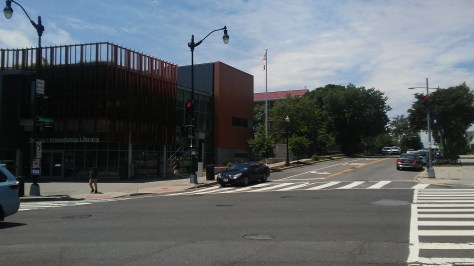
This is Tenleytown, in Washington, D.C.’s Northwest, just a couple of blocks from a campus of American University — where I almost went to school, instead of Mary Washington College in Virginia.  I even (somewhat hilariously) received “honors admission” there.  (I was never actually a true “honor student,” even in high school, because my grades in math and science were fair at best — and anyone who knew me at age 18 could tell you that I was not exactly the brightest bulb in the socket.)

I remember being pretty excited as a high school senior at that admission letter.  American U. was my first choice; I was only seduced away to small-town Virginia by a generous financial aid package from the good people at Mary Washington.  (Yes, young people, Fredericksburg was indeed a small town in 1990, even if it now looks like downtown frikkin’ Fairfax.)

It was freaky sipping coffee in Tenleytown and pondering some other parallel-universe me who lived and studied and partied there as a kid.  (Where would I have bought my comic books?)  Most people don’t think about string theory when they travel, but I am both a science fiction fan and a really weird guy with a lot of time on his hands.  (Where is that other Eric right now?  Is he married?  Is he writing?  Is he equally irritated by Star Wars obsessives, the religious right, Orwellian language, people who push “healthy snacks,” the dumbing down of America, “fun-sized” candy, and the gradual decline of “The Walking Dead?”)

Anyway, Tenleytown a pleasant neighborhood with a brisk, college-town vibe to it.  DC consistently surprises me by how friendly its people can be.

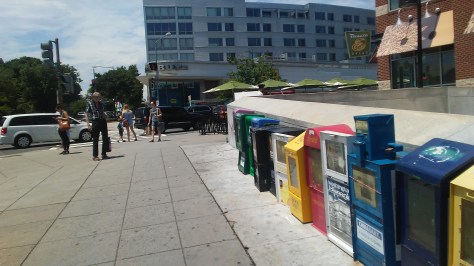
I left some poetry mini-books beside some news-stands on Albemarle Street, a cross-street with Wisconsin Avenue.  The stands alternately inform readers in Greek, Spanish, Chinese and English about how DC’s most deplorable resident has most recently embarrassed our country.  (I admire the Spanish-language papers’ predictable special antipathy for the president.)  No matter how sad the news is, this town will not let you hide behind a language barrier.

Am I nuts, or does that Best Buy look like it was designed with the Watergate in mind?  I keep wondering if that is someone’s idea of an obscure joke.


20180605_124817

20180605_124821

20180605_124824

20180605_124750

20180605_124734

20180605_124946

20180605_125023

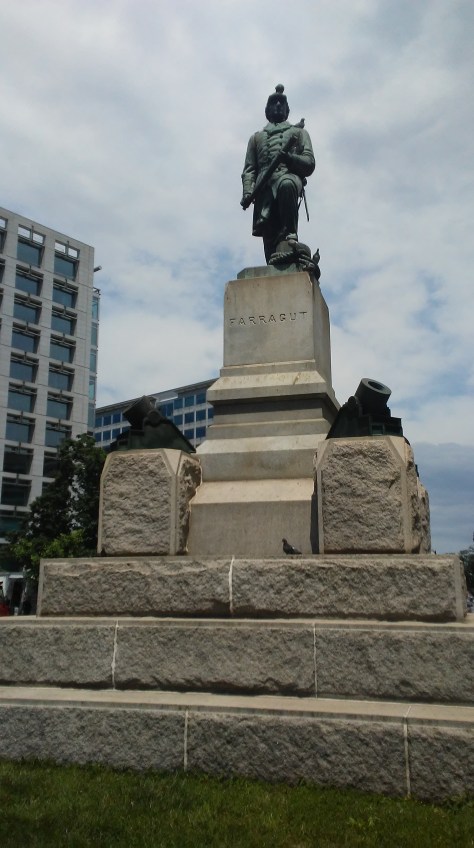
Guerrilla poetry at Farragut Square, Washington, D.C.

June 2018.  This is the only part of Washington, D.C. that can truly remind me of New York City.  (The diverse array of “food trucks” help quite a bit.)  The people there, however, seem far more likely to make eye contact and begin a conversation.  (I briefly chatted with a nice photographer who took a couple of poetry mini-books home with her.)

I’m proud of that last shot you see of pigeons alighting the park’s namesake — even if it is a little fuzzy and even if I only snapped it by chance.  David G. Farragut was a Southerner who nevertheless served heroically as an admiral in the Union navy during the Civil War.  He coined the famous phrase, “Damn the torpedoes, full speed ahead!”  Maybe I’m only demonstrating my ignorance here, but I didn’t even realize that torpedoes were really a thing during the Civil War, even after seeing the C.S.S. Hunley at Charleston, South Carolina as a kid.


20180605_115920

20180605_115742

20180605_114926

20180605_115757

20180605_115805

20180605_115855

20180605_120120

20180605_115904

20180605_113429

20180605_114222

20180605_115559

20180605_115531

20180605_115732

20180605_115653

20180605_115700 (2)


“school shooter,” by Eric Robert Nolan

Grendel’s mother wanted murder; but we all knew that,
you knew that just by looking at her:
the green and odorous skin like dark olive parchment over her cheeks’ low bones,
the blackening teeth where the stale blood caked
and dried in her receding gumlines
like burgundy ink on her molars and incisors,
and a blackening-scarlet
stain on her canines.

Remember when we first saw her —
her flaccid breasts like flour-sacks,
her womanhood a stagnant moss,
the cadaverous, driving
lime of her hips,
her labia in livid lines
of bitter water lilies?

Remember the rising, putrid moon of her —
her green, sour form arching over ours in her ascent,
burning up from the green lake, a gangrene flame from the brackish water,
her profane grin adorning her,
and algae tracing her lips?

Remember the wet weeds
trailing the viridian strait of her throat
like silt-laden necklaces,
and all the mud and water rolling off her knuckles?
The spoiled laurel of her sinewed shoulders,
her outspread arms and their
parody of embrace?
Remember her mocking our own mothers?
Her derisive voice was like
the crack of splitting emeralds, asking,
“Am I so strange to young eyes?”

Remember the boiling fat on her tongue and
her victims’ burning skin there?
The scalps she held in her upturned palms
were like watery garments.
Her talons were as black
as snapping-turtle shells.
We all knew at once that we were quarry.

Remember her
sorrel-colored cataracts?
Her eyes were as green seas
boiling under Ragnarok.
Remember their ruptured capillaries
like collapsing red galaxies?
Remember her very irises bleeding?

But what if evil appeared
not as the face of Grendel’s mother,
but, rather, the ordinary boy in her maw —
as unexotic and as common
as we are?
If we were boys and girls again
and bored in English class —
maybe at Beowulf’s strangeness,
or maybe the strangeness of Jung —
and he were next to us,
with neither green skin
nor blood along his molars,
if he wanted murder, could we tell?
His face was as a clock’s face — prosaic and round.
Neither silt nor sinew lined his frame.
His gaze did not depict a grisly cosmos;
no galaxies had hemorrhaged in his eyes.
Would the difference be perceptible there
between wanting to kill time
and wanting to kill ten?
Would we know that we were quarry?

Tonight we’d like to believe
that the young are strange to old eyes
for any resemblance would kill us,
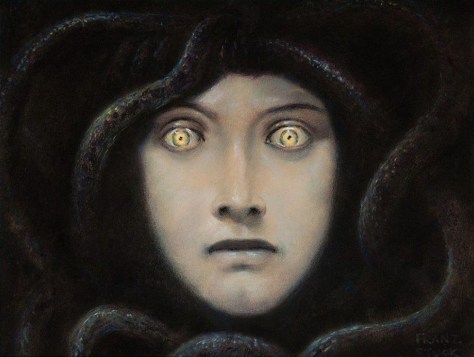
as Medusa’s own face was fatal
to her upon the shield.
As adults, we understand
that Beowulf is only fable —
but that Jung’s reservoir
is a fatal green lake.
Better an Idis than likeness —
if a monster looks like us, it stands to reason
that maybe he could BE us,
we’d nag in our primordial minds.
It might make us envision
a kind of reverse baptism:
our own plain faces
cresting the flat, green waters
to glide across the lake,
but bearing the eyes of strangers,
emerald and seething,
irises bleeding,
crushed green reeds in our jaws, like captive verses …

And we could not suffer the thought.
Better to be quarry, or be drowned.
We’d know that, and so
we would run mad, we would run weeping, we would run forward and ravening to the green, forgiving lake,

where we could sink like Beowulf,
and our silenced lungs would fill with water.

                                                            (May 19th, 2018)

(c) 2018 Eric Robert Nolan


franz-von-stuck-head-of-medusa-1892

Care to peruse my Youtube channel?

Just a reminder — if you happen to enjoy any of my poetry readings here at the blog, then you can find more over at my Youtube channel.  There is a playlist for me reading the work of other poets, and another short playlist for me reading my own work.

I hope that all you guys have had a wonderful weekend!


20180220_122250 (5)

“Delaware Sheets,” by Eric Robert Nolan (read by the author)

Sharon lies,
a sylph amid the sheets
in our room in the hills,
drawn up around her –
are waves of fabric.
Her warmth is the same
as that of green hills:
gentle, blessed by the sun,
fertile with promise.

Her dark eyes
are as thickets.


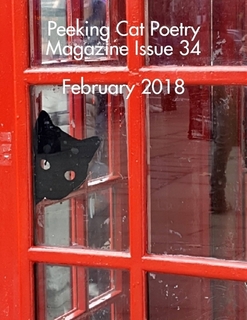
Peeking Cat Poetry Magazine features “This Windy Morning”

The February 2018 Issue of Peeking Cat Poetry Magazine is out, and is available both for purchase and for free in PDF format.   If you’d like to read my poem, “This Windy Morning,” you can find it on page 14.

Thank you once again to Editor Sam Rose for allowing me to share my work!


product_thumbnail